Quick Answer: A business proposal is a formal document that lays out a client’s problem/need, your solution to it, the results a client can expect, and the commercial terms of working together, all in one place, with the goal of getting a “yes.” It’s usually the first real impression your business makes before a meeting, contract, or partnership begins.
Have you ever spent hours writing a business proposal, sent it off with a hopeful click, and then heard nothing back?
For a lot of teams, this document is the hardest one to get right, not because the idea inside it is weak, but because there is no reference point for what a good one looks like for their specific situation. A freelancer’s proposal has almost nothing in common with an investor pitch, and a sponsorship proposal answers a different question than a partnership proposal does.
That is the gap this guide closes. Instead of one generic template, you will go through 11 real business proposal examples: sales, marketing, consulting, freelance, startup, investment, partnership, sponsorship, project, product launch, and real estate, each broken down by what it needs to prove and how it’s usually structured, right after a quick pass through the format and process that ties them all together.
“The best proposals don’t try to sell everything – they solve one problem exceptionally well.”
Looking to learn the fundamentals first? Read our complete guide on how to write a business proposal before exploring these real-world examples.
What Is a Business Proposal?
Before we look at the format or examples, it is helpful to understand what this document does for you.
A business proposal is where your business idea stops being an idea in your head and starts becoming something that other people can look at, ask questions about, and eventually agree to. It puts together the problem, your solution, what you expect to happen and the business details into one story, written for a client partner, investor or someone inside your company.
Business Proposal At A Glance
- Purpose: To get approval, funding or business
- Audience: Clients, investors, partners or stakeholders
- Average Length: 2 to 10 pages
- Core Sections: Executive Summary, Problem, Solution, Timeline, Pricing, Terms, Call To Action
Why Business Proposals Matter More Than People Think
A proposal does its job before you even meet with someone. It gives the reader an idea of what you’re like before you can explain yourself. A good proposal can get you a meeting, get you funding, win you a client or start a partnership. On the other hand, a bad proposal can end an opportunity before you even get to talk about it. When you think of proposals as a way to make decisions rather than just paperwork, the next question is how to make one that works.

Build stronger proposals:
Business Proposal Format: The 8 Sections Every Proposal Needs
A good structure is what makes a business proposal readable and persuasive. Without a format, a proposal can feel all over the place even if the idea behind it is really strong. Most business proposals, no matter what industry they are for, are made up of the basic parts:
- The Title Page is where you introduce your brand and set the tone for the rest of the proposal.
- The Executive Summary is an overview of what you are proposing and why it matters.
- The Problem Statement shows that you understand the reader’s situation and are not just trying to sell them something.
- The Proposed Solution is where you explain what you are offering and how it will help the reader.
- The Marketing or Execution Plan explains how you will deliver the solution.
- The Pricing and Timeline section takes away any uncertainty about how much it will cost and how long it will take.
- The Terms and Conditions section sets out the rules for both parties.
- The Conclusion and Call to Action tells the reader what to do.
A quick way to think about it: the executive summary and pricing section are the two parts most readers actually study closely; if those are weak, the rest rarely gets a fair read. Once this structure is clear, writing a business proposal becomes much easier.
How to Write a Business Proposal Step by Step
A strong business proposal is built through a series of clear, structured steps. By following the process below, you can create a proposal that communicates your value, addresses the client’s needs, and improves your chances of getting approved.
Step 1: Understand Your Client and Objective
Know what problem your client has and what they want to achieve. A proposal that uses their words and priorities will impress them more than one that only uses yours. Think about what a win looks like for your client.
Step 2: Choose the Right Business Proposal Template
Pick a template to start with. This way you can focus on what you’re offering, not on how it looks. A sound structure helps.
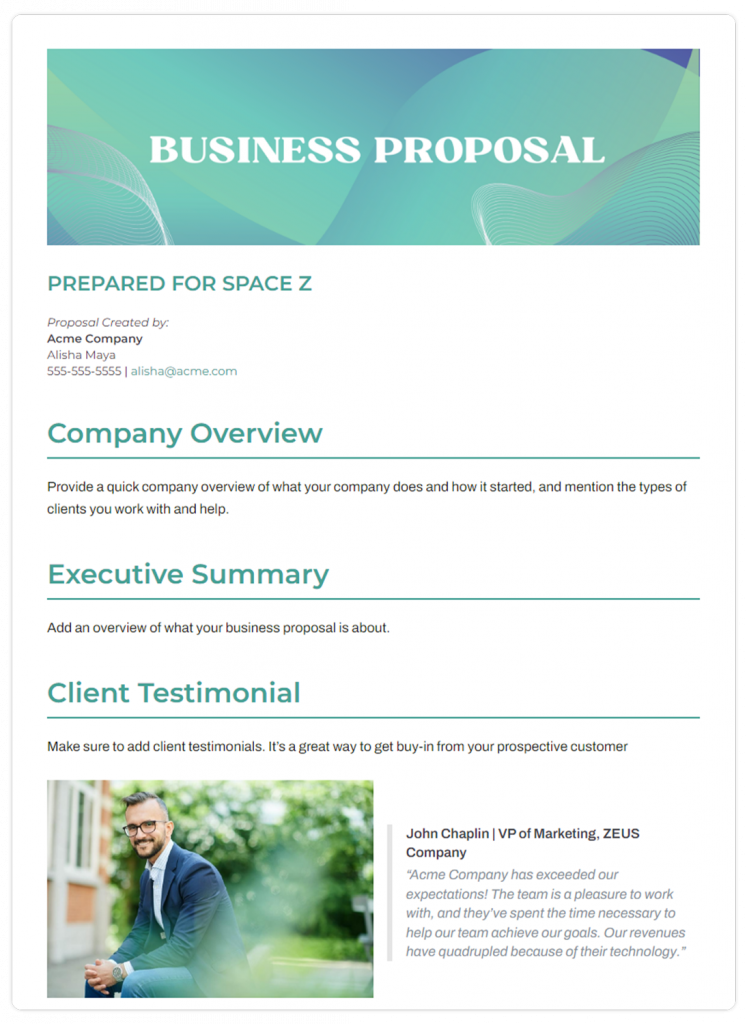
FREE TEMPLATE
The Business Proposal Template That Wins Clients
Includes executive summary, scope, pricing, timeline, & terms.
✔ Pre-filled sections
✔ Customize in minutes
✔ Best for Consultants, Agencies & Businesses
Takes under 1 minute • Trusted by teams at startups & enterprises
Step 3: Write a Clear Executive Summary
Introduce your idea in a sentence. Make it confident and clear. This is where the reader decides if they want to read more.
Step 4: Present Your Solution and Value
Explain your solution in detail. Show how it solves the problem you mentioned earlier. Make it easy for the reader to imagine it working.
Step 5: Add Your Execution or Marketing Plan
Show how you will deliver the solution. This turns your proposal from an idea into a plan.
Step 6: Include Pricing and Timeline
Be specific about how much it costs and how long it takes. Do not be vague. This helps build trust with the client.
Step 7: Review and Finalize
Read your proposal again. Make sure it is clear and easy to understand. Check that nothing contradicts itself.
Business Proposal Review Checklist
✓ Executive summary clearly explains the proposal
✓ Client’s problem is defined
✓ Solution matches business goals
✓ Timeline included
✓ Pricing is transparent
✓ Terms are included
✓ Strong CTA
✓ Contact information included
Now that you know the steps lets look at some examples of business proposals for different situations.
Speed up proposal writing with AI:
11 Business Proposal Examples by Use Case At Glance
This is where the format and steps above stop being theory. Each example below represents a real situation a business faces, and each one leans on the same eight-part structure while shifting its tone, emphasis, and level of detail to match what that particular reader needs to see.
Here is a quick overview of what we will cover:
| Proposal Type | Best For | Primary Goal |
| Sales Proposal | Qualified prospects evaluating your solution | Convert interest into a purchase decision |
| Marketing Proposal | Clients planning business growth | Align marketing activities with measurable business goals |
| Consulting Proposal | Clients seeking expert advice | Recommend solutions based on problem analysis |
| Freelance Proposal | Independent professionals offering services | Define scope, pricing, and deliverables clearly |
| Startup Proposal | Investors, partners, or stakeholders | Present a realistic business vision and growth plan |
| Investment Proposal | Investors evaluating an opportunity | Explain financial potential, risks, and expected returns |
| Partnership Proposal | Businesses exploring collaboration | Demonstrate mutual value and shared objectives |
| Sponsorship Proposal | Brands considering sponsorship opportunities | Show audience reach, exposure, and expected ROI |
| Project Proposal | Teams approving a project | Define scope, timeline, responsibilities, and outcomes |
| Product Launch Proposal | Teams preparing a product launch | Plan launch strategy, positioning, and execution |
| Real Estate Proposal | Buyers, sellers, or property investors | Present property value and investment opportunity clearly |
Now, let’s explore each business proposal in detail.
Sales Proposal Example
Best for: Businesses selling products or services to qualified prospects.
Goal: Convert interest into a purchase decision.
Ideal audience: Decision-makers evaluating vendors or solutions.
A sales proposal is what you use when someone is interested in what your brand has to offer. They have not made a decision yet. The sales proposal shows how your solution can address the problems the person is having; it explains the cost and makes it easier for them to decide. The best sales proposals focus on what the person wants to achieve with their business, not just how great your product is.
Example
A Manufacturing company is looking for software to manage its projects. They have seen two products. Think one of them might be good. A Sales Proposal would explain how the software can help the company, how much it will cost and what the benefits will be. This helps the people making the decision choose the product.
Key Elements
| Executive Summary | Personalize it with the prospect’s goals, challenges, or deadlines discussed during earlier conversations. |
| Problem Statement | Describe the customer’s pain points using their own language whenever possible. |
| Proposed Solution | Clearly explain how your solution addresses the identified business problem. |
| Pricing | Keep pricing transparent, explain what’s included, and recommend the most suitable option. |
| Call to Action | End with one specific next step, such as signing the proposal, scheduling a meeting, or starting a pilot project. |
Pro Tip
- Send the proposal within 24 hours of your last conversation to maintain momentum.
- Recommend one pricing option instead of asking the prospect to compare every package.
- Personalize the proposal with the prospect’s own goals, numbers, or deadlines to increase relevance.
Marketing Proposal Example
Best for: Marketing agencies, consultants, or in-house marketing teams.
Goal: Secure approval for marketing campaigns and growth initiatives.
Ideal audience: Business owners, marketing managers, or clients planning to grow their brand.
A marketing proposal is a plan that shows how marketing efforts will help a business achieve goals. It is not a list of marketing activities that will be done. The best proposals connect each recommendation to results such as getting leads, selling more to customers, making more money or keeping customers coming back. This makes it easy for clients to see how marketing will help their business.
Example
A clothing brand wants to sell 25% of its products online in six months. By just suggesting “search engine optimization, social media and paid ads “, the proposal explains how each activity will help:
- Search engine optimization will bring more people to the website naturally.
- Google Ads will find people who’re likely to buy.
- Email marketing will get people who have bought before to buy
- Social media will help launch products and keep customers engaged.
Each activity is connected to a business goal, not just a list of marketing services.
Key Elements
| Business Goal | Define a measurable objective (e.g., increase leads by 30% or reduce customer acquisition cost by 15%). |
| Target Audience | Clearly identify the ideal customer segment the campaign will target. |
| Marketing Strategy | Explain why each channel (SEO, PPC, email, social media, content marketing, etc.) was selected. |
| Deliverables | List exactly what will be delivered, such as campaigns, landing pages, content, or reports. |
| Timeline | Break the project into realistic milestones with review and approval stages. |
| Budget | Show campaign costs, management fees, and any advertising budget separately. |
| Success Metrics (KPIs) | Define how success will be measured using metrics like leads, conversions, ROAS, CAC, or repeat purchase rate. |
Pro Tip
- Connect each marketing activity to a business goal.
- Focus on business metrics like revenue, leads or conversions rather than metrics like likes or impressions.
- Clearly state what is included and excluded and how success will be measured.
Consulting Proposal Example
Best for: Consultants providing strategic or operational recommendations.
Goal: Demonstrate expertise and propose a clear solution to a business challenge.
Ideal audience: Clients seeking expert advice to solve specific business problems.
A consulting proposal helps when a client knows they have a business problem but isn’t sure what to do. It should show that you understand their challenge, suggest a step-by-step plan and clearly state what they will get from each part of the project. Clients are more likely to approve proposals that first identify the problem and then offer a solution.
Why It Works: A consulting proposal builds trust by diagnosing the problem before recommending a solution.
Example
A retail chain sees that not many people are buying things in their stores. Sales have gone down by 18%. Instead of immediately saying they need training or new technology, the proposal starts by looking at the problem using store data, customer behavior, and talks with important people. Then it gives a plan with steps, timelines and expected results.
Key Elements
| Problem Diagnosis | Summarize the client’s challenge using insights from discovery calls, audits, or available data. |
| Consulting Approach | Divide the engagement into Diagnosis → Strategy → Implementation with a clear purpose for each phase. |
| Deliverables | Specify exactly what the client receives after each phase (e.g., audit report, roadmap, implementation plan). |
| Timeline | Assign a realistic timeframe to every phase to prevent scope confusion. |
| Success Criteria | Define measurable outcomes, such as improved conversion rate, lower costs, or process improvements. |
Pro Tip
- Start with the client’s problem, not with your company or what you do.
- Break the project into parts with clear goals so clients know what they are getting.
- Give the client something to look at, like a report, before the whole project starts. This helps build trust and makes the project seem less risky.
Need to build a project proposal around these elements?
Freelance Proposal Example
Best for: Freelancers offering creative, technical, or professional services.
Goal: Define the project scope, deliverables, pricing, and timeline clearly.
Ideal audience: Clients hiring independent professionals for short- or long-term projects.
When you make a freelance proposal, it should be simple and easy to understand. It is a good idea to make it personal and short. This way it does not sound like something a big company would write. The proposal should clearly state what the project is about, how long it will take, how much it will cost, and when you will be paid. If you are clear about these things from the start, the client will trust you more. You will have fewer problems later on.
Why It Works: When you are clear about what you will do, how much you will charge and when you will finish, the client understands everything. This helps the client make a decision faster.
Example
A freelance graphic designer gets a request to design a logo for a café. The designer makes a proposal that includes what the project is about, two logo ideas, two chances to make changes, and a deadline of seven days. The price is fixed at $500. The client pays a 50% deposit upfront, with the remaining balance due upon project completion. This makes it easy for the client to say yes without needing to ask questions.
Key Elements
| Scope | Clearly state what’s included and excluded. |
| Timeline | Mention delivery date and revision rounds. |
| Pricing | Show a fixed price with payment schedule. |
| Portfolio | Add 1–2 relevant work samples. |
| Terms | Define deposit, balance payment, and extra revision charges. |
Pro Tip
- When you start your proposal, you should say what the project is, when you will deliver it, and how much it will cost.
- You need to make it clear what you are not going to do so the client does not expect more than you can give.
- Write your proposal as if you are talking to the client, not as a letter.
Present your services with confidence:
Startup Proposal Example
Best for: startups seeking funding, partnerships, or stakeholder approval.
Goal: Present a compelling business vision and demonstrate growth potential.
Ideal audience: Investors, business partners, accelerators, and key stakeholders.
When you want people to invest in your startup, you need to show them that your idea is good and that you have a plan to make it work. You have to tell them what you want to do and how you will do it. The best proposals say what you want to happen and how you will make it happen.
Why It Works: Investors look for execution plans for your startup, measurable milestones for your startup and transparent risk assessment for your startup.
Example
A startup that makes healthy snacks wants to get its products on store shelves. Instead of saying it will grow really fast, the proposal says it will be in 50 stores by the end of the summer, explains how it will get there, discusses the biggest challenge it might face, and outlines how it will deal with that challenge.
Key Elements
| Vision | Explain the problem, solution, and market opportunity. |
| Milestones | Set specific, time-bound goals (e.g., 50 stores by Q3). |
| Risks | Identify the biggest risk and your mitigation plan. |
| Go-to-Market Plan | Show how you’ll acquire your first customers or partners. |
| Funding/Partnership Ask | Clearly state what you need and what the other party gains. |
Pro Tip
- Replace goals with measurable milestones.
- Be transparent about risks and mitigation. This builds credibility for your business.
- End with one partnership or funding request. Do not give multiple options.
Investment Proposal Example
Best for: businesses looking to secure investment or financial backing.
Goal: explain the investment opportunity, the expected returns and the associated risks.
Ideal audience: Angel investors, venture capitalists, financial institutions, or private investors.
An investment proposal is used to convince investors that your business is worth funding. The best proposals explain how the business will generate returns, what risks exist, and exactly how the investment will be used, not just optimistic financial projections. Clear assumptions build investor confidence.
Why It Works: Strong investment proposals balance financial opportunities with realistic assumptions and risk analysis.
Example
A software company is seeking $500,000 to improve its product. The proposal will explain how the company will generate revenue, what it expects to happen to its finances, what the biggest problems might be, and how it will use the funds. For example, it might say that 40% of the money will go to improving the product, 35% to advertising, and 25% to hiring people.
Key Elements
| Business Opportunity | Explain the problem, solution, and market potential. |
| Financial Projections | Support forecasts with clear assumptions, not just numbers. |
| Risks | List the biggest risks and your mitigation plan. |
| Use of Funds | Show exactly how the investment will be allocated. |
| Investor Return | Explain the expected ROI or exit opportunity. |
Pro Tip
- Back every financial projection with realistic assumptions.
- Be transparent about risks and use of funds.
- Keep the investment ask specific and easy to evaluate.
Partnership Proposal Example
Best for: Businesses exploring strategic partnerships or collaborative opportunities.
Goal: Demonstrate mutual value and establish a framework for collaboration.
Ideal audience: Potential business partners, executives, and strategic decision-makers.
When two businesses work together, they need to show how they will both benefit from this partnership. A good partnership proposal will say what they want to achieve, what each business is responsible for, what they hope to get out of it and how they will check if it is working. This way both businesses know what they are getting into before they start.
Why It Works: Successful partnership proposals clearly define shared objectives, responsibilities, and mutual benefits.
Example
A SaaS company teams up with a marketing agency to host webinars. The proposal says that the SaaS company will provide the product and the speakers, and the agency will handle the promotion. They agree to review the new leads they get after 90 days and then decide whether they want to continue working together.
Key Elements
| Shared Goals | Define what both businesses want to achieve. |
| Roles & Responsibilities | Clearly assign who does what. |
| Mutual Benefits | Explain what each partner receives. |
| Success Metrics | Track results using leads, revenue, or customer growth. |
| Review Clause | Schedule a 60–90 day performance review. |
Pro Tip
- When you are writing a proposal, it is better to use a “we” perspective as if the businesses are already working together than trying to sell something to them. This way the proposal will sound more like a partnership between the businesses.
- The businesses should define their roles. They should figure out how they will measure success before they start working. This is really important because it helps them know what they are working towards.
- Start with a pilot project before committing to a long-term partnership. This allows both organizations to test compatibility, workflows and results with risk. It is like trying out an idea to see if it works.
If you need this, here’s its prompt: Bit.ai’s Partnership Proposal Email Generator.
Sponsorship Proposal Example
Best for: Organizations, events, nonprofits, or creators seeking sponsorship.
Goal: Show the value sponsors will receive through brand exposure and audience engagement.
Ideal audience: Marketing teams, brand managers, and corporate sponsorship decision-makers.
When you want a company to sponsor your event or project, you need to show them it will benefit their business. A good sponsorship proposal should explain how well your audience fits with their brand, how many people will see their name, what they will get out of sponsoring you, and what they will get for their money.
Example
For example lets say you are in charge of a marathon and you want a sportswear company to sponsor you. Your proposal would say things like: the marathon will have 5,000 participants; the company’s name will be seen by 150,000 people on social media; there are three levels of sponsorship; and after the marathon, you will tell the company how well their sponsorship performed. This makes it easy for the company to decide whether to sponsor you.
Key Elements
| Audience | Share attendee demographics and expected reach. |
| Sponsorship Packages | Offer clear Bronze, Silver, and Gold benefits. |
| Brand Benefits | Specify logo placement, booth space, speaking slots, or mentions. |
| Performance Metrics | Include impressions, leads, attendance, or engagement. |
| Post-Event Report | Promise a results report with campaign performance. |
Pro Tip
- Instead of saying the company will get more attention, say exactly how many people will see their name.
- Make it easy for the company to compare sponsorship levels.
- Show the company how you will measure whether they got their money’s worth, after the event.
Building different sponsorship tiers? Use Bit.ai’s AI Sponsorship Packages Generator to organize your package benefits, pricing, and deliverables →
Project Proposal Example
Best for: Teams requesting approval for a new project or initiative.
Goal: Define project objectives, scope, timelines, budget, and expected outcomes.
Ideal audience: Project sponsors, managers, executives, or internal stakeholders.
A project proposal is a plan that says what we will do, who will do it, when it will be done and how we will make changes. Good project proposals make sure we know what we are doing by writing down what the project is about, what we will deliver, when we will deliver it, and how we will say yes or no to changes before we start working.
Example
A software agency wants to make a website for a client. The agency proposes building a 10-page website. It will take 8 weeks to finish. They also say who will do what, when things will be done, and how they will handle changes if the client wants something after they have said yes to the original plan.
Key Elements
| Project Scope | Clearly define what’s included and excluded. |
| Deliverables | List each deliverable with an owner and due date. |
| Timeline | Break the project into milestones. |
| Budget | Show project cost and payment schedule. |
| Change Requests | Explain how additional work will be reviewed and approved. |
Pro Tip
- Define what the project is about and what we will deliver before we start.
- Assign each task to someone and set a deadline.
- Should have a plan for handling changes to prevent the project from getting too big.
If you need this, here’s its template: Bit.ai’s Project Proposal Template.
See real proposals in action:
Product Launch Proposal Example
Best for: Businesses planning to introduce a new product or service.
Goal: Present a structured go-to-market strategy and launch plan.
Ideal audience: Product managers, marketing leaders, executives, and launch stakeholders.
A product launch proposal explains how a product will be introduced to the market. It should define the target audience, positioning, launch phases, marketing channels, and success metrics so stakeholders know exactly how the launch will be executed. A phased go-to-market (GTM) plan makes launches more predictable and easier to approve.
Example
A skincare brand is launching a sunscreen. The proposal is for working professionals aged 25 to 40. The plan is to have a two-week launch, then run influencer campaigns and sell the product in stores. We will know if it is successful by looking at sales, website traffic, and what customers say about the product.
Key Elements
| Target Audience | Define your ideal customer. |
| Positioning | Explain what makes the product different. |
| Launch Plan | Break it into Soft Launch → Full Launch → Promotion. |
| Marketing Channels | List the primary channels for customer acquisition. |
| Success Metrics | Track sales, conversions, adoption, or revenue. |
Pro Tip
- Better to launch a product in phases rather than all at once.
- Think about where our first customers will come from.
- Define what we want to achieve before we launch the product. It is easy to see if we are successful.
If you need this, here’s its template: Bit.ai’s Product Launch Marketing Plan Template.
Real Estate Proposal Example
Best for: Real estate professionals presenting buying, selling, or investment opportunities.
Goal: Demonstrate property value and support informed purchasing or investment decisions.
Ideal audience: Property buyers, sellers, investors, or real estate developers.
When people buy or sell a house, they want to feel confident about their decision. A good real estate proposal helps buyers, sellers, or investors make a decision based on facts, not guesses. It should have information about the property, what is happening in the market, the price and what to do next. This helps people trust the process.
Why It Works: Buyers and investors make decisions more confidently when proposals are supported by market data and comparable properties.
Example
A real estate agent is selling a 3-bedroom home for $420,000. The real estate agent’s plan includes information about homes that were sold, what is good about the home, the price of the home, what the home will be worth in the future and a plan to sell the home in 30 days, including getting a loan and checking the home.
Key Elements
| Property Overview | Summarize the property’s key features and location. |
| Market Analysis | Include comparable sales and local market trends. |
| Pricing | Justify the asking price with supporting data. |
| Investment Potential | Highlight rental income or appreciation potential, if applicable. |
| Next Steps | Outline inspection, financing, and closing timeline. |
Pro Tip
- Use homes that were sold near the home to say why the price is good; do not just give your opinion.
- Be honest about what’s good and bad about the home.
- Explain what the buyer needs to do to buy the home.
Across all 11, the underlying structure barely changes; what shifts is tone, emphasis, and the specific question each reader needs answered before they’ll say yes. Once you’re working across several proposal types at once, the practical challenge usually stops being “what to write” and starts being “how to keep it all organized.”
Bit.ai Perspective on Managing Business Proposals
Teams often spend more time managing proposal versions than actually improving proposals.
Instead of emailing multiple copies back and forth, keep every proposal in one collaborative workspace like Bit.ai where writers, managers, and clients can comment, edit, and review together. That keeps formatting consistent, prevents duplicate versions, and makes updating proposal templates much easier as your business grows.
Keeping Proposal Writing Organized as You Scale With Bit.ai
Once a team is producing more than one or two proposal types, a familiar set of problems tends to show up. Drafts live in different people’s inboxes, formatting drifts between versions, feedback arrives as scattered comments across email threads, and it becomes genuinely hard to tell which version of a document is the current one, especially when three people have edited it in the same week.
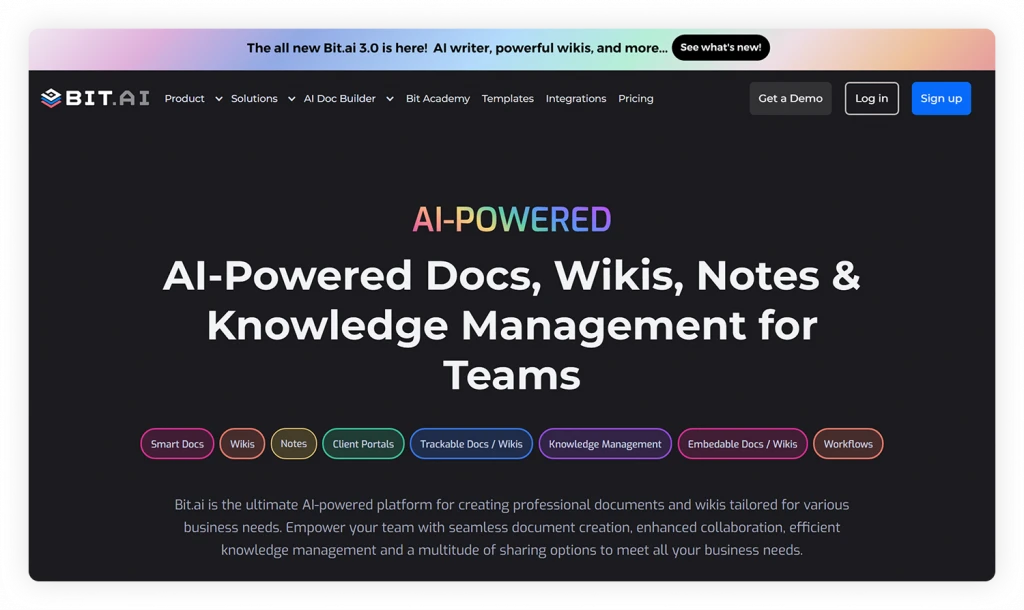
A lot of teams solve this problem by working in a shared space instead of using individual files. Bit.ai is an example of a platform that helps with this kind of problem. It lets your team keep all your proposal templates in one place, make changes and comments on the document at the same time and keep track of what changed and when. This way you will never lose a draft of your proposal.
So, a collaborative workspace like Bit.ai helps solve the operational challenges by keeping proposal templates, edits, comments, and version history in one place. This allows teams to work from a single source of truth, maintain consistency across proposals, and spend less time managing documents.
Write requirements everyone understands:
Business Requirements Document (BRD): Definition, Format & How to Create!→
Wrap Up: Turning Business Proposals Into Business Wins
A business proposal is not a document that someone has in their email box. It is the step in building a relationship. It’s either what gets you a second meeting or what ends things before they even start.
Once you understand how to format your proposal, follow the steps and have an example to work from, writing a proposal does not have to be a guessing game. The difference between a proposal and a great one is rarely the idea itself. It is always about how clearly, specifically and confidently you present your idea on the page.
Whether you’re pitching a new client, presenting a marketing strategy, seeking investors, or proposing a partnership, the strongest proposals make decisions easier. Start with a clear structure, tailor every proposal to your audience, and use the examples above as a framework rather than a script. The more specific your proposal is to the reader’s goals, the more likely it is to earn a “yes.”
FAQs
What’s the difference between a business proposal example and a template?
A template is a blank structure you fill in yourself. An example is a fully written-out version showing how that structure gets applied to a real situation, including tone and what to emphasize for that use case.
What are the most common types of business proposals?
The most common types are sales, marketing, consulting, freelance, startup, investment, partnership, sponsorship, project, product launch, and real estate proposals, each shaped around a different reader and a different question that reader needs answered.
How long should a business proposal be?
Most effective proposals run two to six pages. Complex investment or project proposals can run longer, but length should be driven by what the reader needs to decide, not by a fixed rule.
What mistakes should you avoid in a business proposal?
The most common ones are vague pricing, generic language that could apply to any client, an executive summary that buries the actual ask, and skipping a clear next step at the end.
How does a business proposal differ from a business plan?
A business proposal solves a specific problem for a specific client or partner. A business plan describes the overall strategy, vision, and operations of an entire business, independent of any single deal.
Do I need a different proposal for every client, or can I reuse one format?
The structure of the proposal can stay consistent across clients, but the content inside each section — the problem statement, the tone, the level of financial detail should shift based on who’s reading it and what they specifically need to see.
Should I include pricing in every business proposal?
Yes, unless pricing depends on additional discovery. When possible, provide either a fixed price, pricing range, or explain how pricing will be determined.
Can I use AI to write business proposals?
AI can help create first drafts, improve clarity, and organize content, but proposals should always be reviewed and customized for the specific client, project, or investor.
What makes a business proposal successful?
The strongest proposals clearly explain the client’s problem, present a relevant solution, provide transparent pricing and timelines, and end with a clear next step.
About Our Editorial Team
Our Editorial Team researches, writes, and reviews every article to help ensure it is accurate, practical, and up to date. To learn more about our editorial standards, content review process, and official social media profiles, visit our Editorial Team page.
Why Trust This Article?
The information in this article is based on reputable and authoritative sources. We review our content periodically to keep it accurate and up to date.