A Document Management System (DMS) is software that lets businesses store, organize, secure, and share digital documents in one centralized location. Instead of using shared drives, e-mail attachment, or paper documents, a DMS system ensures a safe place for every document, an audit trail, and controlled access.
Well, most businesses accumulate large volumes of documents across departments; this makes them hard to find, secure, and track over time with manual methods. A DMS addresses these documentation challenges by offering features such as version control, permission-based access, powerful search, document tracking, and secure sharing.
Let’s take a deeper dive into the world of DMS, uncover why your business needs one, and explore the must-have features and top DMS systems to check out now.
What Is a Document Management System?
A Document Management System (DMS) is software that stores, organizes, and controls access to digital documents from a single centralized platform. It replaces manual file storage methods like shared folders and email attachments with structured, searchable, permission-controlled storage.
A DMS typically includes four core functions:
- Storage: keeps documents in one centralized repository instead of scattered folders or drives
- Organization: categorizes files using workspaces, wikis, or folder hierarchies for faster retrieval
- Access control: restricts document viewing and editing based on user roles or permissions
- Version tracking: records changes to a document over time and preserves prior versions
Types of Document Management Systems
Document Management Systems come in different types, each designed to meet specific organizational needs and workflows. Based on their features, deployment methods, and intended use, these systems can be broadly categorized into the following types.
1. Cloud-Based vs. On-Premise vs. Hybrid
Cloud-based DMS is hosted on the vendor’s servers and accessed through a browser or app. The vendor manages storage, updates, and security patching. Businesses pay a monthly or annual per-user subscription instead of investing in and maintaining their own hardware.
On-premise DMS runs on servers your company owns and maintains. Your IT team directly controls data location, security configuration, access control and backup schedules. This requires upfront capital spend on hardware plus ongoing IT staff time to maintain it. Organizations choose on-premises deployment when regulations require data to stay within a specific country or facility.
Hybrid DMS splits documents across both environments: regulated or sensitive files stay on local servers, while other documents are stored in the cloud. This lets a business meet a data residency or compliance requirement for one document type without hosting its entire document library on-premises.
| Model | Choose If | Cost Structure |
| Cloud-based DMS | Your team works remotely or across multiple locations | Per-user subscription, no hardware costs |
| On-premise DMS | A law or contract requires documents to stay on local servers | Upfront hardware cost + IT staff time |
| Hybrid DMS | Only some document types face data residency requirements | Subscription fee + hardware cost for the on-premise portion |
2. Industry-Specific DMS
Industry-specific DMS platforms include pre-built compliance rules, document templates, and workflows for a given sector, instead of requiring a business to configure these features from a generic platform.
These platforms are commonly tailored for industries such as:
- Legal: Organizes files by case/matter number, tracks contract redline history, supports e-discovery requests, and connects to legal billing software (e.g., Clio, PracticePanther).
- Healthcare: Meets HIPAA storage and transmission rules, logs every user who accesses a patient record with a timestamp, and connects to EHR/EMR systems like Epic or Cerner.
- Finance: Meets SOC 2 and GDPR storage requirements, applies document retention schedules set by regulators (e.g., 7-year retention for certain financial records), and generates audit logs for examiners.
- Construction: Tracks blueprint/drawing revisions by date and author, works on mobile devices without a data connection at job sites, and connects to bid management and project scheduling software.
A business in legal, healthcare, or finance should use an industry-specific DMS because these industries carry legal penalties for non-compliant document handling. A business without sector-specific compliance requirements can use a generic DMS and save on licensing cost.
Why Your Business Needs a Document Management System (DMS)
Implementing a DMS can offer several game-changing advantages that will make your work life much easier.
1. Reduce Document Storage Costs
Businesses spend money on office space, printing, paper, maintenance, and document storage. A DMS switches you to digital storage where teams can store and manage large volumes of files without the ongoing costs of maintaining physical records.
2. Protect Documents with Backup and Recovery
We all know how fragile paper documents can be. A coffee spill, an unexpected flood, or even a fire can wipe out years’ worth of important paperwork in an instant. The good news? With a DMS, especially cloud-based ones, your documents are backed up and easily recoverable. That means no more stress over losing critical files.
3. Find Documents Faster with Smart Search
Searching through stacks of paper for one little document? Yeah, we don’t have time for that. A DMS uses smart search functions that help you locate documents quickly, saving your team hours of time. And honestly, who doesn’t love the magic of instant document retrieval?
4. Secure Sensitive Documents with Access Controls
Ever worry about who can access sensitive information? With a DMS, you can create strict access controls so that only authorized users can view or edit certain documents. This helps keep your data secure and ensures that everyone only has access to what they need.

Looking for more ways to control document access?
5. Improve Collaboration with Real-Time Access
Document collaboration often breaks down when teams work from different files, email attachments, or outdated versions. With a DMS, teams can review, edit, comment, and make updates in real time without passing files back and forth. DMS makes working together smoother, whether your team is in the same office or across different time zones.
Key Features to Look for in a Document Management System
What makes a Document Management System (DMS) stand out? It’s not just about storing files, it’s about streamlining your workflow, keeping information secure, and making collaboration effortless. If you’re searching for the perfect DMS, here are the must-have features you don’t want to overlook:
Access Control: Keep Documents Secure and Permissions in Check
A DMS system should let you customize access permissions, ensuring the right people can view, edit, or share documents while keeping sensitive files locked down. Control over access is non-negotiable whether you’re handling confidential contracts or internal reports.
Intelligent Document Organization and Search
As document libraries grow, finding the right file can become as difficult as storing it. Look for a DMS that combines full-text search, metadata, tags, filters, OCR, and AI-powered search to help users locate specific documents or information quickly. Strong search capabilities reduce time spent digging through folders and make large document repositories easier to navigate and maintain.

Ready-to-Use Document Generators
Creating and maintaining business documents can take time. These AI prompts help you create structured documentation for processes, compliance, and business continuity:
Version Control: Track Changes and Restore Previous Versions
Ever made changes to a file and wished you could go back? With version history, you can. Whether you need to track edits, restore an older version, or see who made what changes, this feature ensures that nothing important is lost and every update is accounted for.
Intuitive User Experience: Make Adoption Simple for Everyone
If a DMS feels like rocket science to navigate, your team won’t use it, simple as that. The best systems prioritize a clean, intuitive design so that onboarding is smooth and adoption is effortless. After all, technology should make life easier, not more complicated.
AI-Powered Writing Assistance: Create Better Content, Faster
Modern DMS platforms are going beyond document storage by incorporating AI-powered writing tools. These features can help users draft, rewrite, summarize, proofread, and improve documents without switching between applications. Whether you’re polishing a business proposal, summarizing a lengthy report, or improving the clarity and tone of a document, AI assistance can save time while helping teams produce more consistent, professional content.
Ready-to-Use Business Document Templates
A DMS helps you manage documents, but having a consistent structure makes those documents easier to create, update, and collaborate on. Start with these ready-to-use templates:
10 Best Document Management Systems for Businesses
The list of different document management tools can seem quite daunting, but that’s why we have created a list of the best 10 document management systems on the internet today!
| Best Document Management Software | Best For | Standout Feature | Starting Pricing |
| Bit.ai | Document & knowledge collaboration | AI-Powered Docs & Wikis | Pro: $8/user/month, billed annually |
| Laserfiche | Enterprise document management | Intelligent content management and workflow automation | Custom Quote |
| ONLYOFFICE | Document collaboration | Collaborative document rooms | $20/admin/month |
| DocuWare | Document management & workflow automation | Intelligent indexing and workflow automation | Custom Quote |
| Google Workspace | Cloud-based document collaboration | Integrated Docs, Drive, Sheets, and AI | $7/user/month |
| LogicalDOC | Enterprise document management | Full-text search and document control | Custom Quote |
| Confluence | Team knowledge management | AI-powered search and connected knowledge | $5.42/user/month |
| M-Files | Intelligent document management | Context-first organization and AI | €65/seat/month |
| Revver | Document workflows | Document automation and version control | Custom Quote |
| Box | Enterprise content management | Secure content management with AI | $5/user/month |
Pricing is subject to change and may vary based on plan, users, features, and business requirements.
Let’s go through each one of them in detail and decide which document system is best for you:
 1. Bit.ai
Bit.ai is an AI-powered document collaboration and knowledge management platform that helps teams create, organize, share, and manage business documents and knowledge in one workspace.
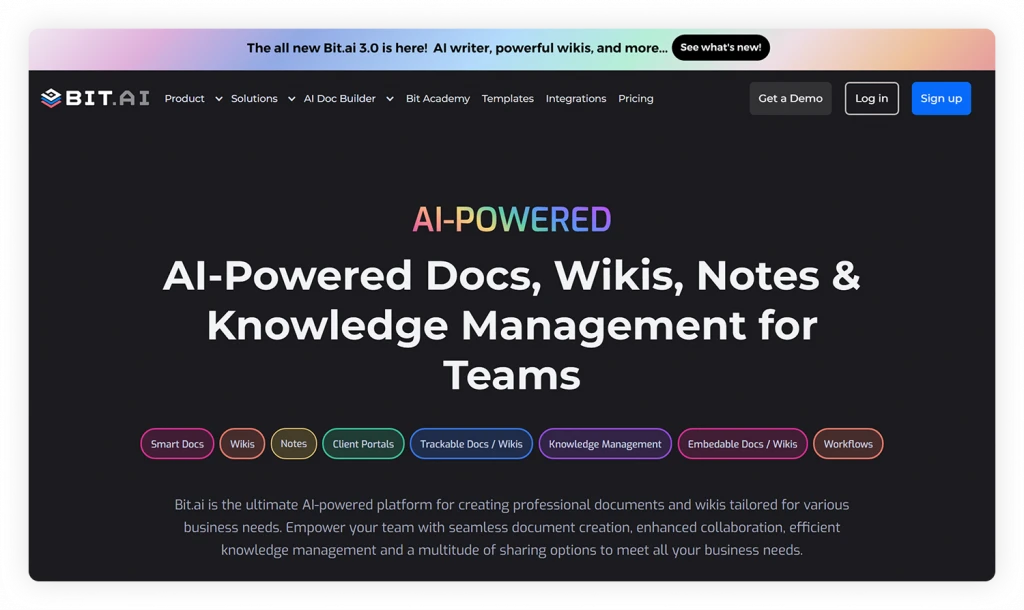
It combines interactive documents, wikis, real-time collaboration, content management, and AI-powered writing tools for modern teams.
Key features of Bit.ai:
- Smart Digital Workspaces for seamless collaboration and file organization.
- Smart Documents & Wikis that allow you to embed rich media and transform static documents into interactive hubs.
- Templates for creating ready-to-use business documents across different workflows and use cases.
- Smart Search for quick and accurate document retrieval.
- Real-time collaboration to enhance teamwork with live edits and comments.
- AI Genius Writing Assistant to help generate content, outlines, and templates with auto-formatting.
- Advanced Permission Management to control access and ensure document security.
- Advanced Sharing with live sharing, trackable documents (password protection, link expiration, lead capture, etc.), and embedding docs and wikis to any website.
Bit.ai is ideal for teams seeking an all-in-one, intuitive solution for document management and collaboration without the complexity of more traditional enterprise tools.
Pricing:
- Free Plan: $0 per member per month
- Pro Plan: Starting at $8 per member per month, billed annually
- Business Plan: Starting at $15 per member per month, billed annually
- AI Genius Add-on: $10 per 100k words per month with any paid plan.
Curious about where AI fits into document management beyond writing assistance?
Explore how AI can transform document workflows, organization, and retrieval.→
 2. Laserfiche
Laserfiche is an enterprise content management and process automation platform that helps organizations capture, organize, secure, and manage business documents and other content. It combines document management with workflow automation, making it useful for organizations that need to control large volumes of information while standardizing document-driven processes.
Key Features of Laserfiche
- Document Management: Organize, version, and retrieve business documents from a centralized repository.
- Workflow Automation: Automate approvals, routing, and repetitive document-based processes.
- Intelligent Document Processing: Extract data from documents to reduce manual data entry.
- Electronic Forms: Create digital forms to collect information and trigger workflows.
- Records Management: Manage retention, classification, and disposal of business records.
Pricing: Custom Quote
 3. OnlyOffice
Next on our list is OnlyOffice, and as the name suggests, it aims to be your ”only office” outside your real office environment.
OnlyOffice allows you to upload a document, spreadsheet, or presentation from your computer directly to their web app and manage it from the cloud. You can track changes made to the docs, leave comments, and access version history too. OnlyOffice supports various document formats including DOC, PDF, HTML, CSV, TXT, and more.
A noteworthy feature of OnlyOffice is the ability to connect any of the cloud storage services like Google Drive, Dropbox, Box, or Microsoft’s Onedrive and keep all your data in one place.
Key Features of ONLYOFFICE
- Real-Time Document Collaboration for co-editing documents, spreadsheets, and presentations.
- Document Rooms for organizing, sharing, and collaborating on files.
- Office File Editing for documents, spreadsheets, presentations, PDFs, and forms.
- Access Controls for managing user permissions and document sharing.
- Cloud or Self-Hosted Deployment for flexible infrastructure and data management.
Pricing: Free Startup plan; Business starts at $20 per admin/month
 4. DocuWare
DocuWare is a digital document management tool that allows you to store your documents in electronic folders for easy storage, search, and retrieval. By storing all your documents in a centralized document pool, you can reduce costs associated with traditional document filing systems which resulting in a faster, more efficient workflow.
DocuWare also protects your files from unauthorized access and loss by providing regulatory compliance security features, and disaster recovery.
Key Features of DocuWare
- Document Management for securely storing, organizing, and retrieving digital documents.
- Intelligent Indexing for automatically classifying and indexing documents.
- Workflow Automation for streamlining approvals, routing, and repetitive processes.
- Electronic Forms for capturing structured information digitally.
- Document Security for controlling access and protecting sensitive business content.
Pricing: Custom Quote
 5. Google Workspace
Google Workspace is a cloud-based productivity suite that includes document creation, file storage, collaboration, and communication tools. For document management, it combines Google Drive with apps such as Docs, Sheets, and Slides, allowing teams to create, organize, share, and collaborate on files in one environment.
Key Features of Google Workspace
- Cloud File Storage for organizing and accessing business files through Google Drive.
- Real-Time Collaboration for simultaneous editing, comments, and document sharing.
- Version History for reviewing changes and restoring earlier versions of files.
- Access Controls for managing file permissions and controlling who can view or edit content.
- AI-Powered Workflows through Gemini features integrated across Workspace apps.
Pricing: Business Starter starts at $7/user/month
 6. LogicalDoc
If you are looking to save time and resources by converting your hard copy paper documents into their electronic counterparts, LogicalDoc is another great solution.
LogicalDOC is an intuitive document management system that requires little to no training to get up to speed with. Its easy drag-and-drop capability allows users to upload files in a jiffy. A capable solution for small as well as large businesses unlike, LogicalDoc facilitates fast content retrieval and process automation.
Since LogicalDoc operates fully in the cloud, there’s no hardware or software setup to get started with it. LogicalDoc comes in three versions: Enterprise and Cloud, Business Edition, and Community Edition.
Key Features of LogicalDOC
- Document Management for organizing and managing files in a centralized repository.
- Full-Text Search for quickly locating information within documents.
- Version Control for tracking document changes and maintaining previous versions.
- Workflow Management for routing documents through defined business processes.
- Access Permissions for controlling who can view, edit, or manage documents.
Pricing: Custom Quote
 7. Confluence
Confluence, by Atlassian, is a document management and collaboration system for teams to communicate internally.
Teams can easily create, share and collaborate on documents, spreadsheets, presentations, and images. Features like automatic versioning, instant previews, full-text search, and pinned comments make it easy to manage your documents across all departments.
Confluence can be helpful if your team already uses Jira and HipChat by Atlassian, as it’s designed to work with those platforms.
Key Features of Confluence
- Knowledge Management for creating and organizing team documentation in one workspace.
- AI-Powered Search for finding information across connected team knowledge.
- Real-Time Collaboration for editing pages, adding comments, and working together.
- Page Version History for tracking changes and restoring earlier versions.
- Permissions and Access Controls for managing who can view or edit content.
Pricing: Free plan available; paid plans start at $5.42/user/month.
 8. M-Files
M-Files is an intelligent information management platform that organizes documents based on their content and metadata rather than traditional folder structures. It helps businesses find information faster, manage document versions, automate workflows, and maintain control over business content.
Key Features of M-Files
- Metadata-Driven Organization for finding and managing documents without relying on folder structures.
- AI-Powered Search for locating documents and information based on context.
- Version Control for tracking document changes and maintaining accurate records.
- Workflow Automation for managing approvals, reviews, and document-based processes.
- Access Controls for protecting documents with role-based permissions.
Pricing: Custom Quote
 9. Revver
Revver is a unique document management solution that makes organizing files and managing workflows a breeze. What makes it special is its focus on teamwork. With a strong version control system, Revver helps teams work together smoothly, whether it’s handling documents, and plans, or creating content for outdoor adventures – even in far-off places.
Key Features of Revver:
- Automates document filing, sharing, and e-signing tasks effortlessly.
- Easy-to-use interface for setting up simple to complex workflows.
- Offers up to 20TB of storage for unparalleled document capacity.
Pricing: Revver’s pricing is custom, ensuring businesses get tailored solutions based on their needs.
 10. Box
Box is a cloud content management and collaboration platform that helps businesses securely store, organize, share, and manage files. It combines content management with workflow automation, security controls, and AI capabilities for organizations handling large volumes of business content.
Key Features of Box
- Cloud Content Management for storing, organizing, and accessing business files.
- AI-Powered Content Insights for extracting information and answering questions about documents.
- Workflow Automation for streamlining document-based processes and approvals.
- Secure File Sharing for sharing content with internal and external users.
- Access Controls for managing permissions and protecting sensitive content.
Pricing: Business Starter starts at $5/user/month, billed annually.

How to Choose the Right Document Management System for Your Business
Choose a DMS based on how well it fits your document workflows, security requirements, team needs, integrations, and long-term business goals. Evaluate these factors before making a decision:
1. Identify Your Document Management Needs
Begin by creating a document flow chart of your organization. Think about where documents are stored now, who accesses them, how they are reviewed and approved, and where they get stuck or where do versions get lost. This will enable you to focus on features that your DMS truly requires.
2. Evaluate Search and Organization
Employees should be able to find the information they need in specific files without having to waste time navigating through different folders. Look for features with full-text search, metadata, tagging, filters, OCR, and AI-powered search to make your search easy.
3. Check Security and Access Controls
Review how the platform protects sensitive documents and controls doc access. Key capabilities may include role-based permissions, encryption, audit trails, authentication controls, document sharing restrictions, and compliance support. It is must to ensure that the security settings are flexible enough to comply with your organization’s needs.
4. Look for Workflow Automation
Workflow automation can minimize manual handoffs if employees routinely pass documents for review, approval, and/or processing. See if the DMS supports the creation of workflows that are similar to existing processes, or if teams need to adapt their processes unnecessarily to align with the DMS.
5. Consider Collaboration Capabilities
For teams that work on documents together, evaluate real-time editing, comments, version control, notifications, and sharing permissions. The goal is to make collaboration easier while maintaining control over document changes.
Want to take document collaboration beyond storage and version control?
See how document collaboration software helps teams and clients work together in the same workflow. →
6. Review Integrations
Your DMS should work with the applications your team already relies on. Check integrations with productivity suites, CRM systems, communication tools, cloud storage, e-signature platforms, and other business software to avoid creating another isolated system.
7. Compare Scalability and Total Cost
Consider more than the starting subscription price. Review per-user costs, storage limits, implementation fees, premium features, support costs, and future upgrades. The right DMS should remain practical as your document volume, users, and business requirements grow.
At the end of the day, a DMS is a productivity tool. Choose the right one, and you’ll wonder how you ever worked without it. Choose the wrong one, and you’ll spend more time wrestling with software than actually getting things done.
How to Implement a Document Management System Successfully
A DMS purchase fails when implementation is treated as a one-day software install instead of a multi-week project. Use this phase-by-phase approach to avoid the most common failure points of DMS: low user adoption and incomplete data migration.
Phase 1: Pre-Implementation Planning (1-2 Weeks)
- Assign a project owner who is accountable for the rollout- someone on your team
- Document your current file structure (folder hierarchy, naming conventions, access permissions) before migration starts
- Identify which documents are duplicates, outdated, or no longer needed; don’t migrate files you don’t need
- Set a go-live date and communicate it to all affected staff at least 3 weeks in advance
Phase 2: System Configuration (1-3 Weeks)
- Build your folder/metadata structure in the new system before uploading any files
- Set access permissions by role (not by individual) so new hires inherit correct access automatically
- Configure workflow automation rules (approval routing, retention schedules) based on your actual business processes, not the vendor’s default templates
- Test integrations with your email, CRM, or ERP system using sample data before connecting live systems
Phase 3: Data Migration (1-4 Weeks, Depending on Volume)
- Migrate a small test batch first (50-100 documents) and verify metadata, formatting, and permissions transferred correctly
- Run migration in batches by department or document type, not all at once, so errors are easier to isolate
- Keep the old system accessible in read-only mode for at least 30 days after migration, in case files were missed
Phase 4: Training (1-2 Weeks, Overlapping with Migration)
- Train department leads first, then have them train their teams, this creates internal leaders instead of relying only on IT
- Run role-specific training sessions (an approver needs different training than someone who only uploads files)
- Provide a one-page quick-reference guide for the 5 most common tasks (upload, search, share, approve, restore a version)
- Record training sessions for new hires who join after go-live
Phase 5: Go-Live and Adoption (Ongoing)
- Disable access to the old system for daily use once go-live starts as running both systems in parallel long-term causes staff to revert to the old habit
- Track adoption with metrics: number of active users per week, number of documents uploaded, number of support tickets filed
- Set a 30-day check-in with department leads to identify workflow gaps the initial configuration missed
- Set a 90-day review to confirm the system is meeting the original goals defined in Phase 1 (e.g., reduced search time, fewer compliance incidents)
A DMS implementation typically takes 4-8 weeks for a small business and 3-6 months for an enterprise with multiple departments and legacy systems. Timeline depends primarily on data volume and number of integrations, not the DMS platform itself.
Common Mistakes to Avoid When Choosing a DMS
Most DMS failures trace back to the tool selection process, not the software itself. Don’t choose any platform just by looking at the catchy demo as a vendor demo can make almost any platform look capable but the problems surface later, during migration, daily use, or an audit.
So, here are some common mistakes to avoid when choosing a DMS:
- Choosing based on price alone: the lowest per user rate will not always include storage costs, implementation fees, and premium support, and can easily double the actual cost in the first year.
- Skipping the compliance check: selecting a platform before confirming it meets your industry’s specific regulation (HIPAA, GDPR, SEC Rule 17a-4) risks fines that exceed years of subscription cost
- Ignoring integration requirements: a DMS that doesn’t connect to your existing CRM, ERP, or email platform forces staff to manually transfer data between systems, canceling out the efficiency gain
- Underestimating migration complexity: assuming existing files will transfer cleanly without testing leads to lost metadata, broken permissions, and mislabeled documents
- Overlooking mobile access: teams consisting of remote workers or personnel in the field (such as construction and sales or healthcare) must have a DMS that supports all mobile access, and doesn’t just offer a basic viewer app.
- Choosing a system that can’t scale: selecting a DMS sized for current document volume without checking storage limits and pricing at 2x or 3x that volume leads to a costly re-platform within a few years
- Ignoring vendor support and response times: it is not worth the price if support tickets are not resolved for days when the document is needed.
- Failing to check data ownership and exit terms: some vendors make it difficult or costly to export your documents if you switch providers later; confirm this in the contract before signing
- Assuming one DMS fits every department: Different teams have different workflows, so a system suited to finance may not meet the needs of construction or field teams.
Final Thoughts on Choosing a DMS
Every company deals with an overwhelming amount of documents, and managing them efficiently can be the difference between a well-oiled machine and complete chaos. A documentmanagement system isn’t just about storing files; it’s about security, accessibility, and productivity. With the right DMS, you’re not just keeping up with the competition; you’re leaving behind the hassle of lost files and wasted time.
So, what’s your take on document management solutions? Is your company already using one, or are you on the hunt for the perfect fit? Let’s talk in the comments, we’d love to hear your thoughts!
FAQs About Document Management System (DMS)
What features should a document management system have?
A DMS should have security for document storage, searching capability, version control, access control, automated workflows, collaboration capabilities, audit trails, integration, and backup/recovery solutions.
How do I choose a document management system?
The document management system must be evaluated according to your needs for workflow, searching, organizing, security, collaboration, integration, scalability, ease of use, and cost.
What is the difference between a DMS and cloud storage?
Cloud storage primarily provides a place to store and access files online. A DMS goes further with features such as document versioning, permissions, workflows, metadata, audit trails, and records management.
Are cloud-based document management systems secure?
Yes, the cloud-based document management systems can be secure when they use encryption, access controls, authentication, audit trails, and regular data backups to protect business documents from unauthorized access and data loss.
What is the difference between a DMS and a content management system?
A DMS focuses primarily on managing business documents and records, including storage, version control, permissions, and workflows. CMS are usually broader and are used to create, manage and publish digital content like pages on the website, online content.
How much does a document management system cost?
The cost of DMS is dependent on different features and storage levels, users, deployment and business requirements. Some platforms have starting prices of a few dollars per user per month, and enterprise solutions can be custom priced.
About Our Editorial Team
Our Editorial Team researches, writes, and reviews every article to help ensure it is accurate, practical, and up to date. To learn more about our editorial standards, content review process, and official social media profiles, visit our Editorial Team page.
Why Trust This Article?
The information in this article is based on reputable and authoritative sources. We review our content periodically to keep it accurate and up to date.