Ever feel overwhelmed by the amount of paperwork involved in marketing? You’re not alone. Creating marketing materials from scratch can be a real hassle. It takes time to figure out the right format, what information to include, and how to make it visually appealing. Wouldn’t it be amazing if you could skip that entire step and just focus on the creative ideas and strategic planning?
This guide offers you a shortcut to marketing success with 20 top-notch marketing document templates. These templates are pre-formatted documents that already have the basic structure in place, saving you countless hours of starting from scratch. Think of them as fill-in-the-blank blueprints for your marketing campaigns.
Let’s get started!
List of Top 20 Marketing Document Templates
1. SWOT Analysis
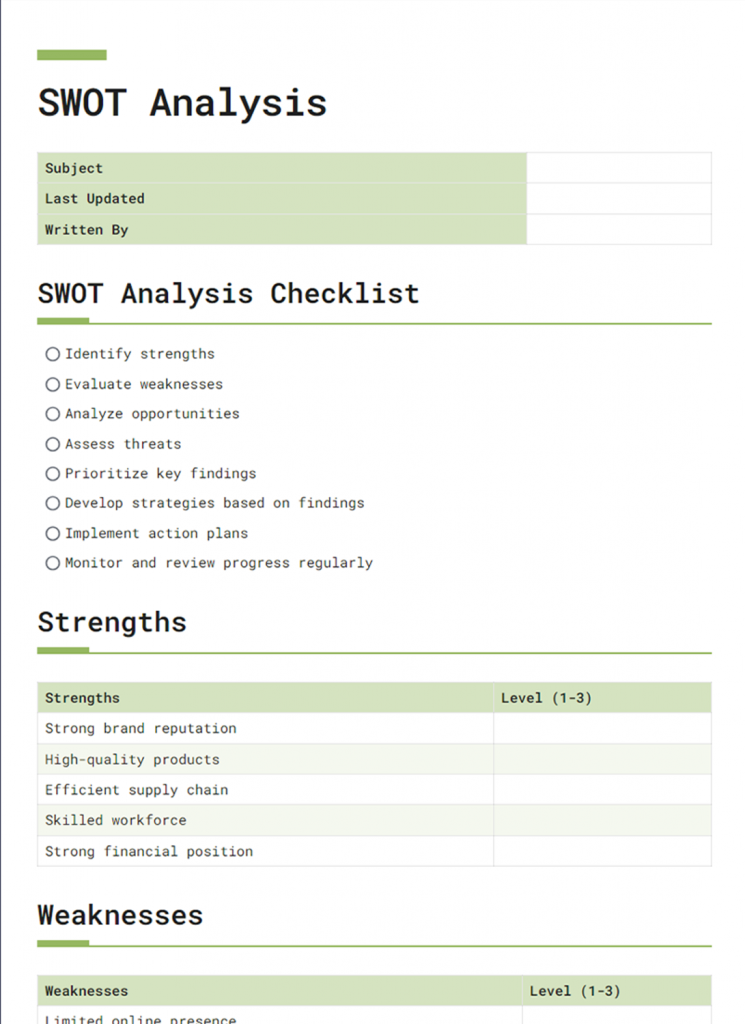
A SWOT analysis is a tool used to assess your business’s overall situation to help you develop a winning marketing strategy. It’s like taking a snapshot of your business from all angles to see what’s working well, what needs improvement, and what external factors might affect you.
Here’s a breakdown of what SWOT stands for:
- Strengths: What are your business’s advantages? This could be anything from a strong brand reputation to a unique product offering.
- Weaknesses: What areas could you improve on? Maybe your website is outdated or your social media presence is lacking.
- Opportunities: What external factors could benefit your business? This might include a growing market trend or a new technology you can leverage.
- Threats: What external challenges could hinder your success? This could be new competition or a change in consumer behavior.
SWOT Analysis Template
| Category | Description | Example (For a shoe store) |
| Strengths | List your internal advantages. | – Strong brand reputation for quality footwear.
– Experienced and knowledgeable staff. – Loyal customer base. |
| Weaknesses | Identify areas for improvement. | – Limited online presence compared to competitors.
– Outdated website design. – Lack of social media engagement. |
| Opportunities | Explore external factors that could benefit you. | – Growing market for athletic shoes.
– Increasing popularity of online shopping. – Potential to partner with fitness influencers. |
| Threats | Consider external challenges you might face. | – Rising costs of materials.
– Entry of new competitors into the market. – Shift in consumer preferences towards more sustainable products. |
2. Buyer’s Persona
Have you ever created a marketing campaign that seemed to miss the mark? Maybe your messaging wasn’t resonating with your audience, or your ads weren’t reaching the right people. This is where buyer personas come in!
A buyer persona is a detailed profile that captures their demographics, behaviors, motivations, and goals. By understanding who your ideal customer is and what makes them tick, you can tailor your marketing messages and campaigns to resonate with them on a deeper level.
Here’s a basic template to get you started on building your buyer persona:
| Category | Description | Example |
| Basic Information | ||
| Name | Give your persona a catchy name | John Doe, the Busy Entrepreneur |
| Age | The age range of your ideal customer | 25-34 |
| Location | Geographic location or target market | Urban areas |
| Occupation | Job title or industry | Marketing Manager |
| Demographics | ||
| Income Level | Annual household income | $75,000+ |
| Education Level | Highest level of education | College Degree |
| Needs & Goals | ||
| Needs | What problems are they facing? | Need a time-saving solution for managing social media. |
| Goals | What are they trying to achieve? | Grow their business and increase brand awareness. |
| Challenges & Pain Points | ||
| Challenges | What obstacles are they facing? | Struggling to keep up with the latest social media trends. |
| Pain Points | What frustrations do they experience? | Feeling overwhelmed by the amount of time social media management takes. |
| Behaviors & Preferences | ||
| Media Consumption | What media channels do they use? | Social media platforms like LinkedIn and Facebook. |
| Buying Habits | How do they typically make purchasing decisions? | Researches online reviews before buying. |
| Information Sources | Where do they go for information? | Industry blogs and online publications. |
3. Competitor Analysis
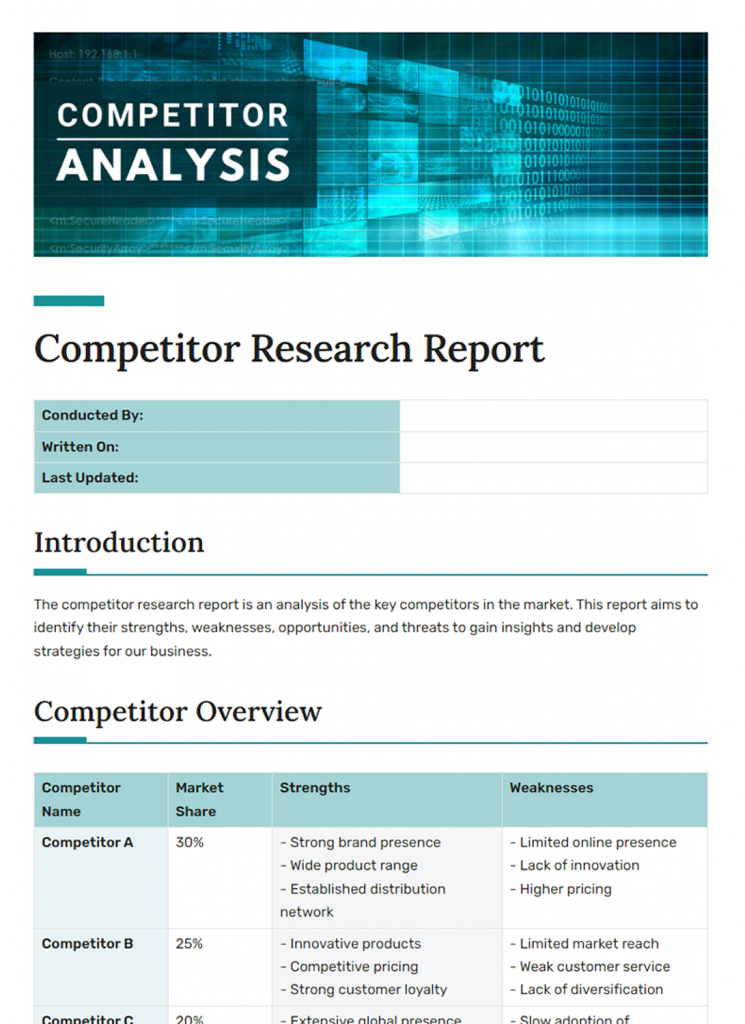
In the game of marketing, knowing your competition is like knowing your next move on the chessboard. Competitor analysis is a deep dive into the strategies and offerings of your main rivals. Here is what to include in it:
| Category | Description | Example |
| Competitor Name | Identify each of your main competitors. | |
| Products/Services | List the products or services they offer. | |
| Target Audience | Who are they trying to reach? | Millennials interested in sustainable fashion |
| Pricing Strategy | How do they price their products or services compared to you? | |
| Marketing Channels | Where do they advertise and promote their business? (Social media, search engines, email marketing, etc.) | Active on Instagram and TikTok |
| Marketing Content | What type of content do they create? (Blog posts, videos, infographics, etc.) | |
| Strengths | What are they doing well? | Strong brand image, excellent customer service |
| Weaknesses | What areas could they improve in? | Limited product selection, outdated website |
| Unique Selling Proposition (USP) | What sets them apart from you and other competitors? | Offer free consultations with stylists |
Researching your competitors? Use Bit.ai’s AI prompts to build a clearer picture of the competition:
- Identify competitors: Use the AI Identify Competitors Generator to find businesses offering similar products or services. →
- Report your findings: Use the AI Competitor Report Generator to organize key findings, comparisons, strengths, and opportunities. →
4. Market Research
Imagine you’re launching a new fitness app. Wouldn’t it be helpful to know who your ideal users are, what features they find most important, and what existing apps they already use? Market research helps you answer these questions and many more. By conducting market research, you gain valuable insights into:
- Your target audience: Who are you trying to reach with your marketing message?
- Customer needs and wants: What problems are your customers facing? What are their buying habits?
- Market trends: What’s hot and what’s not in your industry?
- The competition: Who are your competitors? What are their strengths and weaknesses?
Here’s a basic template to get you started creating your market research report:
| Section | Description |
| Executive Summary | Briefly summarize the key findings of your research. |
| Research Objectives | What were you hoping to learn from your research? |
| Methodology | How did you conduct your research? (e.g., surveys, interviews, focus groups) |
| Target Audience | Describe your ideal customer. |
| Customer Needs & Wants | What are your target customer’s pain points and desires? |
| Market Trends | What are the current trends in your industry? |
| Competition Analysis | Who are your main competitors? What are their strengths and weaknesses? |
| Key Findings & Insights | What are the most important takeaways from your research? |
| Recommendations | How can you use your research findings to inform your marketing strategy? |
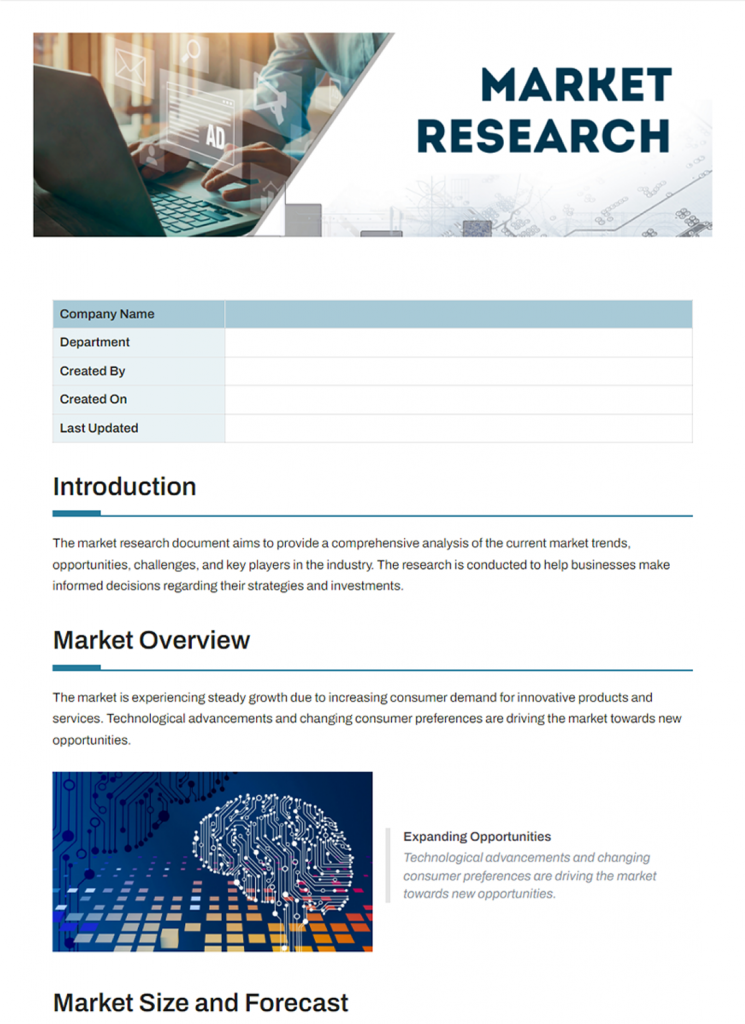
Putting together a market research report? Use Bit.ai’s AI Market Report Generator to organize your research and present your findings clearly. →
5. Project Proposal
A marketing project proposal is like a roadmap for a specific marketing initiative. It outlines the project’s goals, the strategies you’ll use to achieve them, the resources needed, and the expected timeline and budget. This document is crucial for getting buy-in from stakeholders – whether it’s your boss, a client, or a team within your company.
Here’s a breakdown of the key elements you should include in your marketing project proposal template:
| Content | What is it? | Description |
| Executive Summary | A brief overview of the entire proposal, highlighting the project’s goals, key strategies, and expected results. | Grab their attention and quickly explain why this project is important. |
| Project Background | Set the context for the project by explaining the current situation, the challenges you’re facing, and the overall marketing objectives. | Why are you proposing this project? What problem are you trying to solve? |
| Target Audience | Define who you’re trying to reach with your marketing efforts. Be as specific as possible about demographics, interests, and online behavior. | Who are you trying to talk to? Understanding your audience is key to success. |
| Project Goals and Objectives | Clearly define what you want to achieve with this project. Be specific and measurable. KPIs (Key Performance Indicators) can be helpful here. | What do you hope to accomplish? Set SMART goals (Specific, Measurable, Achievable, Relevant, and Time-bound). |
| Marketing Strategy | Outline the specific tactics you’ll use to reach your target audience and achieve your goals. This could include content marketing, social media marketing, email marketing, or other channels. | How will you achieve your goals? Explain your plan step-by-step. |
| Timeline and Deliverables | Create a clear timeline for the project, outlining key milestones and deadlines. Also, specify the deliverables you’ll provide at each stage. | When will things happen? What will be produced at each stage? |
| Budget | Detail the estimated costs associated with the project. This could include personnel costs, software fees, advertising spend, or any other relevant expenses. | How much will it cost? Be transparent about the budget breakdown. |
| Team | Introduce the team members who will be working on the project and highlight their relevant skills and experience. | Who will be working on this? Show why your team is qualified to deliver success. |
| Success Measurement | Explain how you’ll measure the success of the project. This could involve tracking website traffic, engagement metrics, lead generation, or sales figures. | How will you know it worked? Define how you’ll track and measure progress. |
| Conclusion: | Recap the key points of the proposal and reiterate the project’s value proposition. Call to action! | Briefly summarize and emphasize why they should approve this project. |
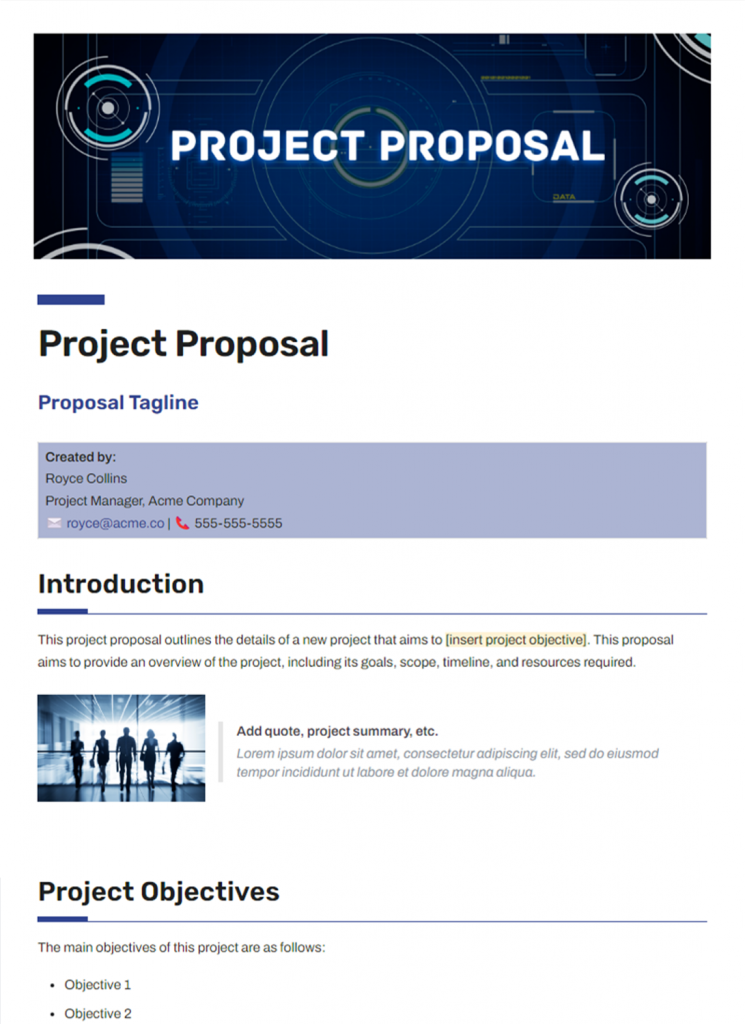
Putting together a marketing project proposal? Use Bit.ai’s AI Project Proposal prompt to organize your project goals, strategy, deliverables, timeline, and budget into a clear proposal →
6. Monthly Calendar Layout
A monthly marketing calendar layout is a visual tool that helps you plan, organize, and track your marketing activities for a specific month. It provides a bird’s-eye view of everything you’ve got going on, ensuring you stay on top of deadlines and campaigns. Here’s a table outlining the key elements you should include in your monthly marketing calendar layout:
Here’s what to include in your monthly marketing calendar template:
| Column | Description |
| Date | The specific day of the month. |
| Campaign/Activity | Briefly describe the marketing activity planned for the day. |
| Platform | Specify the marketing channel (e.g., social media, email, website). |
| Content-Type | For content creation, specify the type of content (e.g., blog post, video, infographic). |
| Status | Track the progress of your tasks (e.g., To Do, In Progress, Done). |
| Notes | Include any additional details or reminders about the task. |
Remember, this is just a basic structure.
7. Social Media Strategy
A social media strategy template is like your roadmap for social media success. It helps you plan your content, target the right audience, and track your progress. Here is what you can include in the template:

| Section | What to Include | Why it’s Important |
| Goals & Objectives | – What do you want to achieve with social media? (e.g., increase brand awareness, drive website traffic, generate leads) | This sets the direction for your entire strategy. |
| Target Audience | – Who are you trying to reach on social media? (e.g., demographics, interests, online behavior) | Knowing your audience helps you tailor your content and choose the right platforms. |
| Competitor Analysis | – What are your competitors doing on social media? | See what’s working for them (and what’s not) to inform your own strategy. |
| Social Media Platforms | – Which platforms will you use? (e.g., Facebook, Instagram, Twitter) | Focus on the platforms where your target audience spends their time. |
| Content Strategy | – What types of content will you create? (e.g., blog posts, images, videos) | This will depend on your goals and audience. |
| Content Calendar | – When and what will you post? | This helps you stay organized and consistent with your posting. |
| Measurement & KPIs | – How will you track your progress? (e.g., follower growth, engagement rate, website traffic) | This helps you see what’s working and what needs to be adjusted. |
8. Marketing Budget
A marketing budget is a financial plan that outlines the amount of money a business intends to spend on its marketing activities over a specific period, usually a year. This budget includes all marketing-related costs such as advertising, promotions, public relations, social media, and more. By using a marketing budget template, you can forecast your expenses, measure your return on investment (ROI), and adjust your spending as needed.
| Section | Description |
| Budget Overview | A summary of the total budget and key financial goals. |
| Marketing Channels | List of different marketing channels (e.g., digital, print). |
| Campaigns | Specific marketing campaigns or projects planned. |
| Expense Categories | Categories such as advertising, events, and content creation. |
| Monthly Breakdown | Monthly allocation of the budget for better tracking. |
| Actual Expenses | Column to record the actual money spent. |
| Variance Analysis | Difference between budgeted and actual expenses. |
| ROI Calculation | Measure the return on investment for each campaign. |
| Notes | Additional comments or observations. |
9. Press Release
A press release is a newsworthy announcement written by a company or organization to share information with journalists, bloggers, and the public. It’s a powerful marketing tool to spread the word about exciting developments, achievements, or upcoming events. Think of it as a formal way to tell the world your news!
Here’s a table to break down the key elements of a press release template:
| Content | Explanation |
| Headline | This is the first thing people will see, so make it catchy and informative. Briefly summarize the main news. |
| Dateline | Include the city and state where the press release is originating from, followed by the release date. |
| Introduction | Briefly introduce your company and explain what the press release is about. |
| Body Paragraphs | Expand on the details of your announcement. Here you can explain why this news is important and how it benefits your target audience. Use strong verbs and keep the language clear and concise. |
| Quotes | Include quotes from relevant people, such as company executives or industry experts, to add credibility and personality. |
| Call to Action (CTA) | Tell readers what you want them to do next, such as visit your website, attend an event, or contact you for more information. |
| Boilerplate | This is a short paragraph at the end that provides background information about your company. |
| Contact Information | Include the name, title, email address, and phone number of a media contact person for inquiries. |
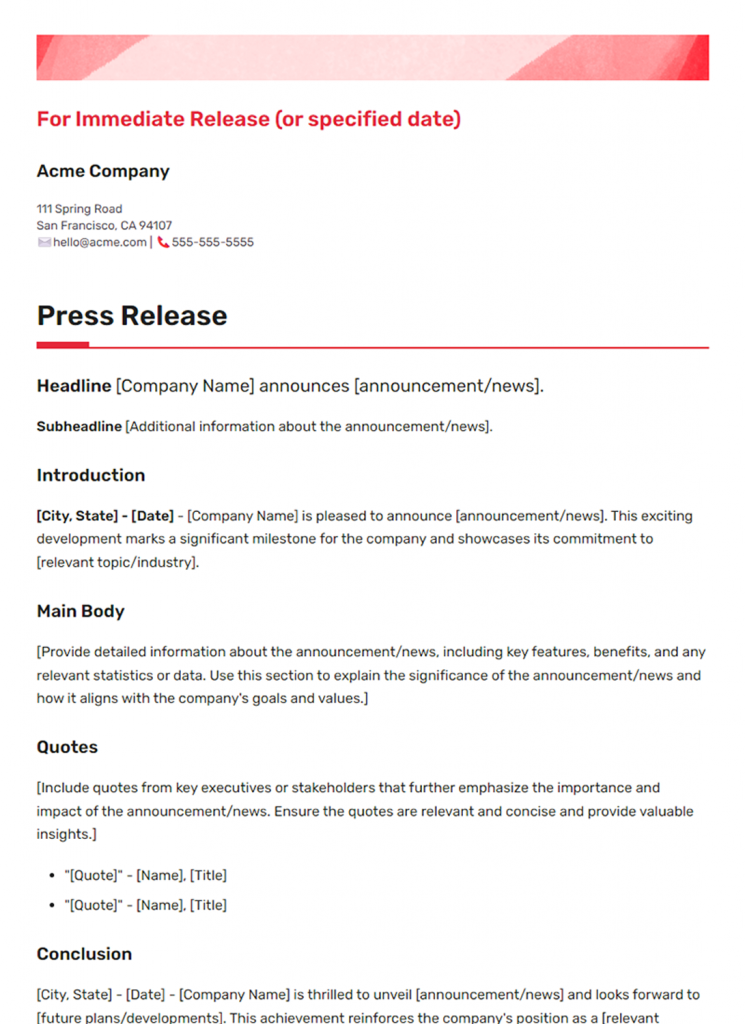
10. Customer Journey Map
A customer journey map is a visual tool that tracks the steps a customer takes as they interact with your brand. It can cover everything from becoming aware of your product to making a purchase and becoming a loyal customer (or not!). By understanding their journey, you can identify areas to improve their experience and boost your marketing efforts.
Content of a Customer Journey Map Template:
| Section | Description | Example |
| Buyer Persona | Who are you mapping the journey for? Define your ideal customer profile. | 25-year-old yoga enthusiast looking for eco-friendly yoga mats. |
| Stages | Break down the journey into stages. Common stages include Awareness, Consideration, Decision, Purchase, and Post-Purchase. | Sees a social media ad about your yoga mats. Reads online reviews. Compare your mats to other brands. Buy a yoga mat from your website. * Leave a review and share photos on social media. |
| Touchpoints | How does the customer interact with your brand at each stage? This includes marketing channels, website visits, customer service interactions, etc. | Social media ads Website product pages Online reviews Email marketing * Live chat with customer service |
| Thoughts & Feelings | What is the customer’s thinking and feeling at each touchpoint? Are they excited, confused, frustrated? | Intrigued by the beautiful yoga mats in the ad. Wants to learn more about the eco-friendly features. Unsure about the mat thickness compared to competitors. Happy with the fast shipping and easy checkout process. * Feels proud to use a sustainable product and wants to share it with others. |
| Pain Points | What are the challenges or frustrations the customer faces during their journey? | Difficulty finding information about mat thickness. Confusing return policy. |
| Opportunities | How can you improve the customer experience at each touchpoint? | Include a size chart and thickness comparison on the product page. Clearly explain the return policy in the FAQ section. |
11. Event Marketing Plan
An Event Marketing Plan is a roadmap for promoting your event to a targeted audience. It outlines your event goals, target demographics, marketing strategies, and budget allocation. A well-crafted plan ensures your event reaches the right people, maximizes attendance, and achieves your desired outcomes.
| Section | What to Include |
| Executive Summary | Briefly introduce your event, target audience, and goals. |
| Event Details | Fill in the nitty-gritty: Event name, date, location, type (conference, workshop, etc.), and what will happen there. |
| Target Audience | Describe who you want to attend: Age, interests, demographics, etc. |
| Event Goals | What do you want to achieve with this event? Brand awareness, lead generation, sales, or something else? |
| SWOT Analysis | Identify your event’s Strengths, Weaknesses, Opportunities, and Threats. This will help you plan for both the good and the bad. |
| Marketing Strategies & Channels | How will you reach your target audience? This could include social media, email marketing, influencer outreach, content marketing, and more. |
| Marketing Budget | Figure out how much you’re willing to spend on marketing your event. |
| Marketing Calendar & Timeline | Create a schedule for your marketing activities. When will you start promoting the event? How often will you post updates? |
| Metrics & Measurement | How will you track the success of your marketing efforts? Will you use website traffic data, social media engagement, or registration numbers? |
| Contingency Plans | What’s your backup plan if something unexpected happens? Bad weather? Low attendance? Be prepared! |
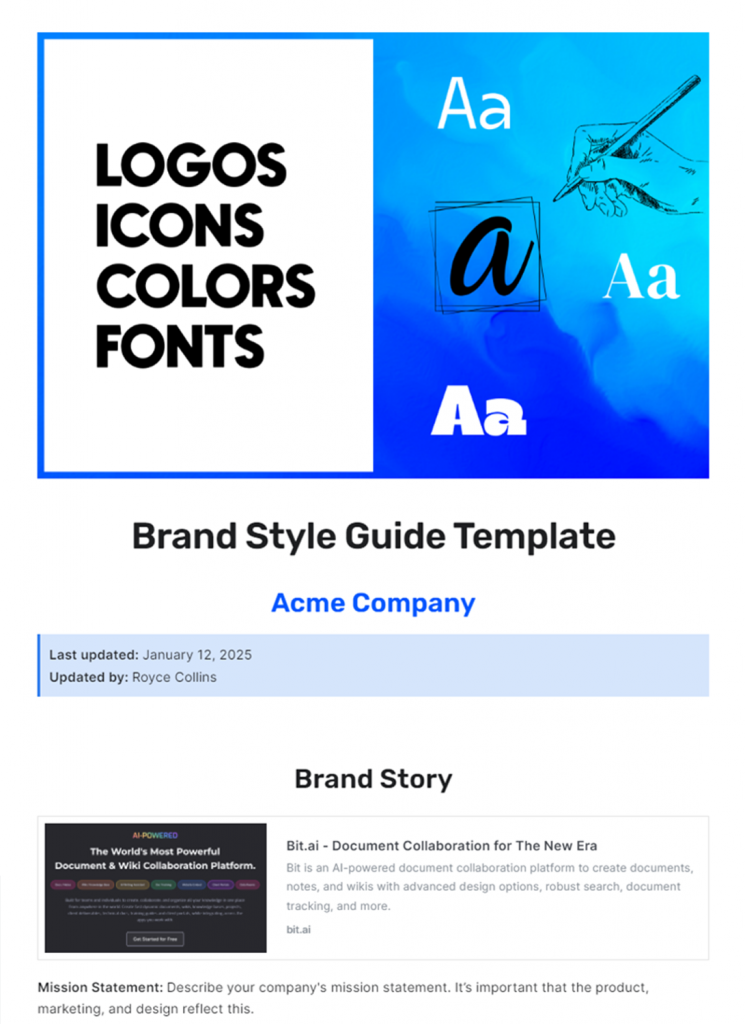
12. Brand Style Guide
A brand style guide, also known as branding guidelines, is a document that defines the visual and written language of your brand. It serves as a rulebook for anyone creating marketing materials, ensuring consistency across all platforms and touchpoints. A strong brand style guide fosters recognition, builds trust, and strengthens your brand identity.
What to Include in a Brand Style Guide
| Content Area | Description |
| Brand Overview | – Mission statement, vision statement, brand values |
| Logo Usage | – Correct logo variations and clear instructions on improper use |
| Color Palette | – Primary, secondary, and accent colors with hex codes or CMYK values |
| Typography | – Approved fonts for headlines, body copy, and logos |
| Imagery | – Style guide for photography and illustrations, including tone, mood, and composition |
| Voice & Tone | – Guidelines for writing style, personality, and appropriate language for different audiences |
| Messaging | – Key messaging points and brand storytelling elements |
| Content Examples | – Mockups or examples of how the style guide translates into marketing materials (social media posts, ads, etc.) |
| Do’s and Don’ts | – Specific examples of what to avoid visually and in messaging |
| Approval Process | – Workflow for getting marketing materials approved based on the style guide |
13. Product Launch Plan
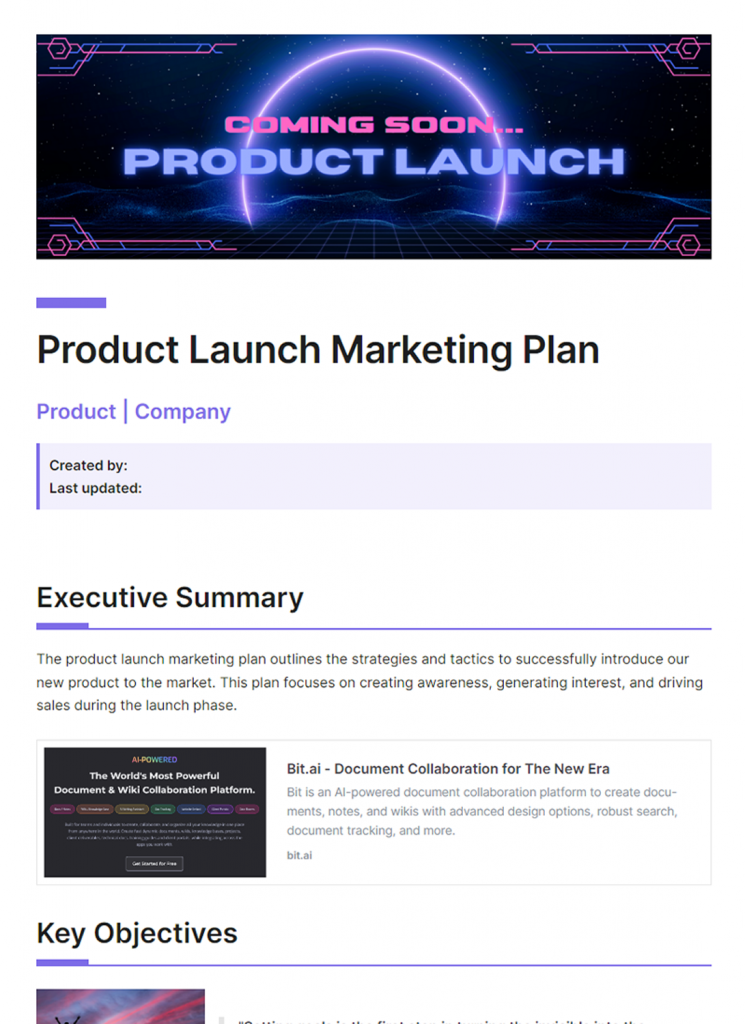
A product launch plan is a roadmap for introducing your new product or service to the market. It outlines the strategies and tactics you’ll use to generate excitement, educate potential customers, and drive sales. This comprehensive document ensures a smooth and successful launch by keeping everyone on the same page and aligned toward achieving launch goals.
Here’s a breakdown of the key elements typically included in a product launch plan template:
| Content | Description |
| Executive Summary | A concise overview of the product launch, including the product itself, target audience, launch goals, and key milestones. |
| Product Description | A detailed description of the product’s features, benefits, and unique selling proposition (USP). |
| Target Audience | A clear definition of your ideal customer profile, including demographics, psychographics, and buying behavior. |
| Competitive Analysis | An analysis of your competitors, their offerings, strengths, and weaknesses. |
| Marketing Objectives | Specific, measurable, achievable, relevant, and time-bound (SMART) goals for the launch, such as brand awareness, lead generation, or sales targets. |
| Go-to-Market Strategy | The channels and tactics you’ll use to reach your target audience, such as content marketing, social media marketing, public relations, or influencer marketing. |
| Messaging and Positioning | The key messages you want to communicate about your product and how it positions itself in the market. |
| Pricing Strategy | The pricing model you’ve chosen for your product and the rationale behind it. |
| Sales Strategy | The channels and tactics you’ll use to sell your product, such as direct sales, online sales, or partnerships. |
| Content Calendar | A detailed schedule for creating and publishing marketing content leading up to and after the launch. |
| Launch Timeline | A timeline outlining key milestones and deadlines for all launch activities. |
| Budget | A breakdown of the costs associated with the launch, including marketing, sales, and product development. |
| Public Relations Strategy | If applicable, a plan for securing media coverage and generating positive publicity around the launch. |
| Launch Metrics | The key performance indicators (KPIs) you’ll use to track the success of your launch campaign. |
| Team Roles and Responsibilities | A clear assignment of roles and responsibilities for all team members involved in the launch. |
14. Partnership Marketing Plan
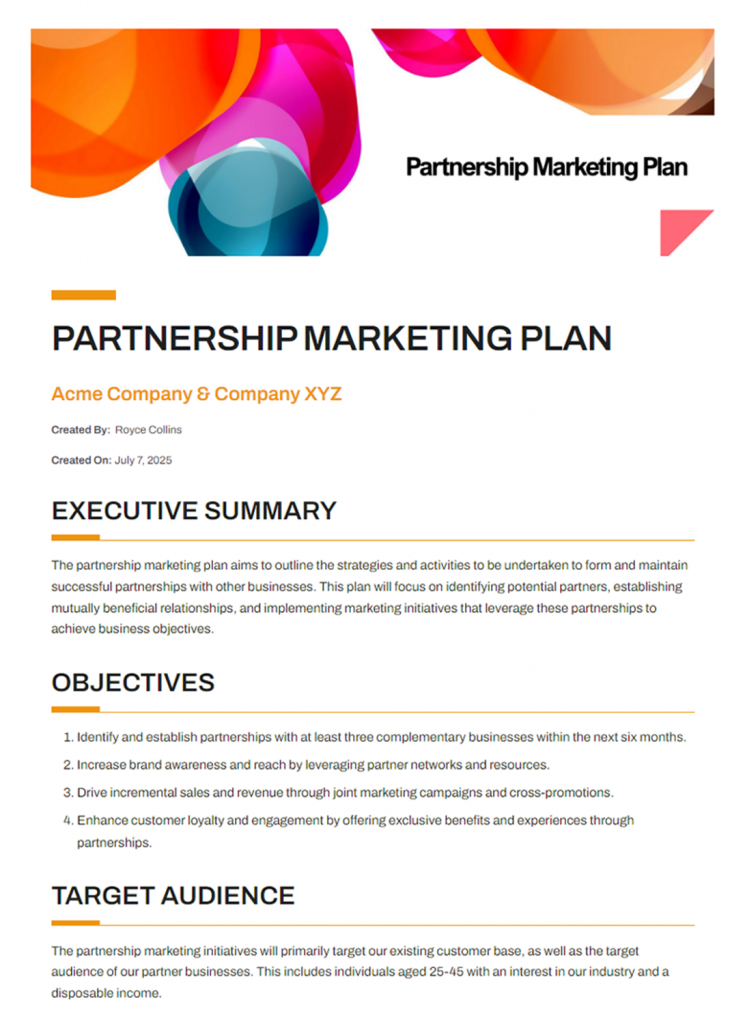
A partnership marketing plan is a strategic roadmap for collaborating with other businesses to achieve shared marketing goals. It outlines the specific tactics and activities that will be undertaken by both partners to leverage each other’s strengths and reach new audiences.
Here’s a table outlining the key sections typically included in a partnership marketing plan template:
| Section | Content |
| Executive Summary | Briefly summarize the key aspects of the partnership, including the partners involved, the target audience, the campaign goals, and the expected benefits. |
| Partner Identification & Analysis | Defines the ideal partner profile, outlines the potential partners considered, and details the chosen partner(s) with a focus on their strengths, target audience, and brand alignment. |
| Campaign Goals & Objectives | Establishes specific, measurable, achievable, relevant, and time-bound (SMART) goals for the partnership campaign. These could include brand awareness, lead generation, sales growth, or website traffic increase. |
| Target Audience Definition | Identifies the specific audience segment the campaign will target, considering demographics, interests, and online behavior. This audience should ideally be a good fit for both partners’ offerings. |
| Marketing Activities & Tactics | Details the specific marketing activities and tactics that will be implemented by both partners. This could include co-branded content creation, social media promotions, joint webinars, or email marketing campaigns. A timeline for each activity should be included. |
| Roles & Responsibilities | Clearly outlines the roles and responsibilities of each partner in the campaign. This ensures everyone is aware of their obligations and avoids confusion. |
| Budget & Resources | The partnership campaign budget is defined and the resources required from each partner are detailed. These could include personnel, software, or creative assets. |
| Success Measurement & KPIs | Identifies the key performance indicators (KPIs) that will be used to track the success of the campaign. These could be website traffic, lead generation, sales conversions, or social media engagement. |
| Communication & Approval Process | Establishes a clear communication plan for both partners, outlining how information will be shared and decisions will be made. This includes frequency of meetings, communication channels, and an approval process for marketing materials. |
| Contingency Plan | Outlines potential challenges that could arise during the campaign and proposes solutions to address them. |
| Exit Strategy | Defines the termination criteria for the partnership and outlines the process for ending the collaboration if necessary. |
15. Customer Case Study
A customer case study is a detailed success story that showcases how your product or service helped a real customer achieve their goals. It acts as social proof, building trust and credibility with potential customers by demonstrating the value you deliver.
| Section | Description |
| Headline | A clear and concise headline that captures attention and highlights the customer’s success. |
| Introduction | Briefly introduce the customer company, their industry, and the challenges they were facing. |
| The Challenge | Describe the specific problem(s) the customer was trying to solve. Quantify the impact of the problem if possible (e.g., lost revenue, decreased productivity). |
| The Solution | Explain how your product or service addressed the customer’s challenges. Highlight the specific features or benefits that were most relevant. |
| The Results | Showcase the positive outcomes the customer achieved after using your product/service. Use quantifiable metrics (e.g., increased sales, improved efficiency) to demonstrate success. |
| Customer Quote | Include a compelling quote from a satisfied customer representative. This adds a personal touch and strengthens the case study’s credibility. |
| Call to Action | Provide a clear next step for the reader, such as contacting your sales team or downloading a free trial. |
| Visuals | Use high-quality visuals like logos, screenshots, and charts to enhance readability and make the case study more engaging. |
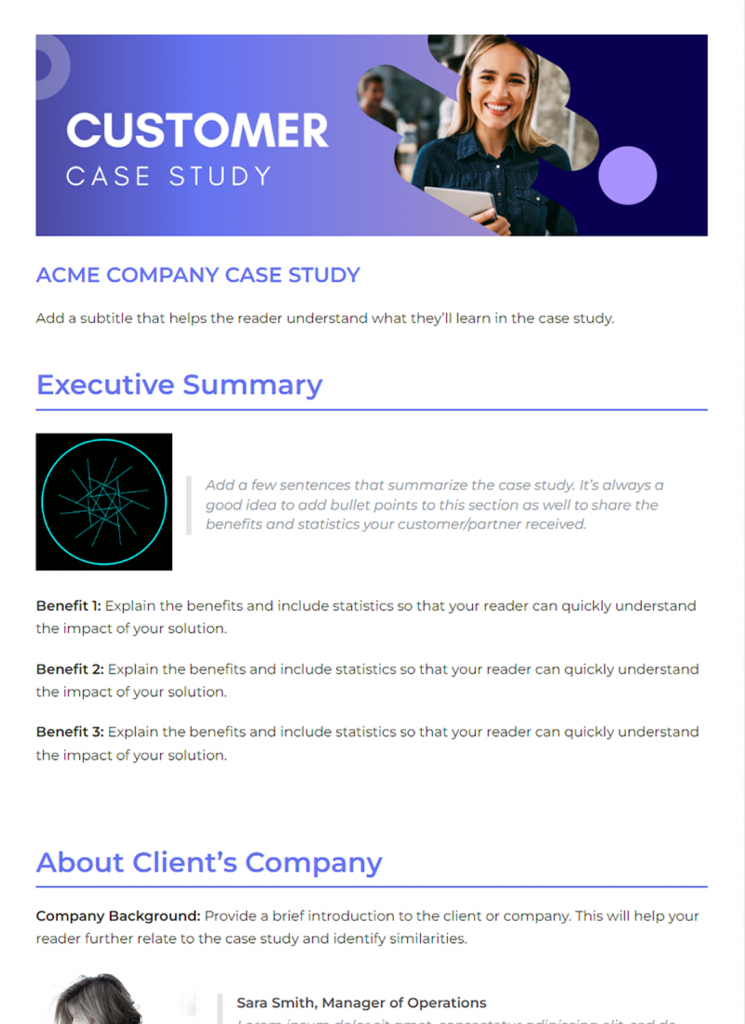
Ready to turn those case study elements into a complete story? Try Bit.ai’s AI case study prompt to structure the challenge, solution, results, and customer insights into a polished draft →
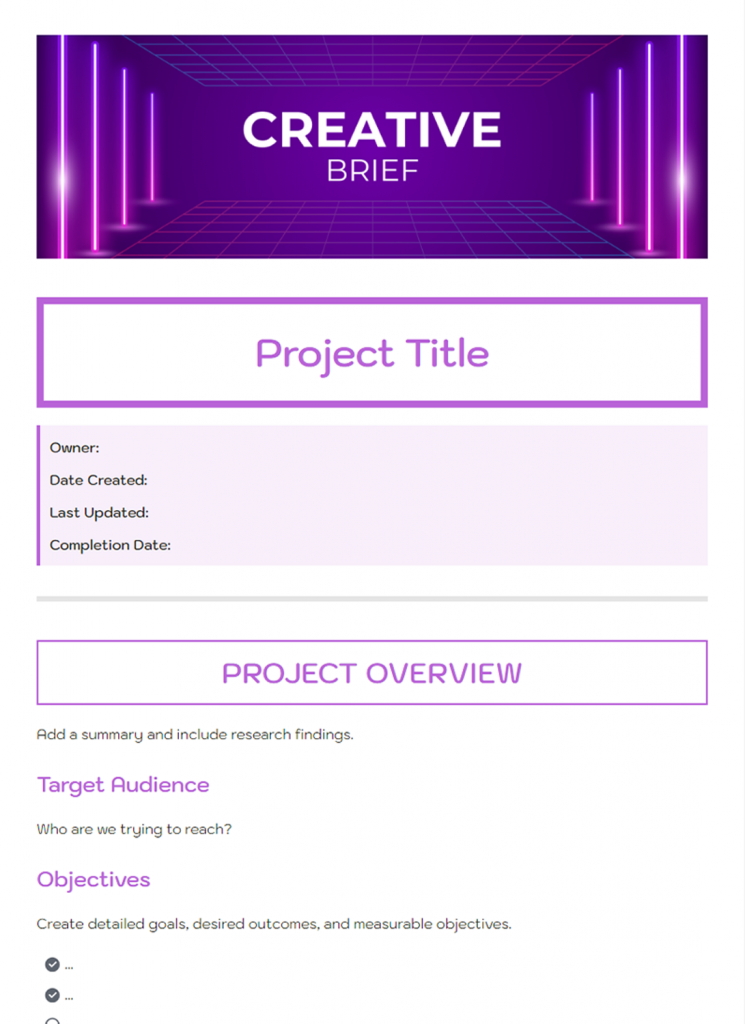
16. Creative Brief
A creative brief is a foundational document in marketing and advertising. It acts as a roadmap, clearly outlining the goals, target audience, and key messaging for a creative project. It ensures everyone involved, from project managers to designers and copywriters, is on the same page and understands the desired outcome.
| Section | Description |
| Project Information | Project name, brief author, date, and due date. |
| Background | A concise overview of the company, brand, and the project’s context. |
| Target Audience | Define the ideal customer, including demographics, psychographics, and media consumption habits. |
| Marketing Objectives | Specify the goals of the creative project (e.g., brand awareness, lead generation, sales). |
| Messaging | Key messages you want to communicate to the target audience. |
| Brand Voice & Tone | Describe the desired personality and style of the creative content (e.g., playful, professional, informative). |
| Competitors | Identify your main competitors and analyze their marketing strategies. |
| Deliverables | Specify the creative outputs expected (e.g., social media posts, video ad, website banner). |
| Timeline & Budget | Outline the project timeframe and any budgetary constraints. |
| Approval Process | Define the process for reviewing and approving the final creative materials. |
| Additional Information | Include any relevant resources or brand guidelines. |
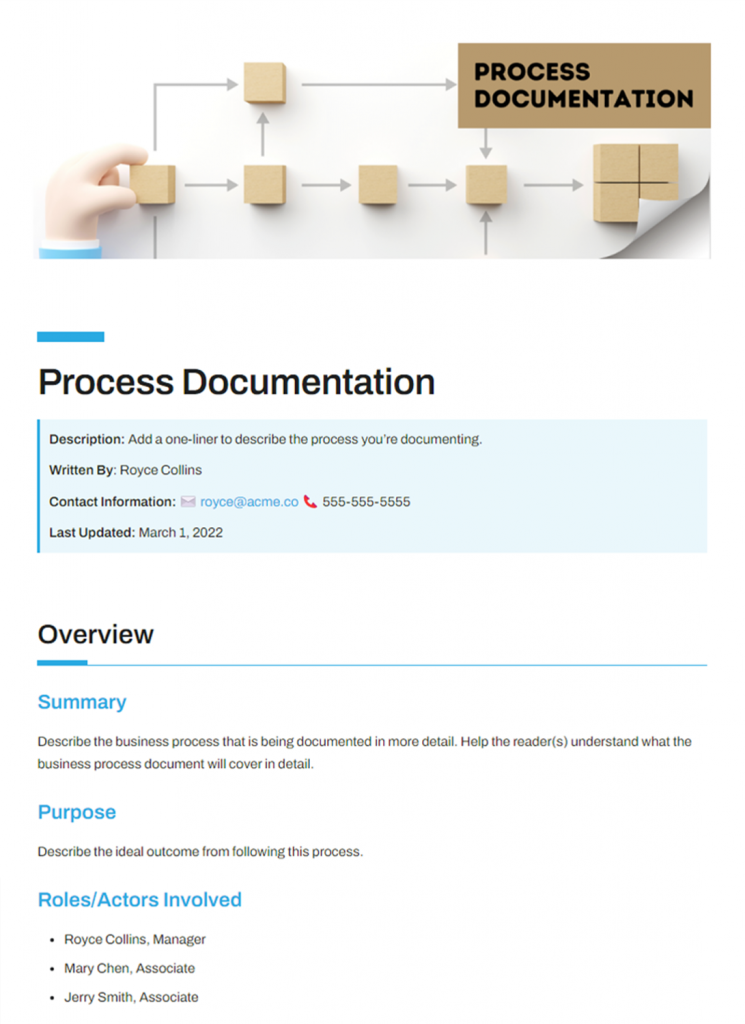
17. Process Documentation
A process documentation template is a framework for capturing the steps involved in a marketing activity. It serves as a roadmap for team members, ensuring consistency and efficiency in executing marketing initiatives. By documenting your processes, you can streamline workflows, identify areas for improvement, and onboard new team members seamlessly.
| Element | Description |
| Process Title | Clearly define the marketing activity the process pertains to (e.g., Content Creation Process, Lead Generation Process). |
| Objective | Briefly explain the goal of the process (e.g., To create high-quality blog posts that drive website traffic and conversions). |
| Target Audience | Specify who the process aims to reach (e.g., Potential customers in the awareness stage of the buyer’s journey). |
| Roles & Responsibilities | Outline the roles involved in the process and their specific tasks (e.g., Content Writer, Editor, Marketing Manager). |
| Steps | Detail each step involved in the process chronologically. This could include research, brainstorming, creation, approval, publishing, and promotion stages. |
| Tools & Resources | List the software, templates, or any other resources needed to complete each step (e.g., Content management system, design software, project management tools). |
| Timeline | Establish a realistic timeframe for each step and the overall process. |
| Approval Workflow | Define the process for content or project approval (e.g., Who reviews and approves drafts, how many revision rounds are allowed). |
| Quality Assurance | Specify the criteria for measuring success and ensuring quality control (e.g., Content quality checklist, SEO optimization guidelines). |
| Revision History | Track any changes made to the process over time and maintain version control. |
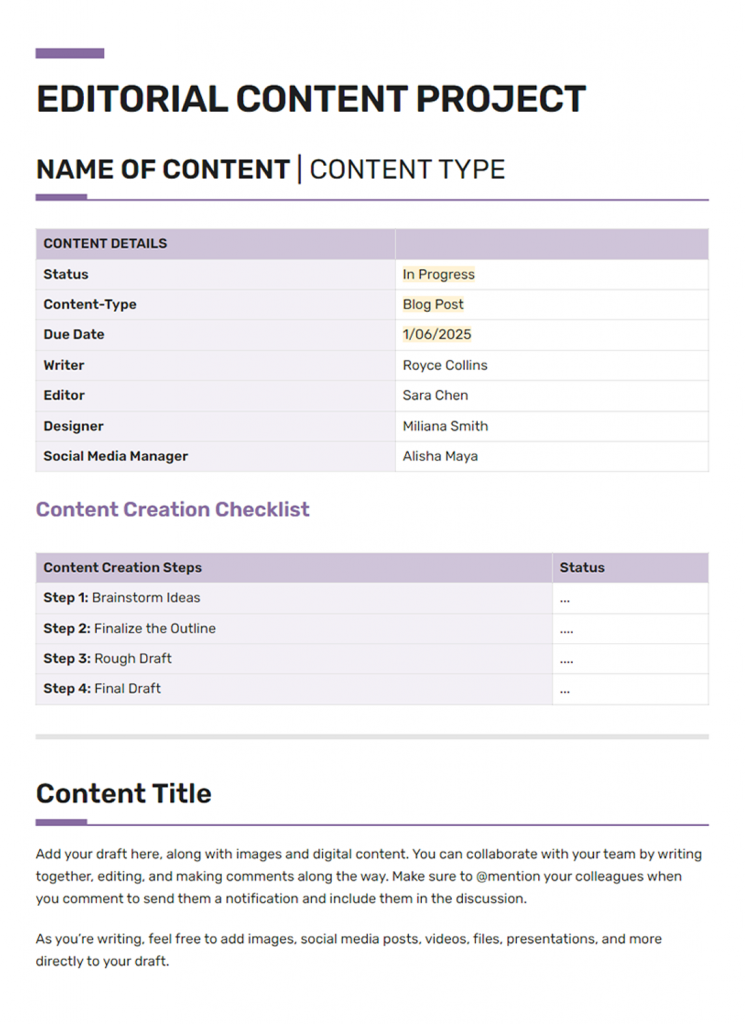
18. Editorial Content
An editorial content plan is a document that outlines your content strategy for a specific period. It details the types of content you’ll create, the topics you’ll cover, the publishing schedule, and who is responsible for each piece.
| Section | Description |
| Target Audience | Define your ideal customer profile. Who are you creating content for? |
| Content Goals | What do you want to achieve with your content? (e.g., brand awareness, lead generation, website traffic) |
| Content Pillars | Identify the core topics that will guide your content strategy. |
| Content Formats | Specify the types of content you’ll create (e.g., blog posts, infographics, videos, social media posts). |
| Content Calendar | Plan your content schedule, including deadlines, titles, and assigned writers. |
| SEO Keywords | Integrate relevant keywords to improve search engine ranking. |
| Content Promotion Strategy | Outline how you will promote your content across different channels. |
| Performance Tracking | Define metrics to track the success of your content (e.g., website traffic, engagement, conversions). |
19. Influencer Marketing Campaign
An influencer marketing campaign template is a blueprint for creating a successful partnership with social media personalities to promote your brand or product. It keeps your strategy organized, ensures clear communication with influencers, and helps you measure the effectiveness of the campaign.
| Section | Description |
| Campaign Goals | Define your overall objectives. Is it brand awareness, website traffic, or sales? |
| Target Audience | Identify your ideal customer, including demographics, interests, and social media platforms. |
| Influencer Selection Criteria | Outline the characteristics you seek in influencers, such as follower count, engagement rate, and niche alignment. |
| Influencer Research | List potential influencers with relevant audience demographics and content. |
| Campaign Budget | Allocate funds for influencer fees, content creation, and campaign promotion. |
| Campaign Brief | Develop a document outlining the campaign goals, target audience, brand messaging, and content expectations for influencers. |
| Influencer Outreach | Craft personalized messages to introduce your brand and campaign to potential influencers. |
| Contract & Agreements | Formalize the partnership with a clear contract outlining expectations, deliverables, compensation, and usage rights. |
| Content Calendar | Schedule influencer content creation and posting dates, ensuring alignment with your overall campaign timeline. |
| Content Guidelines | Provide clear instructions on brand messaging, tone, and content style for influencer posts. |
| Content Approval Process | Establish a system for reviewing and approving influencer content before publication. |
| Campaign Promotion | Develop strategies to amplify influencer content through organic and paid promotion. |
| Measurement & Tracking | Identify key performance indicators (KPIs) to track campaign success, such as engagement, website traffic, and conversions. |
| Reporting & Analysis | Compile data on campaign performance and analyze the results to measure ROI and identify areas for improvement. |
| Post-Campaign Review | Evaluate the effectiveness of the campaign and identify learnings to inform future influencer partnerships. |
Need help planning and managing influencer collaborations? Use Bit.ai’s AI prompts to streamline different parts of your influencer marketing workflow, from finding the right approach to organizing rates, pitches, and collaboration details:
- Influencer Pitch Generator →
- Influencer Rate Card →
- Influencer Collaboration Agreement →
- Influencer Invoice →
- Influencer Collaboration Idea Generator →
- Influencer Content Brief →
20. Email Marketing Campaign
An email marketing campaign template is a pre-defined structure that outlines the key elements for a successful email marketing initiative. It acts as a roadmap, guiding you through the planning, creation, execution, and analysis phases of your campaign.
| Section | Description |
| Campaign Goals | Clearly define the objectives you aim to achieve with this email campaign. Is it to drive sales, generate leads, boost brand awareness, or increase customer engagement? |
| Target Audience | Identify the specific group of recipients you’ll be sending the email to. Consider demographics, interests, and purchase behavior. |
| Email Subject Line | Craft a compelling subject line that entices recipients to open the email. Aim for clarity, intrigue, and a sense of urgency. |
| Preheader Text | This short snippet appears next to the subject line in some inboxes. Use it to elaborate on the subject line or offer a teaser of the email content. |
| Email Content | This is the heart of your campaign. Structure your email with a clear message, engaging visuals, and a strong call to action (CTA). |
| Email Design | Maintain a consistent brand identity with your logo, colors, and fonts. Utilize visuals strategically to enhance the message and break up text. |
| A/B Testing | Plan to test different variations of subject lines, content, or CTAs to see which version resonates best with your audience. |
| Schedule & Timing | Determine the optimal time and day to send your email campaigns based on your target audience’s behavior and industry benchmarks. |
| List Segmentation | Segment your email list to send targeted messages that cater to specific interests or demographics within your audience. |
| Personalization | Incorporate personalization elements like the recipient’s name or purchase history to create a more relevant and engaging experience. |
| Legal Compliance | Ensure your email adheres to anti-spam regulations like CAN-SPAM. Include an unsubscribe option and manage your list hygienically. |
| Success Metrics | Define the key performance indicators (KPIs) you’ll use to measure the success of your campaign. Track metrics like open rates, click-through rates, and conversion rates. |
| Post-Campaign Analysis | Analyze the results of your campaign to identify what worked well and areas for improvement. Use these insights to optimize future email marketing efforts. |
Conclusion
In this guide, we provide you with 20 marketing templates. Remember, these templates are meant to be guides, not rigid constraints. Adapt them to your unique marketing goals and brand identity for optimal impact. As you gain experience and gather data, you can further refine these templates to create a personalized marketing document toolkit that fuels your success.
Good Luck!
Further Reads: