Have you ever wondered how big business goals actually turn into daily work?
Most teams already know what they want to achieve. Maybe to increase sales, improve operations, launch new products, or deliver a better customer experience. But knowing the goal is only the starting point. The real challenge is translating that goal into clear tasks your team can execute every day.
This is where operational planning becomes important. An operational plan helps you break down strategy into practical actions by defining responsibilities, timelines, resources, and performance metrics. Instead of broad ideas, it focuses on the day-to-day work that keeps your organization moving forward.
Operational Plan
An operational plan translates business strategy into structured actions, including objectives, tasks, timelines, teams, and KPIs.
Standardized Format of Operational Plan Examples
To make operational plans easier to understand and apply, every example follows a consistent structure. This helps you compare different industries and quickly adapt the format for your own business.
Standard Operational Plan Format
Every operational plan example in this guide includes:
Objective
A clear, measurable goal that defines what the business wants to achieve.
Key Operational Activities
The specific actions and tasks required to achieve the objective.
Timeline
A step-by-step breakdown of when each activity will be executed.
Team & Responsibilities
The roles involved and what each team or individual is responsible for.
KPIs (Key Performance Indicators)
Measurable metrics are used to track success and performance.
Using this standardized format ensures consistency across industries and makes it easier to turn examples into real operational plans for your business.

Want to know about operational plan in depth?
Check What is Operational Plan & How to Create it? (Free Template Included) →
Operational Plan Examples (At a Glance)
Here are examples of operational plans from different kinds of businesses. This will give you an idea of how operational plans differ across business types before you start reading the details.
Instant Operational Plan Examples Summary
- Manufacturing is about making things. The operational plan focuses on production efficiency, aiming to produce 10,000 units per month, and the key metric is the defect rate.
- For Retail businesses the plan is to increase sales and manage inventory, which means they want to make 15% money and they measure this by looking at the turnover ratio.
- Marketing teams have a plan to get more people interested in their products so they try to get 5,000 leads in three months and they measure how well they are doing by looking at the cost per lead.
- Technology companies have a plan to develop and deliver products, which means they want to launch a new feature in 12 weeks and they measure their progress by looking at how well they complete each part of the project.
- Customer Service teams have a plan to help people quickly so they try to answer questions within two hours. They measure customer satisfaction by looking at the CSAT score.
- Small businesses have a plan to make money so they try to increase their monthly revenue from $25,000 to $35,000 and they measure how well they are doing by looking at the conversion rate.
- Big companies have a plan to grow the whole business, which means they want to make 25% more money every year and they measure their progress by looking at how many new customers they get which is called the customer acquisition rate.
When you look at different types of businesses, you will see something that catches your eye.
For a manufacturing team, the main focus is making things and keeping equipment in good condition. A retail manager, on the other hand, is concerned with ensuring products are stocked and that the store is running well. A marketing team has a job; they have to plan when to start campaigns, create content, and find new customers.
Even though the details of plans differ for each business, the main goal of an operational plan is the same. An operational plan takes what the business wants to do and turns it into steps that the teams can do and track. The operational plan is important for the business because it helps the teams know what to do. The operational plan is used by teams to ensure they are doing what the business wants them to do.
The table below provides a quick comparison of how operational plans differ across industries by highlighting each business’s primary focus and the key metrics used to measure success.
| Industry | Focus | Key Metric |
| Manufacturing | Efficiency & output | Production rate |
| Retail | Sales & inventory | Revenue & turnover |
| Marketing | Leads & conversions | CPL & ROI |
| Tech | Delivery speed | Sprint completion |
| Customer Service | Response time | CSAT |
Let’s discuss each real-world operational plan example across industries in detail. Each example includes objectives, activities, timelines, teams, and KPIs so you can directly model your own plan.
Manufacturing Operational Plan Example
A manufacturing company typically uses an operational plan to coordinate production targets, equipment usage, staffing, and quality control. The overall aim is to have our products manufactured rapidly and with high quality.
Business Objective
Increase monthly production output to produce 10,000 Units Per Month in 6 Months or less while maintaining defect rates under 2%.
Operational Activities
- Create uniform assembly procedures for all production lines
- Establish regular quality inspections at three stages of production
- Regularly maintain machinery in order to decrease unscheduled downtime
- Increase coordination with suppliers so that all raw materials arrive on time.
Team and Resources Involved
- Production manager overseeing daily operations
- 20 production line workers assigned to two shifts
- 3 quality control inspectors monitoring production output
- 2 maintenance technicians responsible for equipment upkeep
Execution Timeline
Month 1-2
Evaluating current processes and producing rate extenuating circumstances.
Month 3-4
Adjust scheduling of employees to improve equipment utilization, use of machines, and enhance efficiency in assembly line production processes.
Month 5-6
Scale up operations while constantly monitoring machine performance, efficiency, and product quality.
Key Performance Metrics
- Monthly production output
- Production cycle time per unit
- Defect rate percentage
- Equipment downtime hours
This type of operational plan helps teams stay efficient in their production activities and, at the same time, ensure that product quality remains unchanged as production volume increases.
Retail Operational Plan Example
Retail businesses need a plan to make sure everything runs smoothly in their stores. They have to manage what they have in stock and make sure customers are happy. Things change fast in retail because people want different things at different times of the year. So a plan helps the people in charge keep everything under control.
Primary Goal
Increase in-store sales by 15% over the next 12 months while maintaining healthy inventory levels and improving customer satisfaction scores.
Key Operational Actions
- Conduct weekly stock audits to avoid running out of or having excess stock.
- Revise the store layout and product placement to align with the best-selling items.
- Inform employees about the products sold and how to provide good customer service.
- Develop sales promotions during peak shopping periods.
Team and Resources
- Store managers oversee overall performance.
- Sales associates supporting sales floor checkout operations.
- Inventory coordinators track stock levels and supplier deliveries,
- Visual merchandising specialists oversee the appearance of store displays.
Implementation Timeline
Month 1–2
Analyze current sales trends and adjust product placement to highlight high-demand items.
Month 3–6
Start targeted promotions and provide training to staff on customer engagement techniques and upselling techniques.
Month 7–12
Improve forecasting in areas of inventory and monitor monthly sales performance during peak retail periods.
Performance Indicators
- Monthly sales revenue
- Inventory turnover ratio
- Average transaction value
- Customer satisfaction rating
By organizing store operations through well-defined activities, schedules, and performance measurement, a retail manager can achieve a better sales performance while at the same time make sure that the daily operations run smoothly.
Technology Project Operational Plan Example
Imagine your product team preparing to release a new analytics feature for customers within the next three months. Everyone understands the goal, but without a clear operational plan the work can easily become fragmented. Developers may focus on different priorities, testing may fall behind schedule, and deployment can quickly become chaotic.
This is why technology teams rely on operational plans to coordinate development work, define responsibilities, and keep projects moving toward release.
Project Goal
Develop and successfully launch a customer analytics dashboard within 12 weeks, ensuring high system performance and a low defect rate.
Core Operational Tasks
- Define product requirements and finalize feature specifications
- Organize development work into two-week sprint cycles
- Conduct regular code reviews and automated testing
- Coordinate deployment and user testing before the official release
Teams and Resources
- The product manager has the overall responsibility for feature prioritization and planning.
- 5 software developers will develop the application.
- Both functional and performance testing will be conducted by 2 QA testers.
- The DevOps engineer will provide support for deployment infrastructure.
Execution Timeline
Weeks 1-2
Complete the requirement analysis for product and create the roadmap for development.
Weeks 3-8
Create core functionality in multiple sprints while doing ongoing testing.
Weeks 9-10
Complete user acceptance testing as well as fixing all defects found during testing.
Weeks 11-12
Launch the new dashboard and monitor how well it works after launch.
Success Metrics
- Sprint completion rate
- Number of bugs identified and resolved
- Deployment success rate
- User adoption of the new dashboard feature
With a well-structured operational plan like this, technology teams can organize their development activities in a coordinated manner and make sure projects flow from planning to release without any hiccups.
Working on a specific initiative instead of day-to-day operations?
Learn how project planning helps organize tasks, timelines, and resources from start to finish →
Marketing Campaign Operational Plan Example
Operational plans are a tool to arrange campaign tasks, synchronize content creation, and oversee the performance of different channels. Campaigns lacking a clear structure can become chaotic very quickly while also missing major deadlines.
Campaign Objective
Generate 5,000 qualified leads within three months through a multi-channel digital marketing campaign.
Planned Marketing Activities
- Develop campaign messaging and content tailored to the target audience
- Create blog posts, landing pages, and social media promotions to support the campaign
- Implement a paid advertising campaign on all major search engines and social networks.
- Develop an email campaign sequence for nurturing potential leads into customers.
Team and Resources
- Marketing manager responsible for campaign strategy and execution
- Content writers creating blog posts, email copy, and landing page content
- Graphic designer producing visuals and advertising creatives
- Digital marketing specialist managing advertising platforms and analytics
Campaign Timeline
Week 1–2
Decide on the campaign message, target audience and content plan.
Week 3–8
Publish content, initiate the advertisement campaigns, and monitor the engagement metrics to measure how the advertisement is being received.
Week 9–12
Optimize campaign performance and focus on lead conversion activities.
Key Metrics for Evaluation
- Number of leads generated
- Cost per lead
- Conversion rate from visitor to lead
- Overall campaign return on investment
Having a well-defined operational plan enables the marketing teams to harmonize the production of creative materials, advertising roll-out, and analytics tracking. In this way, campaigns will run efficiently and produce measurable results.
Customer Service Operational Plan Example
Customer service teams use operational plans to ensure support requests are handled quickly and consistently. An organized plan allows support teams to handle large numbers of tickets, enhance reply times, and still keep high customer satisfaction.
Service Goal
Improve average response time from 6 hours to under 2 hours within the next quarter while increasing the customer satisfaction score (CSAT) to 90 percent or higher.
Support Operations Plan
- Create an urgency-based prioritization system for customer tickets
- Create a comprehensive knowledge base of all FAQ-related content
- Provide live support during our busiest periods
- Have weekly training sessions to enhance product knowledge of the agents
Support Team Structure
- Customer support manager overseeing service operations
- 8 support agents handling email, chat, and phone inquiries
- 1 quality assurance specialist reviewing ticket resolution quality
- Technical support specialist handling complex cases
Implementation Timeline
Week 1 – 2
Create and implement a ticket prioritization system and build out an initial set of knowledge base articles.
Week 3 – 6
Train agents on new support processes and go live with chat support.
Week 7 – 12
Monitor the trends/number of tickets that have been created, iterate on how the workflow operates and increase efficiency.
Performance Metrics
- First response time
- Average resolution time
- Customer satisfaction score (CSAT)
- First-contact resolution rate
By organizing support operations with clear processes and performance targets, businesses can deliver faster responses and build stronger relationships with their customers.
Small Business Operational Plan Example
Small businesses often operate with only a handful of people and a small budget, so an operational plan plays a role in helping them figure out which activities are more essential in growing their business. It also gives a definite framework for conducting daily business, marketing and customer relationship activities.
Business Goal
Increase monthly revenue from $25,000 to $35,000 within six months by expanding online sales and improving customer retention.
Operational Priorities
- Launch an improved website with an integrated online ordering system
- Increase social media marketing activity to attract new customers
- Introduce a customer loyalty program to encourage repeat purchases
- Track weekly sales performance to identify high-performing products
Team and Resources
- Business owner is responsible for operational and partnership management.
- Two employees are responsible for fulfilling customer orders and answering inquiries.
- Freelancer handles web design and promotional material creation.
- Digital marketing tools for social media scheduling and analytics.
Execution Timeline
Month 1–2
Redesign website, enhance products featured on it, build loyalty program.
Month 3–4
Add online ads and greater use of social media in promoting the product.
Month 5–6
Analyze sales patterns and adjust marketing strategies as per customer’s actions.
Performance Metrics
- Monthly sales revenue
- Number of repeat customers
- Online traffic and conversion rate
- Customer acquisition cost
For small businesses, an operational plan like this helps owners stay focused on key priorities while managing day-to-day tasks more efficiently.
Not sure where an operational plan fits into your business planning process?
Start by creating a business plan, then use it to guide your operational goals →
Annual Operating Plan Example
At some point, short-term operational plans are not enough. When your organization begins planning the entire year ahead, you need a broader framework that aligns teams, resources, and priorities across multiple departments.
This is where an annual operating plan (AOP) becomes useful. It helps you outline the major operational goals for the year and coordinate how different teams contribute to achieving them.
Below is a simplified example of how an annual operating plan might be structured.
Annual Objective
We want to grow our company revenue by 25% over the year. This will happen by offering products and getting more customers.
Key Operational Priorities
- We will launch two products to reach new buyers in new markets.
- We will improve our online marketing to better reach customer groups.
- We need to improve our supply chain to save money.
- We must improve our customer support to keep customers.
Departmental Responsibilities
- The Product Team will launch new products that are good and ready for the market. The Product Team will ensure new products are high quality.
- The Marketing Team will make our brand more known. Get more customers by running online ads, partnering, and creating content. The Marketing Team will use campaigns to get customers.
- The Operations Team will work better with suppliers. Manage inventory so products are available. The Operations Team will improve coordination with suppliers.
- The Customer Service Team will improve our support. Respond to customers faster. The Customer Service Team will implement a system for responding to customers.
Annual Timeline
Quarter 1
Complete plans to develop new products and advertise them.
Quarter 2
Start selling new products and start getting customers through marketing.
Quarter 3
Add a new product line and expand distribution channels.
Quarter 4
Assess how well each product did and change our operations for next year based on the analysis from above.
Key Performance Metrics
- Total annual revenue growth
- Customer acquisition rate
- Product launch success rate
- Customer retention percentage
An annual operating plan like this helps organizations align teams around shared goals and ensures that operational efforts throughout the year support the company’s long-term strategy.
Business Operational Plan Example
While every business operational plan is different, most follow the same core structure. They outline business goals, the actions needed to achieve them, who is responsible for each task, and the metrics used to measure success.
The example below is one, but it shows how a business might set up its operational plan.
Business Objective
Expand regional sales by 20% within one year by improving sales processes and strengthening customer relationships.
Operational Initiatives
- Use targeted digital marketing campaigns to generate more leads.
- Implement a structured sales pipeline to track leads.
- Provide sales training for better closing ratios.
- Implement a CRM system to manage customer interactions.
Teams and Responsibilities
- Sales managers are responsible for developing sales strategies and managing team performance.
- The marketing team generates qualified leads through marketing campaigns.
- Sales representatives will provide customer outreach, demonstrate products to the market, and negotiate sales.
- The Customer Success Team will be responsible for maintaining existing client relationships.
Implementation Timeline
Quarter 1
Set up the CRM system and define the sales pipeline stages.
Quarter 2
Implement new marketing campaigns and start delivering sales training.
Quarter 3
Increase lead-to-customer conversion and improve customer engagement plans.
Quarter 4
Evaluate performance results and modify strategies to produce better sales results.
Key Performance Indicators
- Monthly revenue growth
- Lead conversion rate
- Average deal size
- Customer retention rate
This type of operational plan helps businesses connect high-level goals with practical activities, ensuring that teams understand exactly how their daily work contributes to the company’s growth.
Operations Improvement Plan Example
Not every operational plan is created from scratch. In many cases, businesses already have processes in place but need to improve how those processes perform. This is where an operations improvement plan becomes useful. Instead of outlining entirely new operations, it focuses on identifying inefficiencies and implementing targeted improvements.
Example Scenario
An e-commerce company notices that delays in shipping orders make its customers unhappy. It also leads to delivery problems. So the company plans to change how it operates to speed up the fulfilment process.
Improvement Objective
Reduce the average order fulfilment time from 48 hours to 24 hours within three months while maintaining high order accuracy.
Operational Changes
- Implement an automated order management system to reduce the time required to process orders manually.
- Redesign the warehouse to significantly improve picking and packing speed.
- Establish consistent packaging processes across all fulfilment areas.
- Enhance collaboration between the warehouse, sales, and logistics teams.
Responsible Teams
- Operations Manager: Leads an improvement program and keeps track of how it is doing.
- Warehouse team: Carries out ways of picking, packing and managing inventory.
- IT Team: Puts in place. Maintains the new order management system.
- Customer Support Team: Tells customers about their delivery status.
Success Indicators
- How long it takes to fulfil an order on average
- How accurate orders are
- How long it takes to complete a delivery
- How satisfied customers are
This example shows how an operational plan works in practice. Next, we’ll explore common use cases and where businesses typically use operational plans.
Most operational improvements begin with clear documentation.
See how process documentation helps teams analyze, optimize, and scale their workflows →
Real-World Use Cases of Operational Plans
Operational plans are used across different departments to turn business goals into clear, measurable actions. Whether a company is growing, launching a product, or improving internal processes, an operational plan helps teams stay organized, assign responsibilities, and track progress.
Business Expansion
Companies use operational plans when entering new markets, opening additional locations, or expanding their operations. A clear plan helps coordinate resources, timelines, and responsibilities so growth happens in a structured way.
Retail Operations
Retail businesses rely on operational plans to manage inventory, schedule staff, improve store operations, and maintain a consistent customer experience across locations.
Product Development
Product and technology teams use operational plans to organize development tasks, assign ownership, monitor milestones, and keep product launches on schedule.
Marketing Campaigns
Marketing teams use operational plans to coordinate campaigns across multiple channels, manage content calendars, allocate budgets, and measure campaign performance.
Customer Support
Customer support teams use operational plans to streamline ticket handling, improve response times, maintain service quality, and track customer satisfaction.
Process Improvement
Organizations use operational plans to identify workflow bottlenecks, standardize processes, reduce inefficiencies, and continuously improve day-to-day operations.
Operational plans can be applied to almost any business function where consistent execution matters. Understanding these real-world examples is helpful, but creating an effective plan requires following a few proven best practices. Next, let’s look at the key practices that make operational plans more effective.
Looking for examples beyond day-to-day operations?
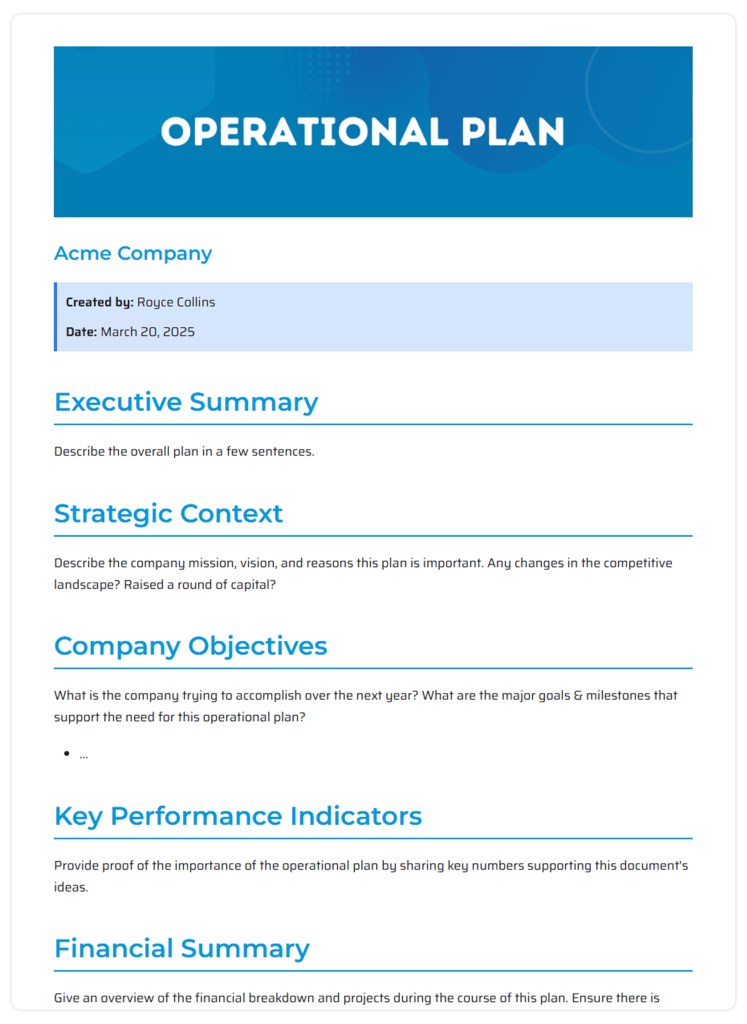
FREE TEMPLATE
The Operational Plan Template That Keeps Teams on Track
Includes objectives, action plans, owners, deadlines, & KPIs.
✔ Pre-built framework
✔ Collaborate in real time
✔ Best for Managers, Operations & Growing Teams
Takes under 1 minute • Trusted by teams at startups & enterprises
Best Practices for Creating an Operational Plan
When you begin building an operational plan, it is tempting to focus only on listing tasks and deadlines. But most teams eventually realize that the real value of an operational plan comes from how clearly it guides daily work. A well-structured plan should help your team understand priorities, responsibilities, and how progress will be measured.
Keeping a few practical principles in mind can help you create operational plans that stay useful long after they are written.
Align Operations with Strategic Goals
Your operational plan should always support the larger goals of your organization. When your team clearly sees how daily activities connect to revenue growth, customer satisfaction, or operational efficiency, work becomes more purposeful and aligned.
If that connection is missing, operational plans may end up being just lists of tasks with no relation to the overall objectives. Clearly showing how strategy translates into daily work enables your team to focus more on results than just on the activities.
Operations work best when they’re driven by strategy
See how strategic planning sets the direction that operational plans bring to life →
Define Clear Ownership
One reason operational plans do not work is that people are not sure who is in charge. When tasks are listed without a person responsible, people think someone else will do them, and important work gets missed.
Assigning a clear point of contact to every project ensures accountability. When each task has a person assigned, your team can track progress more effectively and fix problems more quickly.
Clear ownership also makes it easier for departments to work together. When waiting for updates or approvals, teams know exactly who to talk to and who is responsible for moving the work forward.
Use Measurable KPIs
To keep your plan on track, set indicators that show if your work is getting results. You can use metrics like how much you produce, sales growth, how fast you respond, customer retention, or conversion rates.
These metrics help you see how you’re doing and find areas that need fixing before issues become big problems. They objectively measure progress.
You can then identify areas that need improvement.
Review and Adjust Regularly
Operational plans should never remain static. As your organization grows, priorities shift and new challenges appear. If your team continues following an outdated plan, even well-designed processes can become inefficient.
Regular reviews help you evaluate what is working and what needs improvement. By revisiting your operational plan periodically, you can update priorities, refine workflows, and ensure that your team’s efforts stay aligned with current business goals.
These practices help transform an operational plan from a simple document into a practical system your team can rely on every day.
Bonus: Create and Manage Operational Plans with Bit.ai
At some point, you notice something odd about operational plans. Planning alone is usually not the hardest part. The real challenge arises when the plan is scattered across different locations, for example, in a spreadsheet of KPIs. A document for strategy. Slack messages with updates. Email threads with revisions. Suddenly, the operational plan that was meant to create clarity becomes scattered across tools.
This is where teams often struggle. When operational information is spread across different systems, keeping everyone aligned becomes harder. Updates get missed, documentation becomes outdated, and people start working from different versions of the same plan.
What you eventually realize is that operational planning is not just about writing the plan. It is about managing it as living documentation that teams can access, update, and collaborate on continuously.
This is where a dedicated documentation workspace like Bit.ai becomes useful.
Bit.ai is an AI-powered docs, wikis, and knowledge management platform built for teams to create, organize, collaborate, and manage knowledge in one unified workspace.
Instead of storing operational plans across separate files and tools, you can create a centralized document where your team builds, maintains, and updates the plan together. Everyone involved in operations, management, or project execution can access the same source of truth.
Watch this quick walkthrough to understand how to use this operational plan effectively.
How Bit.ai Supports Operational Planning
Creating an operational plan is easier when your documents, team, and supporting resources are all in one place. Bit.ai helps teams plan, document, collaborate, and share operational plans without juggling multiple tools.
Here are some of the Bit.ai features that support operational planning:
- AI Genius Writer – Generate structured drafts, refine content, and speed up operational planning documentation.
- Organized Workspaces – Keep operational plans, SOPs, reports, and related documents organized in one place.
- Rich Media Embeds – Add spreadsheets, dashboards, charts, and other supporting resources directly into your documents.
- Real-Time Collaboration – Work with managers and team members simultaneously in a single shared document.
- Smart Document Sharing – Share documents securely through live links, PDF, and embeds while ensuring everyone always has access to the latest version.
Using the right tools can make operational planning more efficient, but avoiding common mistakes is just as important. Let’s look at the most common pitfalls that can reduce the effectiveness of an operational plan and how to avoid them.
Common Mistakes in Operational Planning
The best operational plans can go wrong if you make some basic mistakes. Here are the problems businesses often face when planning.
Lack of Clear Objectives
Many operational plans fail because goals are too vague or not measurable. Without clear targets, teams cannot track progress effectively.
No Assigned Ownership
When responsibilities are not clearly defined, tasks often get delayed or ignored because no one feels accountable.
Missing or Weak KPIs
Without measurable performance indicators, it becomes impossible to evaluate whether the plan is working.
Overly Complex Planning
Some operational plans include too many unnecessary details, making them difficult for teams to follow in day-to-day execution.
No Regular Review Process
Operational plans are often treated as static documents, but they need regular updates to stay aligned with business priorities.
Avoiding these mistakes helps ensure your operational plan stays practical, actionable, and aligned with real business outcomes.
Wrapping Up
At some point, every organization realizes the same thing. Strategy only works when it turns into clear daily actions.
An operational plan helps you do exactly that. It connects business goals with practical steps, assigns responsibility, and gives your team a way to measure progress along the way.
The examples in this guide show how operational plans can take different forms depending on the industry, team structure, and business priorities. What matters most is the clarity they create for your team’s daily work.
If you want to understand the full process of building one from the ground up, you can explore our detailed guide on creating an operational plan, which walks through the structure, steps, and template you can use to build your own plan.
FAQs
How do you write an operational plan for a business?
Start by defining your main objective. Then outline the key activities required to achieve it, assign responsibilities, set timelines, and select the KPIs to measure progress.
What is an example of an operational plan?
A restaurant’s operational plan may assign staff schedules, manage inventory, monitor service quality, and track daily sales against targets.
What are the main elements of an effective operational plan?
An effective operational plan usually includes the objective, key operational activities, responsible teams, a timeline for execution, and measurable KPIs.
How does an operational plan differ from a business plan?
A business plan focuses on overall strategy and long-term direction, while an operational plan explains the daily actions and processes used to execute that strategy.
About Our Editorial Team
Our Editorial Team researches, writes, and reviews every article to help ensure it is accurate, practical, and up to date. To learn more about our editorial standards, content review process, and official social media profiles, visit our Editorial Team page.
Why Trust This Article?
The information in this article is based on reputable and authoritative sources. We review our content periodically to keep it accurate and up to date.