A client shouldn’t have to repeat goals, budget, and brand voice they’ve already shared with your agency. Yet, that’s exactly what happens when information gets lost between teams. When a client is handed over to new team member, it can come with unspoken concerns for an agency owner. It’s the fear of lost information, miscommunication, and ultimately, a client feeling neglected or having to explain their needs all over again.
This is a failed client handoff. A client handoff is the process of transferring a client’s goals, context, and ongoing work from one team member to another without disrupting the client’s experience. A strong client handoff process for agencies covers every point where work changes hands: sales to onboarding, strategy to execution, and one account manager to the next.
Each of these points shows the client how organized your agency is. So, ready to learn how agencies can make client handoffs feel effortless? Let’s dive in.
What Is a Client Handoff in an Agency?
A client handoff in an agency is the transfer of a client’s account, context, and responsibilities from one person or team to another. The outgoing person writes down what the new member needs to know about the client. The new member reads it and continues the work, so the client does not repeat anything and they do not notice any service change.
What Are the Different Types of Client Handoffs?
Agencies manage four types of client handoffs. Each involves different people, requires different information, and comes with its own set of challenges.
- Sales to onboarding: The salesperson passes a new client to the onboarding or delivery team. The salesperson knows what was promised to the client, so the delivery team needs that information before the kickoff call.
- Strategy to execution: The strategist hands an approved plan to the designers, writers, or developers who will carry it out. The executors need to know the reasoning behind each decision, not only the task list.
- Account manager changes: One account manager takes over from another because of a promotion, a resignation, or a workload change. The client has an existing relationship with the first person, so the new manager must know the account history.
- Project to retainer or offboarding: A finished project either moves into an ongoing retainer or ends. In both cases, the agency must transfer files, access, and results in an organized way.

Wondering what a client onboarding process should include?
Explore how to organize client information, documents, and responsibilities in one workspace →
The table below shows the main risk for each client handoff type and what the outgoing person should document.
| Handoff type | Main risk | What to document |
| Sales to onboarding | Promises made in sales do not reach the delivery team | Goals, budget, promised deliverables, timeline, decision-makers |
| Strategy to execution | Executors miss the reasoning behind the plan | Approved strategy, target audience, brand voice, success metrics |
| Account manager change | The client repeats past conversations to the new manager | Communication history, open requests, client preferences, past issues |
| Project to retainer or offboarding | Files, logins, and results are lost or left unclear | Final deliverables, account access, performance results, next steps |
All four handoffs share one requirement, i.e., the information must be written down and stored in a workspace where the incoming person can find it.
Why Do Client Handoffs Fail?
Client handoffs often fail because agencies focus on transferring tasks rather than transferring knowledge. The new team member has to spend time figuring things out details about the client instead of moving the project forward. So, here are some common reasons why client handoffs become difficult for agencies.
- Incomplete Client Information: Important details, such as client expectations, project goals, brand guidelines, previous feedback, and communication preferences, are often missing from handoff documents.
- Scattered Documents and Project Information: When project briefs, meeting notes, client conversations, and deliverables are spread across different tools, the incoming team struggles to find the information they need.
- Poor Communication Between Teams: A lack of communication between outgoing and incoming team members can lead to missed updates, overlooked client requests, and confusion about project progress.
- Unclear Roles and Responsibilities: When task ownership, deadlines, and pending deliverables are not clearly assigned, important work can fall through the cracks.
- Clients Have to Repeat Information: Without proper knowledge transfer, clients may have to explain their requirements, share previous feedback, or clarify decisions all over again.
Every client transition comes with its own set of details to manage, from sharing project updates to making sure the new team understands client expectations. Let’s look at seven practical steps agencies can take to make client handoffs smoother and ensure nothing important gets missed.
Keep project details, decisions, and responsibilities organized:
How to Hand Off a Client in 7 Steps
When a client moves to a new account manager or team, the last thing they want is to explain their requirements all over again or chase people for project updates. The new team should be able to pick up where the previous one left off. These seven steps will help agencies make that transition easier.
Step 1: Build a single source of truth
A single source of truth is one shared document that holds everything the agency knows about a client. Every team member reads from it and writes to it, so no one depends on another person’s memory.
The document should contain:
- Goals: what the client wants to achieve and by when
- Stakeholders: who approves work, who gives feedback, and who controls the budget
- Brand voice and preferences: tone, communication style, and topics to avoid
- Past decisions: what the agency tried, what worked, and what the client rejected
- Sales promises: every commitment made before the contract was signed
- Risks: known concerns, such as a stakeholder who changes requirements late
Store the document in one digital workspace tool, such as Bit.ai or Notion, or your project management software. Do not split it across email threads, chat messages, and personal notes. If a new team member cannot find the document in under two minutes, the storage system needs to change.
Step 2: Use a standardized client handoff checklist
A client handoff checklist helps agencies follow the same process every time a client moves to a new account manager or team. Instead of relying on memory, the outgoing team can use it to make sure all important information is ready before the transition.
A well-prepared client handoff checklist should include:
- Project scope and deliverables
- Timeline and the next three deadlines
- Budget and billing status
- Logins, account access, and tool permissions
- Client contacts and their roles
- Open questions and pending client requests
- Risks and known sensitivities

Need a more structured way to manage client transitions? Explore these ready-to-use templates to organize handoff details, transfer responsibilities, and keep important information accessible:
Step 3: Assign one client handoff owner
Every client handoff should have one person responsible for overseeing the entire transition. This person makes sure the client information is complete, the handoff checklist is followed, and the new team knows what to do next.
The handoff owner has three duties:
- Gather the information: Collect the notes, files, and access details from the outgoing person.
- Brief the incoming person: Make sure the incoming person has read the record and the checklist.
- Confirm with the client: Tell the client who their new contact is, what will change, and what will stay the same.
Avoid assigning handoff responsibilities to the entire team without naming one accountable person. When the whole team is responsible, no single person is accountable, and each member assumes someone else handled it.
Step 4: Run an internal handoff meeting first
An internal handoff meeting is a short briefing between the outgoing and incoming team members, held before the client meets the new person. It gives the new person a chance to ask questions without the client watching them work.
Keep the meeting focused and cover these four areas:
- Account context (5 minutes). The outgoing person explains the client’s goals, history, and current status.
- Client personality and preferences (5 minutes). Cover how the client likes to communicate, who makes decisions, and which topics need care.
- Quick wins and open risks (5 minutes). Name one task the incoming person can finish in week one to show progress. Then list the issues most likely to cause problems.
- Questions (5 minutes). The incoming person asks about anything unclear in the record or the checklist.
Record the key discussion points or prepare a short meeting summary afterward. Save it alongside the client handoff documents so the information remains accessible to the team.
Want to prevent important knowledge from getting lost during transitions?
Step 5: Introduce the new team member to the client
Once the internal handoff is complete, introduce the new account manager to the client through a joint call or email. Make the introduction personal and reassuring so the client feels confident about the transition.
During the introduction:
- Briefly introduce the new account manager and their experience.
- Revisit the client’s goals and current project status to show that the team understands their needs.
- Explain how communication and ongoing work will continue.
- Share a simple 30-day action plan with upcoming tasks, deadlines, and the first check-in date.
Step 6: Communicate proactively with the client
Proactive communication means telling the client about changes before the client asks. During a handoff, the client has three questions: what is changing, what is staying the same, and who do I contact now? Send a clear transition email explaining the account manager change, ongoing responsibilities, project timelines, and the new point of contact.
Include these details in your introduction email or follow-up message:
- What is changing: Introduce the new account manager and explain their role.
- What is staying the same: Your reporting schedule, your strategy, and your delivery dates.
- Who to contact: Share the new point of contact and their contact details.
Clear and timely communication helps reduce client uncertainty, avoid confusion, and maintain trust throughout the handoff.
Want to collaborate with clients without losing document control?
Explore ways to share files, manage access, and track updates →
Step 7: Close the Loop and measure handoff success
A client handoff doesn’t end when the new account manager takes over. Agencies need to check whether the transition went smoothly and identify what can be improved next time.
Do three things after the handoff:
- Check in with the client after 2 to 4 weeks: Ask one direct question: “How has the transition been for you?” Also ask if anything was unclear or repeated.
- Hold an internal review: Spend 15 minutes with the outgoing owner, the incoming person, and the handoff owner. List what went well and what slipped.
- Update the checklist and client record: Add each missed item to the checklist, so the next handoff covers it.
You can also track a few metrics to measure the success of your client handoff process:
- Client satisfaction score after the transition (a 1 to 5 rating works)
- Time to first deliverable from the new team
- Repeat-question rate, which is the number of questions the client had to answer a second time
These measures help agencies identify handoff gaps, improve team coordination, and create a more consistent client experience.
What Should Be Included in a Client Handoff Document?
A client handoff document should give the incoming team member everything they need to continue working so that they never have to ask the client for information the agency already has.
Here are the key details every agency should include in a client handoff document:
| Section | Question it answers | What to write |
| Client overview | Who is this client? | Company name, industry, size, and the date the relationship started |
| Goals and success metrics | What does the client want? | Primary goal, target numbers, and the deadline for each |
| Scope and deliverables | What did we agree to do? | Services included, deliverables, and anything excluded from the contract |
| Timeline | What is due and when? | The next three deadlines with dates and owners |
| Budget and billing | What is the financial status? | Contract value, billing schedule, unpaid invoices, and approved extra costs |
| Access and tools | What can the new person log in to? | Accounts, permissions, and who to contact for missing access |
| Contacts and preferences | Who do we talk to, and how? | Each stakeholder’s name, role, and preferred communication method |
| Open items and risks | What could go wrong? | Pending requests, unresolved issues, and known client sensitivities |
Client Handoff Examples by Agency Type
Here are some practical client handoff examples across different agency types.
| Agency Type | Client Handoff Might Include |
| Marketing agency | Campaign assets, strategy, performance reports, content calendar, recommendations |
| Branding agency | Brand guidelines, logo files, visual assets, typography, usage instructions |
| Web/design agency | Final designs, specifications, assets, documentation, maintenance guidance |
| SEO agency | SEO strategy, keyword research, reports, content recommendations, next steps |
| Consulting agency | Final report, research, recommendations, decision documents, implementation guidance |
| Creative agency | Final creative files, source assets where applicable, usage guidance, campaign documentation |
No matter what type of agency you run, make sure the next person has everything they need to take over without confusion. This becomes much easier when client documents, project updates, and team conversations are all in one place.
A centralized workspace like Bit.ai can make this easier by giving everyone access to the information they need. Here’s how Bit.ai can help agencies manage client handoffs more effectively.
How Can Bit.ai Help With Client Handoffs?
Managing client handoffs becomes difficult when information is spread across emails, shared drives, and different project tools.
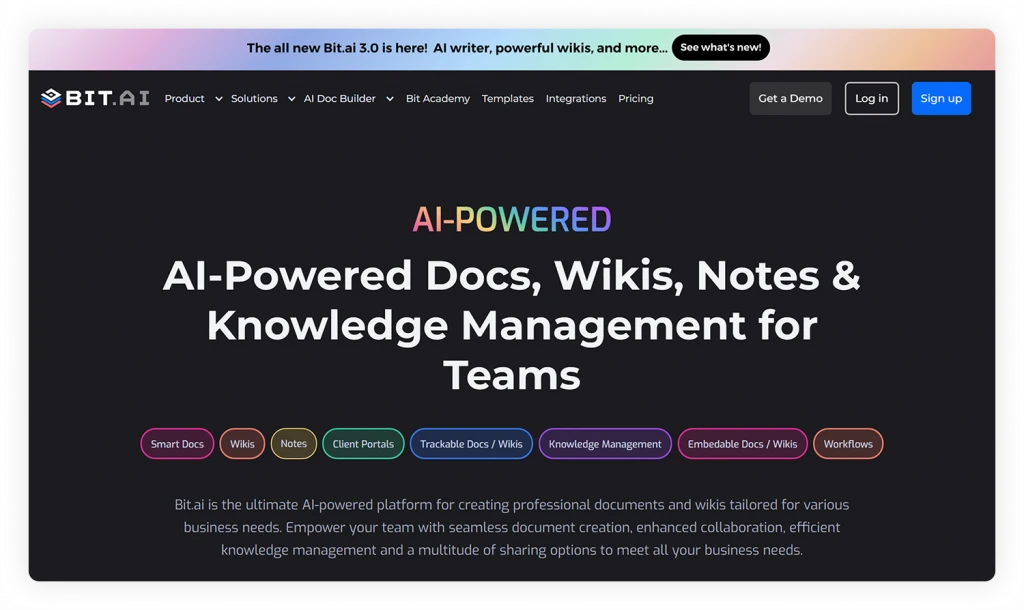
Bit.ai is an AI-powered document collaboration and knowledge management platform that helps agencies create, organize, manage, and share client handoff information from one workspace.
This is how agencies can use Bit.ai to simplify client handoffs:
🔹 Create Dedicated Client Workspaces: Set up separate workspaces for each client to organize project briefs, meeting notes, contracts, reports, and other important documents. Use folders, wikis, and subpages to keep client information structured and easy to navigate.
🔹 Standardize Client Handoff Documentation: Use ready-made templates like documentation handoff, transition plan to create consistent client handoff documents. Add sections for client expectations, project scope, and team responsibilities so important details aren’t missed during transitions.
🔹 Collaborate With Team Members: Use real-time editing, comments, and @mentions to discuss project updates, clarify responsibilities, and coordinate handoff activities. This helps everyone stay informed during the client transition.
🔹 Find Project Information With Smart Search: Quickly locate client documents, project updates, and important information across workspaces. This saves time when the team needs to review previous discussions or find specific details during a handoff.
🔹 Share Client Handoff Documents Securely: Share handoff documents with internal teams or clients through live links. Use access permissions, password protection, and link expiration to control document access and keep sensitive project information protected.
🔹 Use AI Genius to Prepare Handoff Documents: Draft, rewrite, and summarize client handoff documentation with Bit.ai’s AI Genius. Teams can use it to summarize meeting notes, organize project updates, and prepare initial drafts of transition documents.
With Bit.ai, agencies can bring client documentation, project knowledge, and team collaboration together in one workspace, making it easier to transfer accounts and maintain continuity.
Want to give clients one place to access documents, updates, and deliverables?
Best Practices for a Smooth Client Handoff
Here are some best practices to make every client transition easier:
- Start preparing client handoff documents well before the transition.
- Keep client records, project updates, and important decisions up to date.
- Use standardized client handoff templates across all accounts.
- Assign one person to oversee the entire client handoff process.
- Schedule knowledge transfer meetings to discuss project history and expectations.
- Introduce the new account manager before transferring client responsibilities.
- Store client documents and project resources in one centralized workspace.
- Follow up with clients to collect feedback and identify gaps in the handoff process.
- Review and improve your client handoff checklist after every transition.
Final Thought: Make Your Next Client Handoff Easier
A successful client handoff depends on three essentials:
- A written client record: Keep all client details, project updates, expectations, and pending tasks documented.
- One named handoff owner: Assign one person to oversee the transition and ensure nothing gets missed.
- Clear client communication: Inform clients about the changes, introduce the new account manager, and explain the next steps.
Because the best handoff is the one the client never notices. The client does not repeat information, does not wonder who to contact, and does not see the work change hands.
Now go and make your next client handoff smoother with clear documentation, organized information, and better team coordination!
Frequently Asked Questions About Client Handoffs
Q1. What is the difference between client onboarding and client handoff?
- Client onboarding introduces a new client to an agency’s services, processes, team, and workflows.
- A client handoff transfers an existing client relationship, project information, and responsibilities between team members, departments, or organizations.
Both processes aim to create a smooth client experience, but they occur at different stages of the client relationship.
Q2. How can agencies standardize their client handoff process?
Agencies can standardize client handoffs by creating reusable templates, checklists, documentation guidelines, and clear responsibility assignments. Using a centralized knowledge management platform like Bit.ai also helps teams organize client information, share updates, and follow the same handoff process across different accounts.
Q3. Who is responsible for managing client handoffs in an agency?
The outgoing account manager or project manager is responsible for preparing the client handoff. However, the incoming account manager, department leads, and other relevant team members should participate in the process to ensure all important information is transferred and responsibilities are clearly assigned.
Q4. How do you measure the success of a client handoff?
A client handoff is successful when the new team can manage the account without confusion or delays. Check client satisfaction, task completion, information transfer, and how smoothly the project continues.
Q5. How can agencies prevent clients from getting overwhelmed during a handoff?
Agencies should inform clients about the transition early and introduce the new account manager. A clear client handoff checklist, regular updates, and one point of contact help reduce confusion and maintain client trust.
Struggling to keep client information organized during team transitions?
Book a demo to see how Bit.ai helps agencies centralize documentation and simplify client handoffs.