Work today is more complex than ever before.
Teams are spread across time zones. Projects overlap, tasks keep growing, and many companies use too many tools at once. Everyone seems to be busy, yet somehow, the most important things still slip through the cracks.
Well, that’s not a people problem. That’s a work management problem.
Effective work management is the backbone of any high-performing team. It’s what separates organizations that consistently deliver results from those that are always procrastinating. It doesn’t matter whether you’re managing a five-person startup or a hundred-person enterprise team, getting work management right is one of the highest-leverage things you can do.
In this guide, we’ll break down what work management actually means, why it matters, the most common challenges teams face, and the best ways to improve how work gets done.
What Is Work Management?
Work management is the process of planning, organizing, executing, and tracking all the work happening within a team or organization. Work management ensures that the right work gets done by the right people at the right time.
Here are the key components of work management in teams:
- Planning: Defining goals, breaking them into actionable work, and aligning priorities
- Delegation: Assigning the right tasks to the right people based on skills and capacity
- Execution: The actual doing of work with clear processes and minimal friction
- Tracking: Monitoring progress, identifying bottlenecks, and adjusting in real time
- Collaboration: Keeping everyone aligned through clear communication and shared context
- Documentation: Capturing decisions, processes, and knowledge so nothing is lost
Work Management vs Project Management vs Task Management
These three terms are often used interchangeably, but they solve different problems.
| Work Management | Project Management | Task Management |
| Oversees all ongoing work across teams | Focuses on delivering a specific project | Focuses on completing individual tasks |
| Includes planning, collaboration, documentation, and resource allocation | Includes timelines, milestones, budgets, and deliverables | Includes assigning, tracking, and completing daily work |
| Continuous business operations | Temporary initiatives with defined start and end dates | Day-to-day execution |
Think of it this way:
- Task management helps individuals stay organized.
- Project management helps teams complete a project successfully.
- Work management brings everything together by helping organizations manage people, processes, projects, knowledge, and priorities in one connected system.
Because of this broader scope, modern organizations increasingly adopt work management practices rather than relying solely on project management.
Now, let’s look at why work management matters so much for modern teams and organizations.
Why Work Management Matters for Teams and Organizations
Poor work management is expensive and not just in terms of money. It costs time, energy, morale, and trust.
When work management breaks down, here’s what happens:
- Deadlines get missed because priorities weren’t clear
- Duplicate work gets done because teams aren’t communicating
- High performers burn out because workloads aren’t distributed fairly
- Leaders lose visibility into what’s actually happening
- Institutional knowledge walks out the door when people leave
On the flip side, when work management is strong, the impact is immediate and measurable. Teams move faster, stress goes down, and quality of work improves, not because people work harder, but because they work smarter.
According to research from Asana, knowledge workers spend nearly 60% of their time on “work about work”, activities like searching for information, switching between apps, chasing updates, and attending unnecessary meetings instead of doing meaningful work.
This is why effective work management matters so much today. It reduces chaos, improves visibility, and helps teams focus on high-impact work instead of administrative overload.
So, if you want to build a more productive, organized, and efficient team, it’s important to understand the core principles behind effective work management. Read on!
5 Core Principles of Effective Work Management
Strong work management is built on a few simple but important principles. When teams follow these consistently, work becomes more organized, efficient, and easier to manage.
Here are five core principles of effective work management:
1. Set Clear Goals and Align Work to Business Outcomes
Every piece of work that was assigned to a team member should connect to a larger purpose. When team members understand why that work matters for the organization, they make better decisions, prioritize tasks more effectively, and stay motivated even when things get hard.
For this, you can use frameworks like OKRs (Objectives and Key Results) or KPIs (Key Performance Indicators) to ensure that individual and team work is directly tied to organizational goals.
2. Define Ownership and Accountability
When responsibilities are unclear, work falls through the cracks, not because anyone is lazy or careless, but because no one feels responsible for any particular task.
The RACI model (Responsible, Accountable, Consulted, Informed) is a useful framework for clarifying roles on any project or workflow. But even without a formal framework, the principle is simple: every piece of work should have one person who owns it.
3. Manage Workload and Team Capacity
One of the most common work management failures is overloading high performers with work while underutilizing others. Over time, this leads to stress, burnout, and lower productivity.
So, good work management means balancing workloads, understanding team capacity, and adjusting priorities when needed.

Want to master workload management?
Explore workload management process, importance, and best practices →
4. Create Visibility Across Teams
Teams perform better when everyone has visibility into projects, deadlines, and progress. Clear communication reduces misunderstandings and helps teams collaborate more effectively.
Visibility builds trust, reduces status-update meetings, and helps people make better decision. But you should note down that visibility doesn’t mean micromanagement. It means creating systems where progress is transparent by default.
5. Build Processes That Scale
Ad hoc approaches work for small teams in early stages. But as teams grow, managing work informally becomes difficult. Creating clear and repeatable processes helps teams work more consistently and efficiently.
Documented workflows for tasks like onboarding, project management, approvals, or content creation save time and make scaling easier over time.
Now, we’ll discuss the practical strategies to improve work management that help teams stay productive, organized, and focused in day-to-day work.
Proven Work Management Strategies to Improve Team Productivity
Let’s explore some proven work management strategies to help teams and organizations work more efficiently.
1. Use Agile and Kanban Frameworks to Organize Work Better
Agile and Kanban are popular work management methods that help teams stay organized and flexible.
It involves: breaking work into small, manageable chunks; visualizing it on a board; and moving it through stages from “To Do” to “In Progress” to “Done.”
This approach makes teams understand priorities, stay focused, and track work more easily.
2. Prioritize Important Tasks First
Not all work is equally important. Using simple prioritization methods can help teams decide where to spend their time and energy more effectively. So, here are a few tips that can help you complete important tasks first:
- Separate urgent tasks from important tasks
- Classifies work as Must-have, Should-have, Could-have, or Won’t-have
- Evaluate tasks based on Impact, Confidence, and Ease to prioritize work that delivers the highest value with the least effort.
Need better ways to prioritize tasks and focus on high-impact work?
3. Hold Regular Team Check-ins
Consistent communication with the teams is the heartbeat of effective work management. So, hold short daily standups, weekly team syncs, and monthly check-ins to share updates, discuss challenges, and adjust plans quickly.
But keep in mind to keep these regular check-in meetings time-boxed like a 15-minute daily standup, should not become a 45-minute status meeting.
4. Protect Time for Focused Work
Constant interruptions and switching between tasks can lower productivity. Giving employees uninterrupted time to focus on important work helps improve both speed and quality.
Many teams now use time-blocking strategy, where specific hours are reserved for deep work without meetings or distractions. Now, it’s high time for you too to start implementing in your team also!!
5. Build a Culture of Transparency and Psychological Safety
None of the above strategies work if team members don’t feel safe sharing honest progress updates, raising concerns early, or admitting when they’re overwhelmed.
Work management is ultimately a human system, and it functions best when people feel trusted, valued, and safe to communicate openly. So, creating a culture of transparency and open communication helps teams solve issues faster and collaborate more effectively.
6. Use AI and Automation to Save Time
AI tools are making work management faster and smarter. Teams can use AI to summarize meetings, organize information, create reports, automate repetitive tasks, and improve project planning.
As AI continues to transform the way teams work, many businesses are now adopting AI-powered platforms to improve collaboration and manage work more efficiently. One such tool helping modern teams simplify work management is Bit.ai.
Let’s now explore how Bit.ai helps modern teams simplify work management, improve collaboration, and boost productivity with AI-powered features.
How Bit.ai Transforms Work Management for Modern Teams
Among the many tools available to support work management, Bit.ai stands out for its ability to bring documents, knowledge, and collaboration into a single, connected workspace.
Bit.ai is an AI-powered docs, wikis and knowledge management platform that helps teams organize information, collaborate in real time, and manage work more efficiently.
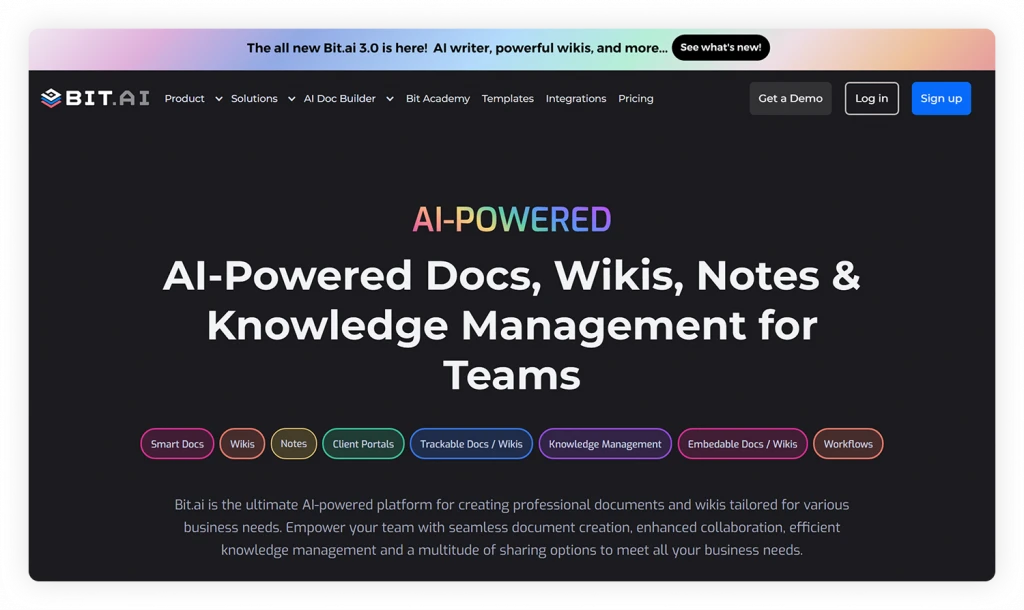
Here are some AI-powered features of Bit.ai that help modern teams simplify work management, improve collaboration, and stay more organized.
Centralize Team Knowledge with Workspaces and Wikis
One of the biggest work management challenges is scattered, siloed information. Bit.ai solves this by letting teams create structured workspaces for different teams, projects, or clients and build wikis that organize all relevant knowledge in one accessible place.
This means onboarding docs, SOPs, project briefs, meeting notes, and process guides all live together in organized spaces.
Create Smarter Documents That Go Beyond Static Text
Bit.ai’s smart documents allow teams to embed rich content like videos, spreadsheets, code snippets, design files, and more, directly into a document. And right inside your docs, you’ll get Bit’s AI Writer that helps teams create content faster and with less effort. It can also improve writing, summarize long information, fix grammar, and help teams turn rough ideas into clear and professional documents.
And the most important thing, you’ll get AI Doc Builder where you are going to get ready-made prompts to create docs in minutes. Just reply to 2-3 questions, and your doc will be ready to use.
Collaborate in Real Time with Your Team
Bit.ai provides real-time collaboration, meaning multiple team members can work on the same document simultaneously with inline comments and everyone can see the latest version of the doc in real time.
Track and Share Documents with Intelligent Sharing Features
Bit.ai makes document sharing simple and secure with live links, trackable links, website embeds, password-protected files, and export documents as PDFs for easy external sharing.
Pricing: Bit.ai offers a free plan, with paid plans starting around $8 per user per month and business plans around $15 per user per month.
Now, let’s explore some best practices to improve the workflow for your team.
Want to turn your workflows into repeatable processes?
Best Practices to Continuously Improve Your Work Management System
Work management is not a one-time setup. It’s an ongoing practice that needs to evolve as your team grows and your work changes. Here are some tips that you can keep in mind to improve your work management systems.
1. Conduct Regular Workflow Audits
Every quarter, review how your team is working. Identify processes that have become outdated, tools that are underused, and bottlenecks that have emerged. Small inefficiencies compound over time and catching them early prevents bigger problems later.
Looking for smarter ways to streamline workflows and eliminate bottlenecks?
2. Gather Team Feedback and Work on it
The people doing the work have the best insight into what’s working and what isn’t. Create regular channels for honest feedback like retrospectives, anonymous surveys, or open office hours and act on what you hear.
Teams that feel heard are more engaged, more accountable, and more willing to invest in improving how they work together.
3. Measure What Matters
Define the metrics that indicate your work management system is healthy:
- Cycle time: How long does it take to complete a typical piece of work?
- On-time delivery rate: What percentage of work is completed by the deadline?
- Meeting load: How much of the team’s time is spent in meetings vs. doing work?
- Documentation coverage: Are key processes documented and accessible?
Review these metrics regularly and use them to guide improvements.
4. Embrace a Culture of Continuous Improvement
The best work management systems are built by teams that are humble about their process and committed to making it better over time. This means normalizing conversations about how you work, and treating process improvement as a first-class responsibility, not an afterthought.
And by following these things, you can genuinely build an effective work management system for your team.
Best Practices Checklist for Effective Work Management
Use this checklist to evaluate whether your current work management system supports productivity and collaboration.
✓ Goals are clearly defined and prioritized.
✓ Every task has an assigned owner.
✓ Teams have visibility into ongoing work.
✓ Processes are documented and easy to access.
✓ Knowledge is stored in a centralized location.
✓ Progress is reviewed regularly.
✓ Feedback is captured and documented.
✓ Workloads are balanced across team members.
✓ AI and automation reduce repetitive work.
✓ Continuous improvements are made based on team feedback.
If you answered “no” to several of these points, it’s a good indication that your work management process could benefit from additional structure and documentation.
Conclusion: Build a Work Management System That Actually Works
Work management is not about managing tasks but rather clarifying things for the people.
When priorities can be seen, responsibility are obvious, and all things are linked, work stops feeling like a burden. People don’t have to keep asking for updates, managers don’t have to step into every detail, and progress doesn’t depend on constant reminders.
So, simply put, effective work management makes hard work yield results. Once hard work yields results, teams cease to feel that they are overloaded with work.
And when effort turns into results, you stop feeling busy and start feeling in control of your work.
FAQs
How to improve management skills in the workplace?
You can get better at managing teams by doing things such as setting clear priorities, communicating your expectations clearly, listening to your team members, and regularly reviewing what is working and what is not. Effective management is based on being consistent, empathetic, and having the ability to lead people with clarity rather than control.
What is the difference between work management and workflow management?
Work management is the broader practice of planning, organizing, executing, tracking, and improving work across an organization. Workflow management focuses specifically on designing and optimizing the sequence of tasks required to complete a particular process. In other words, workflow management is one component of an effective work management strategy.
What are common work management challenges?
Common challenges include unclear priorities, weak ownership, scattered communication, tool overload, and lack of visibility into progress. These issues usually come from missing structure rather than lack of effort.
Why is work management important for teams?
Work management is a great way to keep teams on the same page, help them regularly achieve the set goal, and keep everything organized. It helps to clarifying doubts, promoting teamwork, and making certain that the hard work leads to the results.
What tools are popularly used for work management?
Work management tools generally come with the features where one can easily manage tasks documents communication, and collaboration altogether. The best ones are those that create less hassle and enable teams to work clearly rather than in a complicated way.
About Our Editorial Team
Our Editorial Team researches, writes, and reviews every article to help ensure it is accurate, practical, and up to date. To learn more about our editorial standards, content review process, and official social media profiles, visit our Editorial Team page.
Why Trust This Article?
The information in this article is based on reputable and authoritative sources. We review our content periodically to keep it accurate and up to date.