Have you ever searched for a simple answer at work and ended up opening ten different files, chats, and emails instead?
That feeling is frustrating. And it happens more often than it should.
Every organization creates knowledge every single day — through policies, processes, decisions, training materials, and project learnings. But when this knowledge is scattered everywhere, it stops helping people. It starts slowing them down.
A knowledge base changes that.
It gives your information one clear home. A place where anyone on your team can go, search for what they need, and actually find it — without depending on someone else or digging through endless folders.
In this guide, you will learn everything about knowledge bases — what they are, the different types, the benefits they bring, and exactly how to build one for your team. You will also find real examples and learn how platforms like Bit.ai make the entire process simpler and smarter.
Let’s start from the beginning.
What is a Knowledge Base?
A knowledge base is basically a single location where an organization’s most valuable information is kept, well-organized, and made easily accessible.
Imagine it as a clever online library for your team.
Rather than having important pieces of info scattered among emails, chat messages, random folders, and people’s memories, a knowledge base gathers everything into a neat, searchable environment. Guides, policies, FAQs, onboarding materials, process papers, troubleshooting steps, all of them reside in one spot.
However, a great knowledge base accomplishes much more than just keeping information.
It links information. One article backs up another. Each update is a step forward. Gradually, your knowledge base becomes a living entity that evolves along with your company, not an old and unused folder.
So, it is quite clear that a knowledge base for teams means fewer repeated questions and quicker decisions. For a new person, it may mean faster onboarding and less dependency on senior staff. For a customer, it may mean instant self-help and better support.
Most importantly, a knowledge base achieves the goal of changing information from something you have to hunt to something you can actually rely on.

PRO TIP
A knowledge base is simply a tool that becomes successful only when users trust it enough to rely on it regularly. If your team is still asking the same questions, it suggests that your knowledge base requires a better structure, not merely more content.
Since you now understand what a knowledge base is, let’s take a look at the various kinds and how each one fulfills a different role.
Type of Knowledge Base
Not all knowledge bases are designed to fulfill the same function. Different teams, users, and objectives demand different types. Grasping these types can assist you in creating the right system for your particular requirements.
These are the primary types of knowledge bases that you should familiarize yourself with.
Internal Knowledge Base
This is the information your team relies on every day.
An internal knowledge base software assists companies in accumulating onboarding manuals, HR regulations, tool guides, and internal workings, all in one place. Employees don’t have to ask various colleagues how something is done; they open the knowledge base and get the answer straight away.
This is one way to shield your organization from the loss of knowledge and simultaneously enable the teams to work autonomously, without having to wait around for answers.

Still answering the same questions again and again?
Create an internal FAQ to give your team quick, consistent answers →
External Knowledge Base
This is the knowledge your customers rely on.
Picture a scenario where a customer attempts to reset their password at midnight. Instead of waiting for support, they go to your help center and discover a well-guided, step-by-step solution that resolves their issue in a few minutes. That’s an external knowledge base at work.
It helps reduce the load on your support team while, at the same time, customers feel empowered and self-reliant.
If this was useful, read this…
Knowledge Sharing Platform vs Knowledge Base: The Key Differences! →
Public vs Private Knowledge Base
A public knowledge base is available to everyone, think product documentation, user guides, community help, etc.
In contrast, a private knowledge base is only for the eyes of selected people. It holds things such as sensitive workflows, company strategies, financial processes, etc., out of public reach but accessible to the right team members.
Both serve different purposes, but both protect and organize knowledge in their own ways.
Progress Knowledge Base
This is where the information on growth is kept.
Your team, after each project, writes down the things that went well, those that did not, and their overall impression. These insights slowly develop into a progressive knowledge base. Instead of making the same errors again, your team is always learning and improving.
Different types of knowledge bases play different roles. But when combined, they form a system in which knowledge is not lost, only becomes stronger.
Now that you know the different kinds, let us look at internal vs external knowledge bases side by side so that you can figure out what your organization actually needs.
Benefits of Using a Knowledge Base
A knowledge base is more than just a store of content. It’s a method of simplifying, speeding up, and calming down work for each and every person. Check out the advantages that really matter.
1. Instant Access to Answers
You do not want a person to have a question and await a reply, right? A knowledge base allows individuals to search and find answers immediately; they are not even dependent on a coworker or sending a message and waiting. It eliminates the pauses that are not necessary and keeps the workflow smooth throughout the day.
Eventually, people give up asking others for the simplest data. They rely on the system. This raises their feeling of self-assurance, self-reliance, and velocity in work every day.
2. Greater Team Productivity
Each time someone is asked the same question, it is like breaking their thoughts into pieces. Explaining each time also wastes the time that could be used for actual work.
In this way, a knowledge base cuts down the number of interruptions that people experience by granting them the information first of all. When your team is not stopped by stopping for clarifications that they are longing for, then they are able to dedicate their attention to the work that is of real significance. The productivity is enhanced not because individuals work harder, but because they are finally free to work without being interrupted.
3. Same Processes and Decisions
If there is no knowledge base, the person will continue following his or her own way as to how things should be done. This causes the customers to get mixed up, make errors, and get different types of results from the team.
Content is created one time only and then followed by all members of the team, if you have a knowledge base. It leads to the feeling of the team being on the same wavelength in making decisions. Results become predictable. The quality remains high, and it is easier to achieve that even if the team size changes considerably.
4. Stronger Knowledge Retention
Usually, when people leave, they take a lot of their knowledge with them.
With a knowledge base, however, their expertise is recorded and can be used in the future. New employees don’t need to completely reinvent the wheel; instead, they can get their hands on everything the team has discovered over time, which not only makes onboarding quicker but also more enjoyable each time.
5. Better Customer Experience
Customers demand prompt responses. They don’t want to be kept waiting for support to answer even the most straightforward questions.
A knowledge base allows them to address issues independently, wherever and whenever they want. When customers are effortlessly supported, trust naturally grows. And as trust grows, so do the duration of relationships.
So, apart from enhancing your internal processes, a knowledge base changes the way both your team and your customers interact with work on a daily basis.
Since you have learned about the perks, it’s time we dive into what actually makes a knowledge base effective.
Knowledge Base Examples
In many cases, a knowledge base is easier to comprehend if you know how actual organizations are using it. Large and small companies have developed well-structured knowledge bases that assist their teams and customers in locating information quickly and with confidence.
Here are three famous examples of knowledge bases, which, in different ways, demonstrate what an excellent knowledge base is and can be.
1. Google Help Center
The Google Help Center can be considered one of the most popular knowledge bases in the world, as it helps millions of users who heavily depend on products such as Gmail, Google Drive, and Google Photos on a daily basis.
Instead of making users reach out to customer support for every minor issue, Google has categorized its documentation into three main areas: account management, troubleshooting, and product features. In each article, a single issue is tackled, and detailed steps for its resolution are given in the clearest possible language.
Key takeaway:
An efficient knowledge base should make the answers both easy to locate and to understand. Having distinct categories and using plain language will substantially decrease the volume of support requests.
2. Shopify Help Center
The comprehensive knowledge base offered by Shopify enables entrepreneurs to create and operate their online stores without hesitation.
The help center of Shopify guides you through the entire process of setting up a store, handling payments, arranging shipping, and resolving technical issues in a simple, technical language that is perfect not only for beginners but also for experienced users who wish not to be overwhelmed.
Besides selling and technical problems solving functions, Shopify’s knowledge base has also tutorials and frequently asked questions which users can use to learn the platform step by step, that is not only to fix problems but to grow their skills as well.
Key takeaway:
Besides simply addressing problems, a knowledge base must also help users get more out of their product over time.
You might also enjoy reading this:
How to Build an Effective Knowledge Base for Technical Support? →
3. Stripe Developer Documentation
Many developers reckon the docs of Stripe as the prime example of a technical KB. Stripe, being a payment platform for software products, needs top-notch documentation since developers must have very precise and detailed guidance on how to incorporate the respective tools properly. The docs, inter alia, offer step-by-step tutorials, sample code as well as straightforward elucidations, which make even complicated integrations seem quite doable.
The pieces fit together nicely, starting with the elementary notions, gradually going to the more difficult topics, so that the developers do not ever get the feeling of being lost or bewildered as to the direction to take.
Key takeaway:
A knowledge base should help users to accomplish complex paths taking them through rounds. It is possible to make even technical in-depth information a piece of cake with the right framework and straightforward writing.
The examples illustrate that knowledge bases, depending on the way they are put together, can positively influence a range of different activities, such as helping the customers with issue troubleshooting and, at the same time, delivering the developers the means to learn about complex integrations.
In fact, the underlying intention remains unchanged. The knowledge base ought to simplify the locating, understanding, and applying of the information.
Having looked at knowledge bases in big organizations, coming up next is a step-by-step guide on how to build a knowledge base for your team.
How to Create a Knowledge Base Step-by-Step
Deciding on a tool is not what kick-starts creating a knowledge base. It ignites with the need for clarity.
Lots of teams jump on the bandwagon of trying out free knowledge base software even before reflecting on what exactly their knowledge base should achieve. Most teams make this mistake, in fact. You have to figure out what exactly you are creating, and why, before you get to the point of choosing a platform.
Let me explain to you how to do it simply, effectively, and with no hassle at all.
Step 1: Define Your Purpose and Audience
The first thing to do is to identify the target audience of your knowledge base and the main functions you expect.
Is it aimed at your team members or at users? Will it serve as a staff training resource, a help center for customers, or an operations handbook? The answers to these questions are very simple but they set the stage for everything, such as the layout, the language, the content type, and even the software that you will end up selecting.
Eventually, a knowledge base that does not have a clearly defined purpose will deteriorate into just another cluttered storage space that no one will ever utilize.
Step 2: Plan Your Structure
When you think about your knowledge base, think categories, rather than pages.
Divide the topics into sets of related content, such as new employee training, rules, workstations, procedures, and help manuals. This way, users get the idea right away about what sort of information each part holds and where they should turn to when they want to find something.
Even the average writer can’t beat a properly laid-out blueprint at saving time and effort. When your users can find their way around your collection of knowledge without getting confused, that is when they will actually start using it.
Step 3: Create Simple and Useful Content
One of the best ways to write is to imagine that you are explaining a concept to somebody completely unfamiliar with the topic. You should use straightforward language, keep paragraphs short, and provide practical steps and examples. This way, you can avoid using difficult words and industry terms. Ideally, every piece should address one main question in a clear and comprehensive manner.
The aim is to be clear rather than impressive.
Step 4: Review, Improve, and Update Regularly
A knowledge base is never complete since it is always a work in progress.
Once you change your processes or your team discovers new things, you should update, fix, and enhance content on a regular basis. Not only does it keep your data reliable, but it also avoids having obsolete information cause errors unnoticed.
It is more beneficial to have a knowledge base that is being updated regularly than a perfect-looking one that is stale.
Step 5: Encourage Team Contribution
Don’t give everything to one person.
Ask your entire team to participate by adding, suggesting, and enhancing content. When knowledge is not the property of a single individual, it spreads more quickly and remains accurate for a longer period. The more people contribute, the richer and more dependable your knowledge base will become over time.
Building a knowledge base your team can rely on?
Use Bit.ai’s AI prompts to organize company knowledge, document product information, and create helpful articles that make answers easier to find.
Now that you understand the principles of a knowledge base, it’d be great to discover the best platform to support your team’s efforts in this matter.
Meanwhile, Bit.ai could be the perfect support to your team’s knowledge management efforts.
How Bit.ai assists teams in creating a Knowledge Base
One thing is to build a knowledge base. However, keeping it organized, updated, and making sure it stays useful over time are the areas where teams usually fail.
The issue is not that teams stop caring. It is that little by little, the information again starts to be disseminated through different tools. Documents get scattered. Articles become old, and nobody knows which version of the guide is the correct one. And in a short time, the knowledge base becomes just a place where information is lost.
What teams really need is a single connected workspace where documentation, collaboration, updates, and structure co-exist, and do so without having to constantly rebuild everything from scratch.
This is precisely the purpose for which Bit.ai was developed.
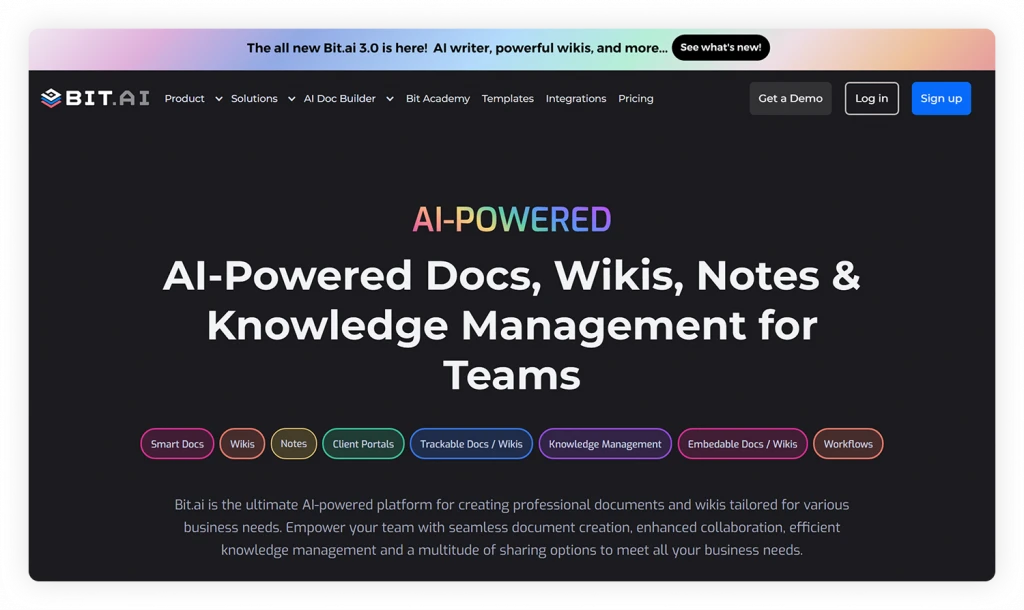
Bit.ai is a docs, wikis, and knowledge management platform powered by AI that enables teams to create, organize, collaborate, and manage their knowledge in a single unified workspace. Rather than switching between different tools, all your team’s necessities will be in one intelligent and structured place.
Here is why Bit.ai makes building and managing a knowledge base both easier.
Real-Time Collaboration
Knowledge is very seldom created by a single individual.
One person writes the first version, another one edits it, and there might be someone else who updates it later on. Bit.ai integrates that entire process into the document itself. Team members have the ability to make comments, propose changes, and update information, all without transferring the conversations to separate email threads or chat messages.
Feedback remains tied to the relevant content, so your team is always aware of what is being discussed and the reasons behind it.
Version History You Can Trust
Processes change, and so teams learn new things, and documentation gets updated. Bit.ai has a built-in version history that tracks every change you make. You will be able to tell when changes occurred and by whom. This way, your team will always be aware that they are working on the most up-to-date and reliable information rather than an outdated version that was simply forgotten to be updated.
Organized Workspaces and Structure
When your knowledge base grows, organizing it will become even more important than the content itself.
Bit.ai adopts workspaces, folders, and structured categories, which enable teams to organize knowledge by department, project, or topic. HR policies, onboarding guides, product documentation, and process playbooks are all housed within clearly structured spaces; these spaces are not only easy to find but also easy to navigate and maintain. Bit also makes it easy for you to convert any document into a wiki. This is a smart way to organize connected information around the same topic.
There is no need for wandering around asking for links or endlessly browsing through folders.
AI Genius Writer for Faster Documentation
Creating documentation is sometimes the most boring and the slowest part of putting together a knowledge base.
Bit.ai offers you an AI Genius Writer, an AI-powered assistant that helps your teams to draft new content, summarize long documents, rewrite sections for clarity, and improve existing articles. Since it works right inside your workspace, your team can create and refine knowledge base content without switching between tools or breaking the flow.
When documentation, collaboration, organization, and AI assistance all work together in one place, maintaining a knowledge base becomes a task your team can actually keep up with without it feeling like a second job. Your knowledge base stops being a collection of static documents. It becomes a living system that your whole team can rely on every single day.
Now, let’s wrap everything up in the conclusion.
Conclusion
Every company generates knowledge on an ongoing basis. The main point is whether that knowledge is being archived and leveraged, or it just slowly disappears without being noticed.
When there is no knowledge base, information relies on people’s memories, random messaging, and filing systems that are all over the place. Major procedures get overlooked. The newly hired don’t know what to do. The customers have to wait too long before getting the answers to their simple questions.
Implementing a knowledge base flips the entire scenario around.
You and your colleagues cut down on rehashing the same queries. New hires accelerate their learning curve. Customers self-serve their queries. And everyone, from the youngest intern to the highest-ranking officer, operates using the same straightforward, trustworthy information.
A knowledge base not only archives what you know but also safeguards what you have established and ensures that nothing of value is ever lost again.
Besides, with any software like Bit.ai, it is a great opportunity for you to build and maintain such a database that will cater to your needs more than ever. From the highly organized working areas to real-time engagement and AI-based writing help, Bit.ai equips your team with everything they require to make such a knowledge base that truly performs and improves over time.
Therefore, if your team is still relying on random files and repeated questions, it is about time to do something about it.
Build your knowledge base.
FAQs
Q1. What are the types of knowledge bases?
There are four main types of knowledge bases: internal, external, public or private, and progress knowledge bases. An internal knowledge base is where a company keeps its employee-related processes and policies. External knowledge bases are made for customers and typically contain product help and support content. A public knowledge base is available to everyone, whereas a private one is only accessible to specific team members. Progress knowledge bases document the experiences and lessons learned from previous projects, thus assisting team development over time.
Q2. What are the benefits of a knowledge base?
Having a knowledge base makes your team more productive, cuts down on the number of questions that are asked over and over again, helps new employees get up to speed more quickly, saves important knowledge in the company, and allows customers to find solutions themselves. It is essentially a single, dependable source of information that everyone on your team relies on daily.
Q3. What are some examples of knowledge base tools?
A few widely recognized examples of knowledge base tools are Bit.ai, Notion, Confluence, and Guru. Such solutions enable teams to draft, organize, find, and keep documentation accessible with features such as live collaboration, version commenting, rights management, and AI-assisted writing. Bit.ai stands out as it provides a clever, consolidated work environment that simplifies the creation and handling of a knowledge base for any size team.
Q4. What is the difference between an internal and external knowledge base?
Simply put, an internal knowledge base is your team’s resource, storing workflows, policies, manuals, and training documents that staff need to work efficiently. On the other hand, an external knowledge base is your customers’ guidebook; it is filled with product manuals, FAQs, and help documents that enable customers to resolve their issues independently, without reaching out to the support team.