Have you ever wondered what happens to your organization’s most valuable knowledge when the people who created it move on?
Picture this. A senior employee leaves, a key process breaks, and suddenly no one knows why things were done a certain way. Documents exist, but they are scattered. Answers exist, but they live inside emails, chats, and memories. What disappears in that moment is not just information. It is institutional knowledge, often referred to as an organization’s institutional memory.
It is something that you witness daily, though you might not even refer to it by that term. It is the tacit knowledge that accompanies decisions, the practices along which the documents are created, and the experience that is learned through many years of projects. When this knowledge is not captured, organized, and protected, organizations are forced to relearn what they already knew.
This is why securing institutional knowledge has become a business priority rather than an administrative task. Companies nowadays are not simply handling documents. They are keeping work consistent, preserving the reasoning behind decisions, and making sure progress continues even when teams change.
In the sections ahead, you will explore what institutional knowledge actually looks like inside real workplaces, why it becomes vulnerable over time, how structured knowledge management protects it, and how the right systems help teams keep critical knowledge accessible and usable long after it is created.
What is Institutional Knowledge?
You usually don’t notice institutional knowledge when everything is working perfectly. Work is flowing, decisions feel easy, and people seem to be following the instructions without any explanations. You notice when it is not there.
A system fails, a decision is postponed, or someone asks: “How was it done before?” That gap between written instructions and real understanding is where institutional knowledge lives.
Institutional knowledge is the collective understanding your organization builds over time through experience. It includes documentation, but it also goes beyond it. It covers the reasoning behind decisions, lessons learned from past work, and the practical know-how teams develop day to day.
In simple terms, it is your organization’s memory, the context that keeps work consistent even as people and teams change.
Once you understand what institutional knowledge really looks like in day-to-day work, the next question becomes unavoidable: how do organizations actually capture and maintain it in a way that lasts?

Want a More Productive Team?
Learn How Knowledge Sharing in the Workplace Enhances Productivity →
Understanding the Knowledge Management Process
You have probably seen this happen in your own organization. Someone solves a problem after weeks of effort, figures out a smarter way to run a workflow, or learns an important lesson during a project. For a while, everything works better. Then months later, the same problem shows up again because that knowledge never made it beyond the people involved.
This is where most teams struggle. Knowledge is constantly being created through daily work, but without a clear process, it stays personal instead of becoming organizational. Over time, your team starts relying on memory, scattered files, and individual experience rather than shared understanding.
The knowledge management process exists to prevent exactly that. It helps you move knowledge from individual moments of learning into structured assets your entire organization can use. It is not a one-time documentation effort. It is an ongoing cycle that keeps knowledge accurate, accessible, and useful as your organization evolves.
When this process is intentional, knowledge becomes easier to find, easier to trust, and easier to reuse. Without it, even valuable insights slowly disappear into folders, inboxes, and forgotten conversations.
Step 1: Capturing Institutional Knowledge
The first challenge is recognizing where important knowledge actually lives. You will find it in project documents, meeting notes, internal discussions, emails, and most importantly, in the experience of your team members.
You don’t have to record everything. Concentrate on knowledge, which is the basis for decisions and daily work.
Gradually, knowledge capture will be integrated into the workflow, and therefore, great insights will not be lost due to staff changes or project turnover.
Without intentional capture, knowledge rarely disappears all at once. When employees leave, the context behind decisions often leaves with them.
Step 2: Organizing and Structuring Information
Once knowledge is captured, structure determines whether your team will ever use it again.
The use of clear naming conventions, logical hierarchies, tags, and any other orderly practices helps you in quickly locating the information you need at the moment. Structure turns scattered content into usable knowledge that your team can rely on during real work.
You have likely experienced the opposite situation. Documentation exists somewhere, but finding the right version takes longer than recreating it. When an organization fails, teams stop trusting documentation altogether.
Bonus Read:
Top 10 Best Knowledge Management Tools for Smarter Workflows. →
Step 3: Securing and Maintaining Knowledge
As your knowledge base expands, the requirements for protection and reliability become equally significant.
Sensitive information requires controlled access so the right people can use it safely. At the same time, knowledge must stay current. Methods change, new tools come into use, and decisions also change over time. Periodic review helps ensure that outdated information is updated, explained, or archived if it is no longer useful before it causes misunderstanding.
When knowledge is not maintained, it stops supporting your team and starts slowing them down.
Step 4: Sharing and Updating Knowledge
Knowledge becomes truly valuable when your team can actively use and improve it together.
If you can share what’s new, add explanations, and improve the information together, knowledge remains dynamic instead of being just a document. Your company enjoys the benefit of learning overall rather than a few individuals gaining isolated expertise.
As knowledge begins to flow naturally across teams, your organization becomes more resilient to change. Work no longer depends on remembering who knows what, because the knowledge itself remains accessible.
At this point, one realization usually becomes clear. A process alone is not enough. To make knowledge management consistent and scalable, you need systems that support these behaviors as part of everyday work.
How Knowledge Management Systems Help Preserve Institutional Knowledge
You usually notice the problem first, not the solution. A project stalls because no one can find the latest process. A decision gets delayed because no one remembers what was done last time. The answer is there somewhere, but you have to dig through folders, chats, or ask around until the right person responds.
At some point, you realize the issue is not a lack of knowledge. It is a lack of visibility.
This is where knowledge management systems start to change how your organization works. Instead of knowledge being spread across tools and people’s memories, everything is brought into one structured, searchable place. Information stops being something your team hunts for and becomes something they can rely on.
When knowledge is centralized and organized, work becomes less dependent on who remembers what. Teams move faster because the context already exists. New employees ramp up more smoothly because knowledge is already available.
Over time, you notice that the main focus of the talk has shifted. People are no longer discussing how to find information but what to do next with it. The system removes bottlenecks your team didn’t even realize were there.
And once that happens, one thing becomes clear. Having a system matters, but it only works if it fits naturally into how your team already works.
Choosing the Right Knowledge Management System
Once you see how much smoother work becomes with organized knowledge, the question changes. You stop asking whether your organization needs a knowledge management system and start asking which one will actually support the way your team works.
This is where many teams run into trouble. Not every productivity tool is designed to preserve institutional knowledge. Some platforms are excellent at storing files. Others focus on tasks or communication. But storing information is not the same as protecting knowledge. When the system isn’t built for long-term clarity, you often end up adding another layer of clutter rather than solving the problem.
The right system should feel less like separate software and more like a natural extension of how your organization learns, documents, and improves over time.
If a platform fits a company’s existing workflow, the employees will start using it effortlessly as it supports the work they are already doing.
Features to Look For in an Institutional Knowledge Management System
As you evaluate options, certain capabilities make a noticeable difference in how well knowledge survives and stays useful.
Structured Documentation Support
Your team must have the capacity to generate and systematize knowledge in a manner that is clear and consistent. Structure transforms disorganized information into step-by-step instructions that people can easily understand and follow. Without it, documentation quickly becomes noise.
Advanced Search and Filtering
Search should do more than match keywords. You should be able to locate knowledge based on context, categories, and relevance, so answers appear when your team needs them, not after long searching.
Real Time Collaboration
Institutional knowledge grows when people build it together. It is necessary for your team to have the capability to contribute, edit, and update the information together without any interruption to the work. Collaboration is a guarantee that the knowledge represents actual practice and not just instructions that have become outdated.
Tired of Information Chaos? Know this..
How to Improve Information Management for Teams and Businesses →
Version History and Change Tracking
Knowledge evolves alongside your organization. A dependable system records the changes made, the time they were made, and keeps older versions if necessary. This context helps the teams to grasp the explanation of the decisions and not just see the end results.
Security and Compliance Considerations
As your knowledge base grows, trust becomes essential. Institutional knowledge often includes operational details, internal strategies, and sensitive information. Access controls and permission settings ensure the right people can contribute while sensitive content remains protected.
When your team trusts the system, they use it consistently. And consistent use is what keeps knowledge accurate and alive.
Scalability for Growing Organizations
What works for a small team rarely works the same way at scale. As your organization grows, so does the volume and complexity of knowledge. A system that cannot scale forces teams to eventually resort to fragmented tools and workarounds.
Scalability ensures your knowledge base grows with you instead of becoming another system you eventually outgrow.

PRO TIP
Test any knowledge management platform using your real internal content rather than sample data. Real workflows quickly reveal whether the system can handle your organization’s actual complexity.
Choosing the right system is rarely about checking feature boxes alone. It is about ensuring long term knowledge stability and usability for your team. Once that clarity forms, it becomes easier to recognize how certain platforms naturally align with institutional knowledge management needs.
Bit.ai for Institutional Knowledge Management
At some point, you realize that good intentions alone are not enough to preserve institutional knowledge. Your team might be willing to document processes and share learning, but if there is no right environment, knowledge gradually goes back to being scattered in files and private conversations. The system you choose ultimately determines whether knowledge stays organized or fades over time.
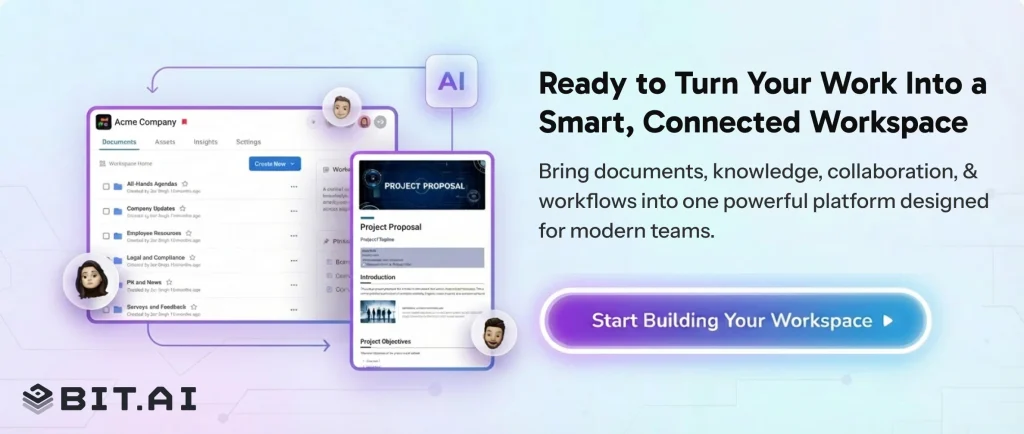
Bit.ai is an AI-powered docs, wikis, and knowledge management platform built for teams to create, organize, collaborate, and manage knowledge in one unified workspace.
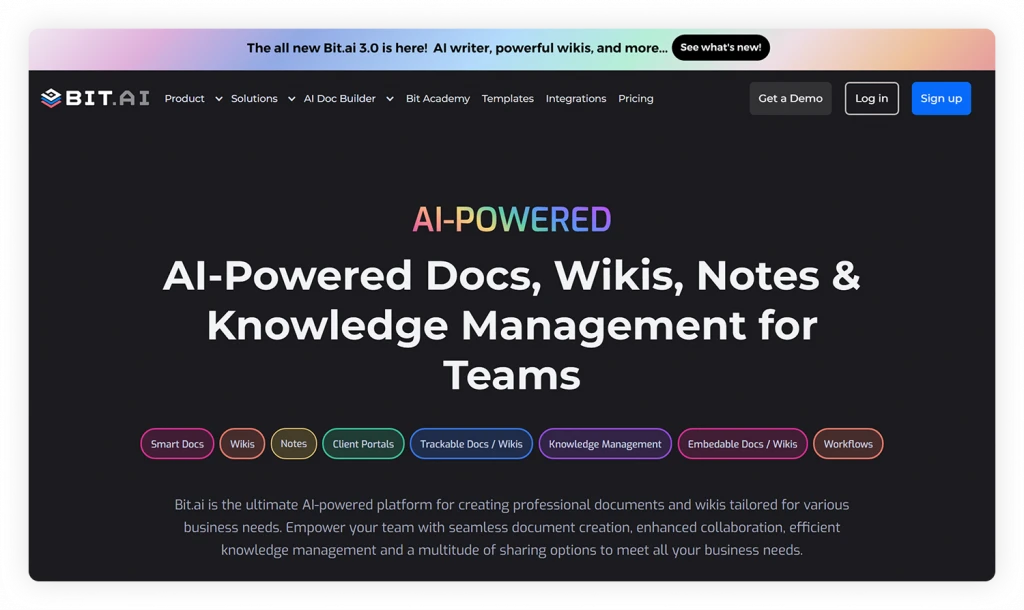
It supports the way teams naturally work by bringing documentation, collaboration, and knowledge organization into a single structured environment.
Instead of treating documents as isolated files, Bit.ai helps you treat them as living knowledge assets that evolve alongside your organization.
How Bit.ai Supports Institutional Knowledge Retention
When your knowledge lives in shared, structured workspaces, it becomes easier for your team to contribute, update, and maintain information as work progresses. Bit.ai allows you to centralize institutional knowledge so that the vital information will not be dependent on individual employees or be scattered across various tools.
Your team is able to work together simultaneously, improve documents continually, and keep the knowledge up to date without having to start over with the processes every time.
Over time, this shifts knowledge ownership from individuals to the organization itself, which strengthens continuity during team changes or growth.
Through a mix of collaborative documentation and AI support, Bit.ai not only helps in knowledge capture but also helps in knowledge maintenance, helping the information stay relevant instead of getting old.
Key Capabilities of Bit.ai for Knowledge Management
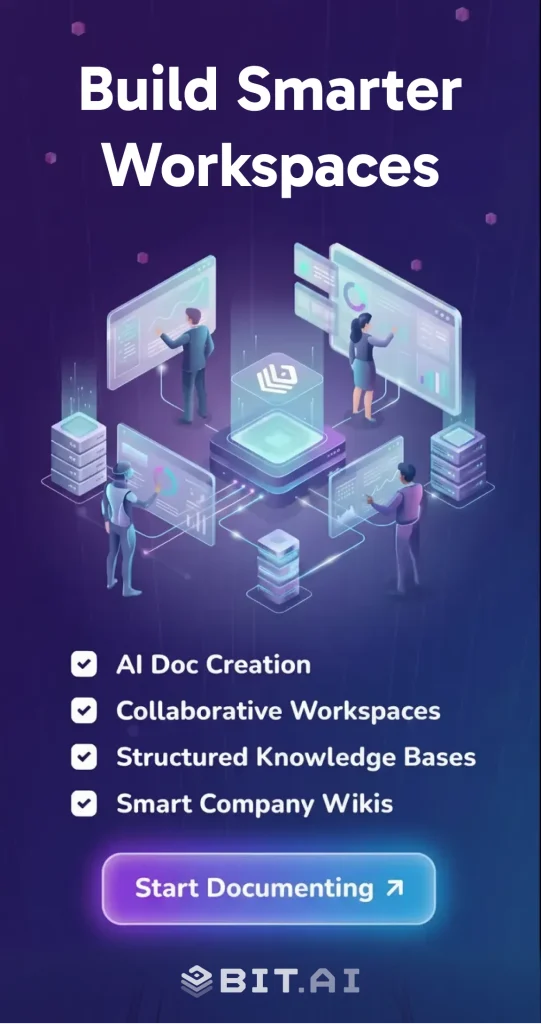
Bit.ai supports institutional knowledge through practical capabilities that align with everyday workflows:
- Collaborative Documents and Wikis: You can create shared documents and internal wikis that teams update collectively, allowing knowledge to evolve as processes and decisions change.
- Smart Workspaces: Workspaces help you organize knowledge by department, project, or function while keeping everything connected within a unified system.
- Version History and Change Tracking: Every update is recorded, so your team can easily see how the information has developed and go back to previous versions if necessary.
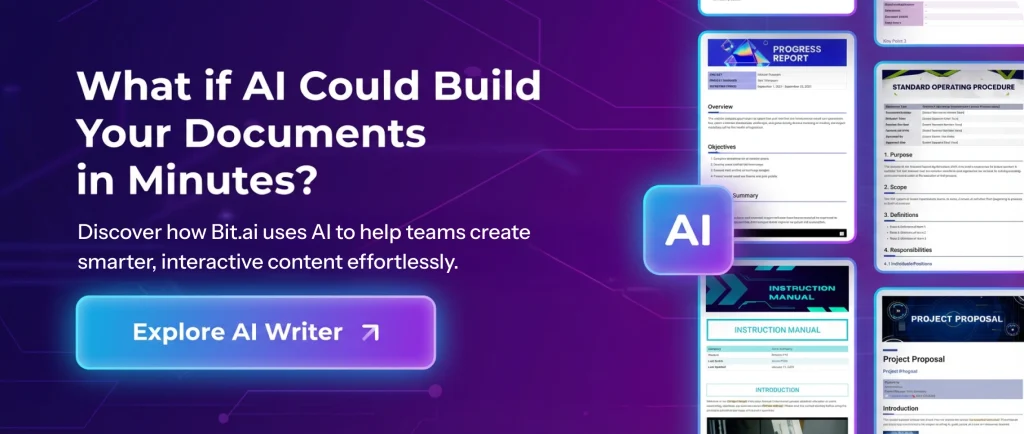
- AI Genius Writer: AI Genius Writer helps your team create, rewrite, summarize, and structure content faster while maintaining consistency across documentation. This supports ongoing knowledge creation without increasing manual effort.
- Search and Navigation: Structured organization, together with intelligent search, enables you to find the information very fast, which means less time is wasted on looking for it, and you have more time to use it.
- Access Control and Permissions: Permission settings allow you to control who can view, edit, or manage knowledge, helping protect sensitive organizational information while maintaining collaboration.
- Multiple Sharing Methods: You can share documents in multiple ways depending on how you want to distribute information. Share secure links, invite collaborators with view or edit permissions, embed documents on websites or portals, or export files for offline sharing when needed.
Pricing: Bit.ai offers flexible plans ranging from a free version for individuals and small teams to paid plans starting at $8/month designed for growing teams, and a business plan at $15/month.
Once your knowledge is supported by a platform built for collaboration and structure, a new question naturally emerges: What are the best practices to secure institutional knowledge? Let’s explore one by one.
Preserving institutional knowledge takes more than storing old documents.
Best Practices to Secure Institutional Knowledge
Securing institutional knowledge is much easier if the process is divided into clear and repeatable actions. The practices suggested here will help knowledge become reliable instead of easily lost.
1. Make Knowledge Capture Part of Daily Work
When documentation is optional, it gets delayed. It goes without saying that when documentation is integrated into the workflows, it becomes a normal thing.
Motivate your teams to write down the decisions, processes, and learnings as a part of the project implementation, not at the project completion.
2. Standardize How Knowledge Is Documented
Use regular formats, naming conventions, and templates. Standardization gets rid of confusion, and it makes knowledge feel familiar to different teams, regardless of who created it.
3. Schedule Regular Knowledge Reviews
You should not let the institutional knowledge become stagnant. It is crucial that you carry out regular audits to update, verify, or delete inaccurate content to maintain trust in your knowledge base, which could otherwise be lost silently due to outdated information.
4. Assign Shared Ownership
Knowledge is not supposed to depend on a single individual. When ownership is spread among contributors and reviewers, there will be continuity even if roles change or teams expand.
Shared responsibility also encourages collaboration, which strengthens the quality and accuracy of institutional knowledge over time.
5. Capture Knowledge During Transitions
Employee departures, position modifications, and project completions are important instances when knowledge transfer occurs. Make it a practice to capture knowledge during these instances.
6. Connect Knowledge to Real Work
Link documentation directly to workflows, tools, and processes. Knowledge that is connected to real tasks actually gets used. On the other hand, knowledge that is separated from the task receives little attention and may be completely neglected.
7. Build a Culture of Knowledge Sharing
Tools can store knowledge, but it is the CULTURE that decides whether the knowledge keeps on growing. Inspire a team environment where ideas are openly shared, reward those who contribute, and incorporate collaboration as one of the criteria by which success is gauged in your team.
When people see knowledge sharing as part of teamwork rather than extra effort, institutional knowledge strengthens continuously.
PRO TIP
You should always connect a knowledge update step with each major project milestone so that the expansion of institutional knowledge happens automatically as the work goes on.
When these practices are followed consistently, institutional knowledge stops feeling like something you might lose and starts becoming a reliable organizational advantage. From here, it becomes easier to step back and recognize how securing knowledge supports long-term stability and growth.
Wrapping Up: Building a Strong Institutional Knowledge Foundation
Institutional knowledge may sound like something focused on preserving the past, but in reality, it is what allows your organization to move forward with confidence.
You notice the difference when it’s missing. Work slows down because context has to be rebuilt. It takes double the time to make decisions when no one knows what was tried before. Instead of being a shared understanding, progress becomes reliant on individuals.
However, if knowledge is structured and easy to reach, it changes the whole picture. Teams move faster because the answers already exist. Decisions become easier because past learning is always available. And transitions feel smoother because knowledge stays with the organization, not with individuals.
Securing institutional knowledge is not a one-time effort. It is an ongoing practice of capturing, organizing, and sharing what your organization learns over time.
And when that foundation is in place, every future decision starts from a stronger position than the last.
FAQs
What is institutional knowledge in an organization?
Institutional knowledge accumulates over a period of time as a result of the processes, documented practices, decisions, and experiences. The institutional knowledge includes both written information and knowledge that has been developed through actual working experience.
What tools help with institutional knowledge retention?
Knowledge management systems, internal wikis, documentation platforms, and collaborative workspaces help organizations capture, organize, and preserve institutional knowledge in a structured and accessible way.
What is the difference between explicit and tacit knowledge?
Explicit knowledge is documented and easily shared, such as manuals and guidelines. Tacit knowledge exists in people’s experience, judgment, and skills, and is harder to document or transfer.
What role does technology play in knowledge retention?
Technology provides the structure, security, and accessibility needed to store, update, and share institutional knowledge consistently across teams and over time.