Have you ever been in a meeting where two teams used the same word, but meant completely different things?
Revenue means one thing to finance, something else to sales. “Customer” means one thing to support, something more technical to analytics. Everyone appears to be aligned, but decisions gradually diverge as the language is not a truly shared one. The issue is not communication. It is clarity.
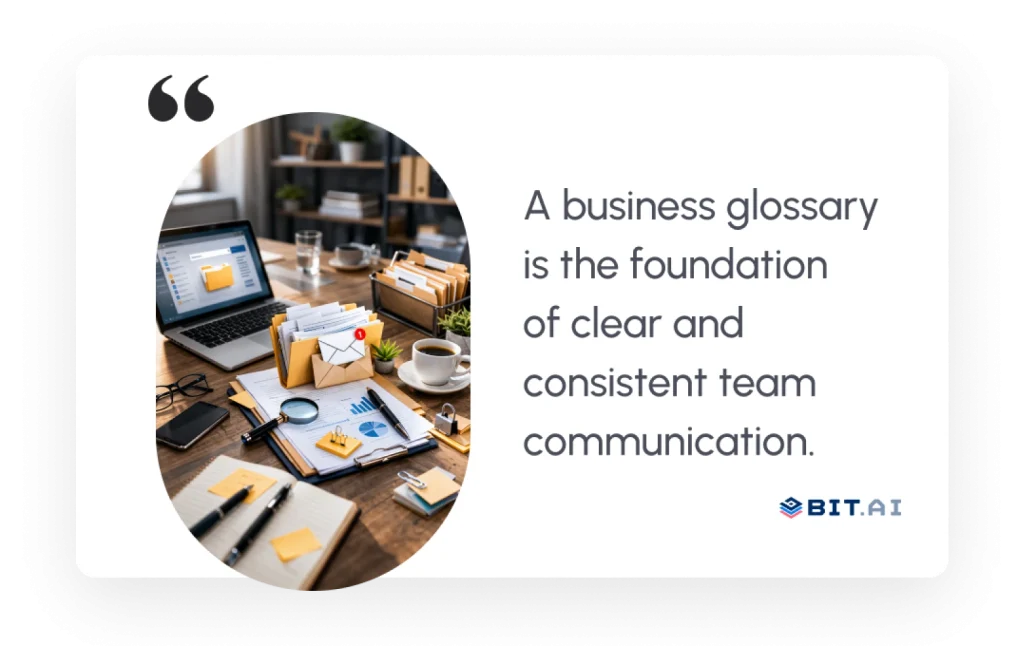
A business glossary solves this problem for teams by providing them with one reliable place to know what the key terms really mean. It reduces confusion, prevents mistakes, and ensures everyone is speaking the same language.

The challenge is not creating a glossary. It is managing it without it turning into another outdated document no one uses.
In this guide, you will see what a business glossary really is, why it matters, how to build one step by step, and how AI-powered platforms like Bit.ai make glossary management effortless by centralizing terms, standardizing definitions, and keeping everything continuously updated.
What is Business Glossary Management?
Every organization has its own language. Expressions, acronyms, indicators, and procedures gradually evolve. The issue arises when those interpretations differ between teams. This is the point where a business glossary comes into play.
Business glossary management is the process of defining, organizing, updating, and governing key business terms so everyone in the organization understands them the same way.
Business Glossary in Simple Terms
A business glossary centralizes all key business terms with their definitions in one place. It details the meaning of the term, its usage, and the context with which it is related. A business glossary, as opposed to simple lists, is organized, uniform, and designed for the whole organization’s understanding.
Business Glossary vs Data Dictionary
A business glossary defines terms in simple language. A data dictionary specifies the technical attributes such as data types, tables, and fields.
Both are necessary, but they are different tools with different functions. The business glossary is a tool for people to stay aligned. The data dictionary is a tool for systems to stay aligned. When they work together, organizations achieve meaningful consistency across data, people, and decisions.
next, let’s understand what are the benefits of a consistent business glossary.

Check this out…
Consistent Business Terms: The Key to Better Team Alignment
When teams use the same words but mean different things, work slows down. Using consistent terms across an organization allows all employees to have a common language. This helps eliminate confusion and promote teamwork. The following is why this is important.
1. Faster and Clearer Communication
When terms are defined and used consistently, conversations become simpler. Teams spend less time explaining what they mean and more time acting on decisions. Meetings become shorter, and messages are easier to understand.
2. Better Decision Making
Leaders rely on reports, dashboards, and updates to make decisions. When business terms are not clear, the whole decision-making process is based on different interpretations. Consistent terminology makes sure all the parties see the same data and come to the same understanding.
3. Smoother Cross-Team Collaboration
Different teams can be collaborating on the same data, yet each team looks at it from its own perspective. A common vocabulary of business terms enables marketing, sales, finance, and operations to be on the same page. As a result, communication barriers are lowered, and conflicts between teams can be avoided.
4. Fewer Errors and Rework
Misunderstood terms often lead to mistakes that need fixing later. Properly defining clear, concise definitions can help minimize mistakes, avoid duplication of effort, and reduce the chance of providing the wrong service or product.
5. Faster Onboarding for New Team Members
New employees struggle when terms are unclear or used differently across teams. A consistent glossary helps them understand how the organization works and contribute faster without constant clarification.
A successful business glossary is a core data management best practice that provides a common reference point for business terms, clear communication, confident decision-making, and better collaboration as teams grow.
Once you understand why a business glossary matters, the next question becomes clear. What happens when organizations do not manage their glossary at all?
Unmanaged Business Glossaries: The Real Problem Teams Face
On the surface, it may seem harmless when teams use slightly different definitions. But over time, these small differences grow into serious misalignment. Reports tell different stories. Meetings turn into clarification sessions. Projects slow down because everyone is trying to make sense of terminology instead of moving forward.
Unmanaged glossary terms do not just create confusion. They quietly create risk.
1. Confusing Terminology Across Teams
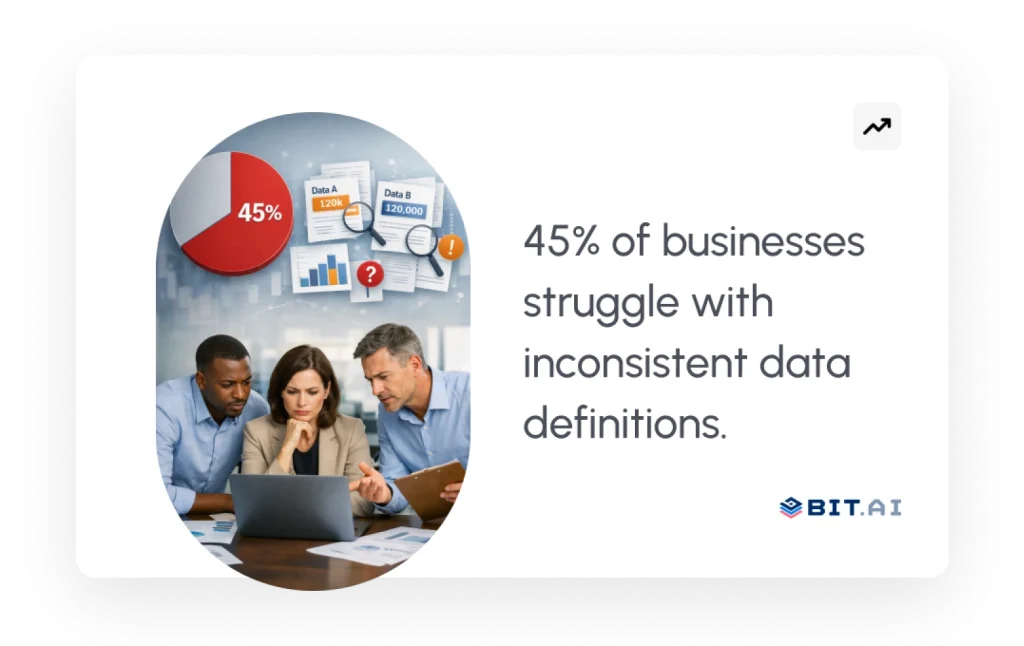
Marketing, finance, product, operations, and analytics often use the same terms but mean completely different things. When definitions remain merely in people’s minds instead of being clearly documented, then miscommunication becomes normal. Teams believe they are on the same page, but in reality, they each operate under different assumptions.
2. Miscommunication That Slows Decision Making
Leaders rely on an accurate, shared understanding to make the right decisions. However, if terminology is not consistent, then even the best data will lose clarity within it. As such, people have to repeatedly stop and clarify what a number or piece of information truly represents. Conversations circle back because everyone does not speak the same language. Progress slows for no real reason except a lack of shared definitions.
3. No Central Source of Truth for Business Terms
Without a managed glossary, knowledge fragments are scattered. Definitions can be found in emails. Some are concealed in documents, presentations, or even the memory of an individual. New employees make assumptions, senior employees interpret, and the company operates on assumptions instead of being aligned. A business glossary is no longer just a “nice to have” reference. It is the very basis of clarity.
The next logical step is understanding what a truly effective business glossary should actually include.
If this was useful, read this…
How to Build and Maintain a Business Glossary Step by Step?
Building a business glossary is not about creating a massive document in one attempt. It is about setting up a clear, usable system that your teams can trust and actually rely on. When the process is simple, the glossary stays relevant. When it stays relevant, it truly supports decision-making.
Here is how you can build it in a practical and sustainable way.
Step 1: Identify and Prioritize Key Business Terms
Start with the terms that cause the most confusion or impact the most critical decisions. These are usually metrics, frequently used business terms, and words that different departments interpret differently. Focusing on important terms first makes the glossary useful right from the beginning.
Add these into your glossary:
Step 2: Standardize Structure, Format, and Naming
Consistency is the key to success. Every glossary term needs to have a definite and obvious pattern. Describe a term by stating the meaning, the area in which the term is used, and any relevant background.
When every entry is of the same appearance and has the same feel, people can comprehend and have confidence in it more quickly.
Step 3: Assign Ownership and Review Responsibility
Every term will need to have an owner responsible for approving the term’s definition, reviewing changes, and maintaining accuracy. This ensures that a glossary is kept up-to-date and will remain credible as an organization grows or changes in status/structure.
Step 4: Keep the Glossary Updated and Easily Accessible
A glossary is not a one-time project. It should evolve as your business evolves. Make it easy to update, easy to search, and easy to access. When teams know the glossary is always current, they will rely on it naturally.
Once you have a clear structure, the real opportunity appears. AI can reduce the effort, speed up creation, and help teams maintain consistency without extra workload. That is where modern AI tools completely change what glossary management feels like.
How AI Tools Transform Business Glossary Management?
Traditionally, business glossary management takes time, coordination, and constant manual effort. Someone has to collect terms, refine definitions, get approvals, and make sure updates never fall behind. AI changes that reality. Instead of glossary management feeling heavy, it becomes faster, smarter, and easier to maintain.
Here is how AI simplifies the entire process.
1. AI-Assisted Term Suggestions and Definitions
AI can identify frequently used business terms, detect inconsistencies, and suggest definitions based on context. Instead of starting from a blank page, your team starts with intelligent recommendations. This speeds up creation and reduces the chances of missing important terminology.

2. Automated Updates Instead of Manual Maintenance
As your company expands, the words you use change. With AI, you can monitor the changes, identify old terms, and change when the definitions no longer correspond to the current usage. Thus, your glossary remains a living one without the need for a continuous manual check.
3. Faster Knowledge Sharing Across Teams
AI-powered glossary solutions make it easy for teams to locate terms, grasp the context quickly, and communicate knowledge in an efficient manner. Rather than digging through folders or looking up files that are spread out, anyone can get the correct definitions right away. As a result, misunderstandings are minimized, and the collaboration is kept at a high level.

With AI handling the heavy work in the background, glossary management becomes easier, more accurate, and far more reliable. And this is exactly where platforms like Bit.ai stand out as a truly centralized and intelligent glossary hub for modern teams.
If this is useful, read this…
Procedural Knowledge: Definition, Benefits & Real-Life Uses! →
Business Glossary Examples: Key Terms to Use
Use the table below as a reference to build a business glossary that keeps your team clear, consistent, and aligned.
| Term | What It Means (Simple Explanation) | Why It Matters in Real Life | Example |
| Revenue | The total money a business earns before expenses | Helps teams understand overall business performance | A company earns $12,000 from sales in a month |
| Profit | The money left after all expenses are deducted | Shows if the business is actually making money | $12,000 revenue – $8,400 costs = $3,600 profit |
| Customer Acquisition Cost (CAC) | The cost to acquire one new customer | Helps marketing and sales control spending | Spending $600 to get 100 customers = $6 CAC |
| Customer Lifetime Value (CLV) | Total revenue a customer brings over time | Helps decide how much to spend on acquiring customers | A user spends $25/year for 3 years = $75 CLV |
| Churn Rate | Percentage of customers who stop using your product | Indicates customer satisfaction and retention issues | 10 out of 100 users leave → 10% churn |
| Conversion Rate | Percentage of users who take a desired action | Measures the effectiveness of marketing or product | 1,000 visitors → 50 signups = 5% conversion |
| ROI (Return on Investment) | The return you get from an investment | Helps evaluate if efforts are worth it | Spend $120 on ads → earn $360 = positive ROI |
| KPI (Key Performance Indicator) | A measurable value used to track success | Keeps teams aligned on what matters most | Monthly revenue, traffic, or signups |
| Workflow | A sequence of tasks to complete a process | Improves efficiency and reduces confusion | Content creation → review → publish |
| Stakeholder | Anyone involved or affected by a project | Ensures proper communication and decision-making | Managers, clients, investors |
| Scalability | Ability to grow without major issues or costs | Important for long-term business growth | A SaaS tool handling 1,000 → 100,000 users easily |
| Onboarding | The process of helping new users or employees get started | Impacts first impressions and retention | Product tutorials for new users |
| Automation | Using technology to perform tasks without manual effort | Saves time and reduces human error | Automated email responses |
| Data Silos | When information is isolated and not shared across teams | Leads to miscommunication and inefficiency | Marketing and sales using separate data |
| Collaboration | Teams working together toward a shared goal | Improves productivity and results | Designers and developers working on a product launch |
Using Bit.ai as a Centralized Business Glossary Hub
For a business glossary to actually work, it must live where teams already do their work. It should be easy to use, easy to update, and easy to trust. If it feels hard to manage, people stop using it.
This is where Bit.ai fits naturally.
It is an AI-powered docs, wikis, and knowledge management system built for teams that want a clear, shared understanding across their work.
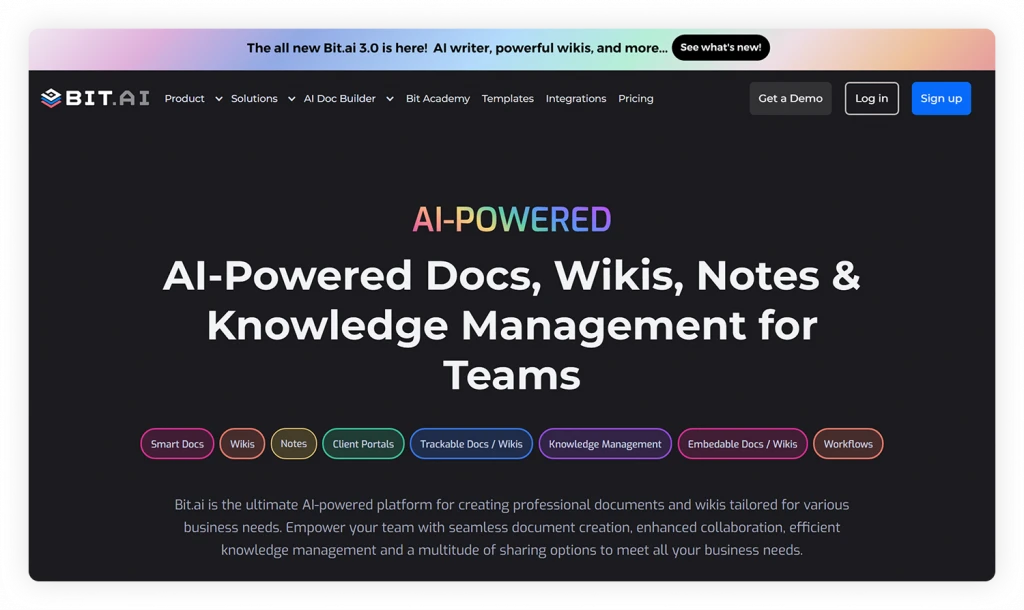
Instead of turning glossary management into extra work, Bit.ai helps you keep all business terms in one simple, shared space that stays useful over time.
1. Centralized Glossary Management in One Workspace
With Bit.ai, teams can store and organize all glossary terms inside a collaborative workspace. Each term lives in a document that can be updated, reviewed, and reused over time.
This helps teams manage definitions without creating duplicate files or outdated versions. Everyone knows where to go to find the correct meaning.
2. AI Genius Writer for Clear Definitions
Writing definitions can be slow when you start with a blank page. AI Genius Writer inside Bit.ai helps by suggesting clear and simple definitions that teams can edit and approve.
You always stay in control. AI only helps you write faster and stay consistent, so everyone understands terms the same way.
3. One Trusted Place for All Business Terms
Your glossary lives in one shared workspace. There are no scattered files and no outdated versions. Everyone sees the same definitions and the most recent updates.
This creates one clear source of truth that teams can rely on every day.
4. Simple Team Collaboration Inside the Glossary
Teams can work together directly inside glossary documents. People can suggest changes, leave comments, and update definitions in one place.
Moreover, the changes are directly linked to the terms; thus, the issues and ideas discussed do not get lost in emails or chat messages.
5. Fast Search and Clear Organization
A glossary only helps if people can find answers quickly. Bit.ai makes it easy to search for terms and understand their meaning in seconds.
Clear structure and simple navigation allow teams to easily locate the information they need, without having to search for the corresponding folders.
6. Shareable Glossary Pages that Stay Updated
Instead of sending static files, Bit.ai lets you share live glossary pages. When a definition changes, everyone sees the update automatically. You can share them as a live link, embed the living document, or wiki them on any website or blog.
This keeps teams aligned without sending new versions or reminders.
When your business glossary lives in Bit.ai, it stops feeling like something you need to maintain. It becomes a helpful system that supports clear communication, shared understanding, and confident decision-making across the organization.
Wrapping Up: Building a Smarter Business Glossary System
When your company is in sync, things just go smoother. Decisions get clearer. Collaboration seems quicker. Miscommunication just fades away. A well-maintained business glossary is more than just a look-up guide. It is the very basis for clarity, trust, and confident decision-making.
AI now makes this far easier than it has ever been. You can create a centralized glossary that is accurate, searchable, and always up to date without the need to manage endless files and manual updates. Your glossary with Bit.ai becomes a living knowledge system enabled by AI Genius Writer, real-time collaboration, and intelligent organization. Teams get a single source of truth. Language remains consistent. Knowledge is in sync.
When managing a glossary feels like a breeze, your company is able to communicate more effectively and work more efficiently.
FAQs
Q1: How to build a business glossary?
Start with the most crucial business terms that confuse and influence key decisions. Clearly define them, standardize the structure for each entry, assign ownership for approvals, and make your glossary accessible and updatable so that teams will actually use it.
Q2: Why is business glossary management important?
Business glossary management ensures everyone in your organization uses the same language with the same meaning. It reduces miscommunication, improves collaboration, strengthens data interpretation, and helps leaders make confident decisions based on shared understanding.
Q3: Which is the most appropriate strategy when preparing a glossary?
The best strategy is to keep it centralized, well-structured, and continuously maintained. Set up explicit formats, designate owners, and be certain that every term has context, use, and is clear. A straightforward, uniform method is always more effective than a complex system.
Q4: How do AI tools make it easier to manage business glossaries?
Using AI tools, it is possible to create glossary terms more rapidly, keep uniformity, request changes, and have the explanations always in agreement with the actual usage. Platforms like Bit.ai make glossary management easier with AI Genius Writer, centralized organization, live collaboration, and always updated glossary pages.