Imagine a world in which all the important answers you need are only a question away. Forget about digging through endless documents, the nightmare of “Who has the latest version?”, and the obstacles to accessing knowledge that make you less efficient at work.
Welcome to the digital world of 2030!
By 2030, artificial intelligence (AI) will make this a reality and transform knowledge managementfrom a static archive to a dynamic knowledge ecosystem, letting teams collaborate smarter, quicker, and more creatively than they ever have.
Let’s take a look at how AI will change knowledge management, why it matters, and what you can do to get ahead of the game.
What is Knowledge Management?
Knowledge management is the process of collecting, organizing, sharing, and using information within a company. It helps teams store important knowledge, documents, ideas, processes, and experiences in one place so everyone can easily access them when needed.
To manage this information effectively, companies use knowledge management systems such as wikis, document libraries, intranets, databases, and shared workspaces. These tools help teams collaborate better and make information easier to find and share across departments.

Explore more in-depth:
However, traditional knowledge management systems often come with challenges such as:
- Disorganized files and folders
- Hundreds of search results with irrelevant information
- Outdated or duplicate content
- Difficulty finding the right information quickly
As businesses continue to generate massive amounts of data and content every day, these traditional KM systems are no longer enough. Employees today need instant access to accurate information without wasting time searching through endless documents and folders.
This is exactly where AI-powered knowledge management is changing the game. By using artificial intelligence, businesses can automate organizational activities, improve search accuracy, personalize information, and make knowledge easier to access than ever before.
So, in the next section, we’re going to explore the major ways AI is expected to transform knowledge management by 2030.
6 Ways AI Will Transform Knowledge Management by 2030
Here are six major ways AI will transform knowledge management and redefine how businesses store, organize, and access information by 2030.
1. Intelligent Search & Semantic Retrieval
Think about the last time you searched for a file or document at work. You probably typed a few keywords, opened multiple links, and still struggled to find the right information. That’s the problem with traditional keyword search: it matches exact words, not the actual meaning behind your search.
But AI-powered search is completely different. It understands what you’re actually trying to find, even if you don’t use the exact right words.
For example, if you type “how do we handle unhappy customers?”, an intelligent search engine won’t just look for those exact words. It will understand that you’re asking about customer complaint processes and show the right policy document, even if it’s titled “Client Escalation Protocol.”
So, by 2030, searching a knowledge base will feel less like Googling and more like asking a knowledgeable colleague. You describe what you need in plain language, and the system figures out the rest.
2. Auto-Documentation & Knowledge Capture
One of the biggest problems in most workplaces is that valuable information often gets lost. Teams have important meetings, make key decisions, and discuss useful ideas, but none of it gets written down. Two months later, nobody remembers why that decision was made or where the information was shared.
This is where AI becomes your silent note-taker, process documenter, and institutional memory, all at once.
Today, AI tools can already:
- Transcribe and summarize meetings automatically
- Detect decisions made in conversations and log them
- Watch how a task gets done and turn it into a step-by-step process document
- Update existing documents when new information comes in
But by 2030, the idea of manually writing internal documentation will feel as outdated as fax machines. Businesses will rely heavily on AI to capture knowledge as it happens: in real time, in the background, without anyone having to stop and document things separately.
They sound similar, but they’re built for different purposes
Here’s how knowledge management and document management compare in the real world→
3. Personalized Knowledge Delivery
Imagine starting your workday and instead of opening five different tools to figure out what’s going on, your knowledge system already knows:
- You’re onboarding a new client this week
- Your team just shipped a product update
- There’s a policy change that affects your role
So it surfaces exactly the documents, updates, and context you need, without you having to ask about anything.
That’s personalized knowledge delivery. AI learns your role, your projects, your habits, and your gaps and proactively brings relevant knowledge to you. So, by 2030, knowledge management systems will feel more like smart assistants that understand what employees need and provide useful information before they even ask for it.
4. Natural Language Interfaces (Conversational KM)
What if instead of browsing through folders and wikis, you could just ask your company’s knowledge base a question and get a direct, accurate answer in seconds?
That’s exactly where we’re heading with AI.
Natural language interfaces let employees talk to their knowledge systems the way they’d talk to a person. You don’t need to know where a document is stored, what it’s called, or which tool it lives in. You just ask:
- “What’s our return policy for enterprise customers?”
- “What did the product team decide about the Q3 launch?”
- “How do I submit a reimbursement request?”
And you get a clear, conversational answer and along with a link to the source if you want to dig deeper.
So, by 2030, most internal knowledge bases will have a conversational AI layer on top of them. This is especially powerful for new employees who don’t yet know where anything is.
Looking for the right knowledge management tool?
5. Knowledge Gap Detection
Here’s a scenario most teams recognize: someone makes a mistake because they followed an outdated process document. Or a new employee spends days trying to figure something out because nobody ever wrote it down. Well, honestly, these aren’t people problems, they’re knowledge gaps.
And in the worst case scenario, you usually don’t know a knowledge gap exists until it causes a problem.
But AI can help solve this by continuously analyzing knowledge systems and identifying issues such as:
- Documents that haven’t been updated in 12+ months
- Topics your team keeps searching for but can’t find answers to
- Questions that keep getting asked repeatedly in chat (a sign something isn’t documented)
- Missing steps in processes based on how work actually gets done
Think of it as a spell-checker, but for your entire knowledge system. It quietly monitors everything and alerts you when something needs attention.
So, by 2030, AI will play a major role in maintaining healthier, more reliable knowledge systems across organizations.
6. Cross-Platform Knowledge Synthesis
Here’s the reality of most modern workplaces: knowledge is everywhere and nowhere at the same time.
Some information lives in emails, some in chat tools, some in project management software, and some inside documents or internal wikis. Meeting summaries get saved in one-off folders that nobody ever opens again.
Finding any info requires knowing which tool it’s in, who created it, and when. But AI will help solve this problem by connecting knowledge across all business tools and bringing everything together in one place. The AI pulls relevant context from wherever it lives: your chat tools, your documents, your emails, your project management software and brings it together in one place.
So, by 2030, the best AI systems won’t just integrate with your everyday tools. It will understand relationships between data, connect relevant insights, and provide employees with a complete picture instead of scattered information.
Now, as AI continues to reshape the future of knowledge management, businesses need platforms that are built to support smarter collaboration, faster access to information, and AI-powered workflows. And that’s where Bit.ai steps in as a smart, modern AI-Powered solution built for this new era of work.
Bit.ai: The Best Platform to Future-Proof Your Knowledge Management
Bit.ai is an AI-powered document collaboration and knowledge management platform built to help teams create, organize, and share knowledge in one central place. Unlike traditional file-storage systems, Bit.ai combines an interactive AI-Powered workspace, structured wiki, and real-time collaboration so that organizations can quickly find and use the information they need as they grow. With built-in collaboration tools and AI-assisted writing, Bit.ai helps teams move from scattered files toward organized, living knowledge.
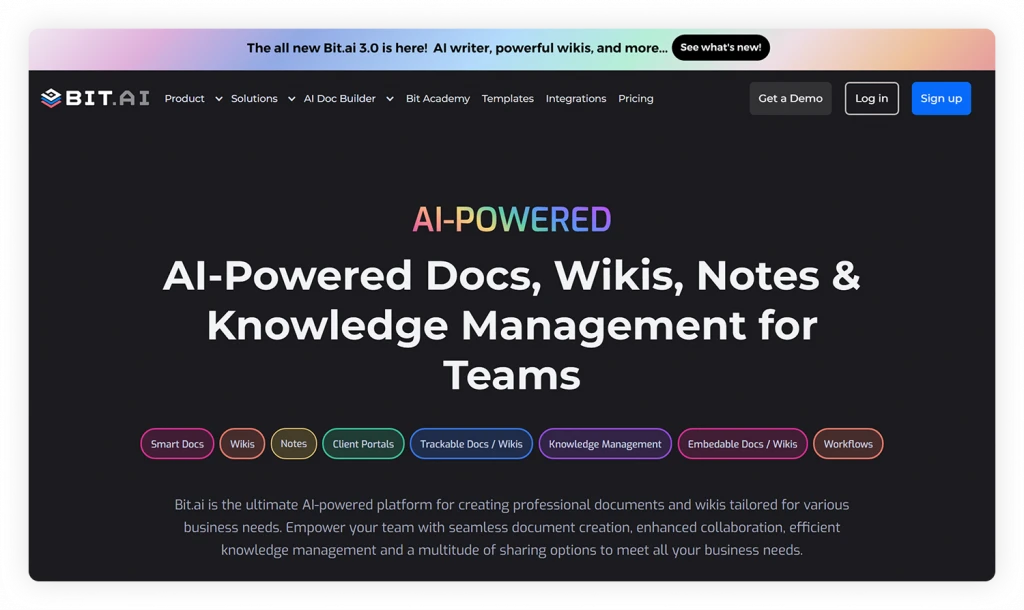
Let’s explore the AI-powered features offered by Bit.ai that can help businesses stay organized, improve collaboration, and future-proof the way teams manage information:
AI-Powered Document Creation
Bit.ai comes with AI-powered documents that help teams create, refine, summarize, and improve content directly inside their workspace with the help of AI Genius Writer. Instead of spending hours manually creating SOPs, meeting notes, process documents, or internal knowledge resources, teams can use AI assistance to generate polished and structured documents much faster.
Bit.ai also offers an AI Doc Builder that helps businesses create professional documents in minutes. Users simply answer a few prompts, and the platform automatically generates ready-to-use documents without starting from scratch.
100+ Rich Media Embeds and Integrations
Work rarely lives in just one tool. With Bit.ai, you can bring content from apps like Google Sheets, Figma, Miro, and many others directly into your document. Instead of switching between tabs, everything stays in one place, giving your team full context without breaking their workflow.
AI-Powered Workspace Organization
Organize your workspace by using folders, subfolders, and several wikis. Instead of employees wasting time searching through multiple tools, they can quickly locate documents, notes, project information, and internal resources from one centralized platform.
Real-time Collaboration
Work on a document simultaneously with your co-editors. You can use @mentions to tag coworkers, put comments right where feedback is needed, and follow changes as they occur.
Advanced Sharing & Client Portals
Sharing documents is very simple and secure. You can send live links, embed documents on websites, or invite guests in a secure manner. Guest access, along with permission control, enables you to decide exactly who can see or edit the content, thus facilitating collaboration not only internally but also with clients.
With these excellent features in place, Bit.ai is showing us how current platforms are changing knowledge management, making it more dynamic, smart, and collaborative.
Wrapping Up
We are at the dawn of a new era of knowledge sharing. In 2030, artificial intelligence knowledge management systems will not only collect knowledge; they will be thinking, speaking, and assisting you in your ability to work smarter. They will lead you to insights before you even ask, instigate conversations you would not have thought to engage in, and keep knowledge fresh.
In 2030, we fully expect to see these systems merge, grounded in AI-enabled knowledge.
If you’re excited about knowledge management systems but unsure exactly how AI fits into all of this, think small, move quickly, trust your instincts, and start with a simple tool like Bit.ai today. The systems of the future are conversational, intuitive, and predictive. And the earlier you get in, the better positioned you’ll be when you ask your system in 2030, “What’s the best move next?” and get a confident, data-backed product recommendation back – in a matter of seconds.
FAQs
How can AI help knowledge management?
AI automates intake, powering smart search, generating summaries, suggesting relevant content, simplifying management, and uncovering insights through predictive analytics. It runs an entire “living” knowledge ecosystem instead of just a static index or a document silo.
What is the best knowledge management software?
There is no best; no software fits all. But some strong contenders include:
- Bit.ai is great if you care about interactivity in your documents, AI templates, and built-in analytics.
- Confluence with AI plugins is terrific for adding intelligent search and summarization.
In any case, look for AI-assisted search, summarization, analytics, and governance. The “best” will depend on your company’s size, culture, and the types of data you use.
How many pillars are in a knowledge management strategy?
- Creation
- Capture & codification
- Storage & retrieval
- Sharing & collaboration
- Application in work practices
- Governance & risk management
- Measurement & continuous improvement
- Culture & motivation
With AI, each of these pillars gets a shot of nitrous automated tagging, stale detection, recommendations, predictive insights, and compliance.
What are the three major knowledge management systems?
The classic primary types are:
- Document-based systems (e.g., Bit.ai)
- Expert systems/knowledge bases (e.g., internal wikis, Q&A sites)
- Collaborative platforms (e.g., Slack, Teams, that have KM capabilities)
About Our Editorial Team
Our Editorial Team researches, writes, and reviews every article to help ensure it is accurate, practical, and up to date. To learn more about our editorial standards, content review process, and official social media profiles, visit our Editorial Team page.
Why Trust This Article?
The information in this article is based on reputable and authoritative sources. We review our content periodically to keep it accurate and up to date.