AI agents aren’t just futuristic concepts or something only big tech companies experiment with. If we talk about reality, AI agents are already quietly woven into your everyday life, without you even noticing.
Think about using Netflix. When you get movie suggestions that you’re interested in, or if you’ve asked Siri to remind you of a meeting, it’s not just about an app. You’re interacting with AI agents quietly working behind the scenes, making decisions, and helping you save time, plan better, and stay organized.
These intelligent AI systems are so seamlessly integrated into our routines that they almost feel invisible, but their impact is very real.
Quick Summary: Where You See AI Agents in Daily Life
AI agents are already a part of your everyday routine. You interact with them when you:
- Ask voice assistants like Siri for help
- Get personalized recommendations on Netflix or TikTok
- Use navigation apps like Waze to avoid traffic
- Attend meetings summarized by AI tools
- Make secure online payments
👉 In simple terms, AI agents observe, decide, and act to make your life easier.
So, in this blog, we’ll take a closer look at some fascinating real-life examples of AI agents and how they’re shaping the way we live and work.
10 Real Life Examples of AI Agents
AI agents are all around us, quietly helping with everyday tasks, making decisions, and saving us time.
Here’s a quick overview of some of the most common AI agents you interact with daily and how they add value in our lives.
| AI Agent | Category | What It Does | Key Benefit |
| Siri | Voice Assistant | Performs tasks using voice commands | Hands-free productivity |
| Zoom AI Companion | Workplace AI | Summarizes meetings & extracts action items | Saves time & improves collaboration |
| Tesla Autopilot | Autonomous Driving | Assists with driving decisions | Safer & less tiring driving |
| Waymo Driver | Self-Driving AI | Fully autonomous vehicle operation | No human driver needed |
| Waze | Navigation AI | Optimizes routes using real-time traffic | Faster travel & time saving |
| Stripe Radar | Fraud Detection | Detects and prevents fraudulent transactions | Secure online payments |
| IBM Watson Health | Healthcare AI | Analyzes medical data for insights | Better decision-making in healthcare |
| Duolingo Max | Education AI | Personalizes language learning | Improved learning experience |
| TikTok Algorithm | Content Recommendation | Suggests personalized content | Better user engagement |
| LinkedIn Job AI | Recruitment AI | Matches users with job opportunities | Smarter job discovery |
Now, let’s take a closer look at some real-life examples of AI agents that show how they impact our daily lives.
1. Siri (Apple)
Let’s start with our first AI agent example, Siri.
Siri is Apple’s built-in voice assistant that helps you perform tasks just by speaking. You can ask it to set alarms, send messages, check the weather, play music, or even answer basic questions, without touching your phone.
Your voice becomes the command – AI handles the rest in seconds.
But what actually makes Siri an AI agent? Well, it comes down to three things: understanding, decision-making, and action.
- Understanding: When you speak, Siri listens and uses natural language processing to understand your words. In simple terms, it figures out what you’re saying even if it’s not perfectly phrased.
- Decision-making: Once Siri understands your request, it figures out what you actually mean. For example, if you say “Call mom,” it decides whether to dial a saved contact, ask for clarification, or choose the most likely option.
- Action: Finally, Siri takes action. It completes the task for you, like making the call, setting a reminder, or sending a message.
This entire process happens in seconds, without you having to figure out how the system works.
What also makes Siri powerful is that it improves over time. It learns from your usage patterns, recognizes your voice better, and becomes more accurate in handling your requests.
So, in simple terms, Siri works like a personal assistant that can understand, decide, and act for you, making it a perfect real-life example of an AI agent.
2. Zoom AI Companion
The other good example of an AI agent in real-life work is that of Zoom AI Companion, an AI-powered and smart meeting agent that aims at enhancing work productivity and collaboration.
If your day is filled with virtual meetings, you already know how challenging it can be to stay fully engaged while also capturing important details in the meetings. That’s exactly the gap this AI agent fills.
Meetings happen once – AI makes sure nothing important is ever missed.
Rather than simply recording meetings, it uses artificial intelligence to understand conversations in real time. It determines valuable conversations, filters unnecessary data, and turns all this into structured knowledge in a clear and easy-to-understand doc.
Once the meeting ends, you don’t have to depend on memory or messy notes. The AI agent automatically provides:
- Meeting summaries with key highlights
- Important decisions were made during the discussion
- Action items with clear next steps
Zoom AI Companion has the ability to independently process information and deliver meaningful output without constant user input. It doesn’t just store information; it interprets and organizes it in a useful way.

Learn more:
3. Tesla Autopilot (AI Agent in Autonomous Driving)
A more advanced and real-world example of an AI agent is Tesla Autopilot, developed by Tesla.
The Tesla Autopilot is based on a combination of cameras, sensors, and AI models to interpret what is happening around the car. It is also able to identify lanes, other traffic, road signs, obstacles, and then make driving decisions based on the information.
AI doesn’t replace the driver – it makes every decision faster and smarter.
Instead of handling every aspect of driving manually, the system assists the driver with tasks like steering, acceleration, and braking, which makes driving more convenient and less tiring. However, it still involves the supervision of drivers actively.
Here’s how this powerful AI agent works:
- Analyzes real-time road conditions using sensors and cameras
- Makes split-second driving decisions (lane keeping, speed adjustment)
- Assists with navigation and traffic-aware cruise control
- Continuously improves through software updates and data learning
In simple terms, Tesla Autopilot acts like an intelligent co-driver that observes, decides, and assists, making it one of the most advanced real-life examples of AI agents in action.
4. Waymo Driver (Fully Autonomous Driving AI Agent)
A true example of a driverless AI agent in the real world is the Waymo Driver, developed by Waymo.
Unlike driver-assistance systems, this AI agent is designed to handle the entire driving process on its own without the need for a human driver. It operates fully autonomously in selected areas, where passengers can ride without anyone behind the wheel.
No driver, no shortcuts – just AI making real-world decisions on its own.
Waymo Driver uses a combination of sensors like LiDAR, cameras, and radar to build a detailed, real-time understanding of its surroundings. It detects vehicles, pedestrians, traffic signals, and road conditions, and then makes safe driving decisions based on that data.
Here’s how this powerful AI agent works:
- Drives the vehicle without human intervention
- Sensors are used to constantly scan the environment.
- Makes real-time decisions on navigation, speed, and safety.
- Operates in designated areas with high accuracy and reliability
In simple terms, Waymo Driver acts like a fully capable human driver, but powered entirely by AI, making it one of the most advanced real-life examples of AI agents in action.
Know the difference:
Different Types of AI Agents (Simple Explanation + Examples) →
5. Waze (AI Navigation and Traffic Assistant)
Another everyday example of an AI agent is Waze, developed by Google.
Waze is an AI-powered navigation app that helps you reach your destination faster by analyzing real-time traffic conditions.
AI turns traffic chaos into the fastest possible route – every single time.
It just doesn’t show directions; the AI agent continuously monitors traffic, road closures, accidents, and user-reported updates. Based on this data, it dynamically adjusts your route to avoid delays.
Here’s what it does:
- Provides real-time route suggestions based on traffic conditions
- Detects accidents, roadblocks, and congestion
- Suggests faster alternative routes automatically
- Learns from user data and driving patterns
In simple terms, Waze acts like a smart co-pilot that constantly watches the road ahead and guides you through the fastest possible route.
6. Stripe Radar (AI Fraud Detection Agent)
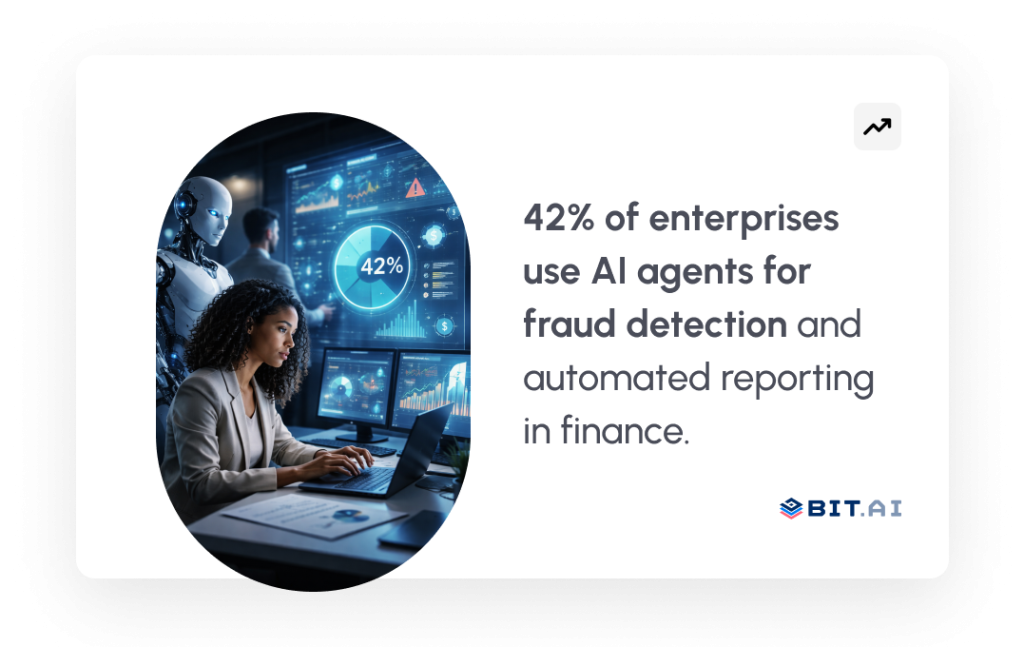
Every time an online payment is made, AI agents of Stripe Radar analyze the transaction in real time to detect potential fraud. It looks at multiple signals, like location, device details, transaction patterns, and user behavior, to decide whether a payment is safe or risky.
Every transaction is a decision – AI makes it in milliseconds to stop fraud.
Businesses do not need to go through transactions manually and can trust this system to detect or prevent suspicious activity automatically.
Here’s what it does:
- Monitors transactions in real time
- Identifies unusual or risky patterns
- Flags or blocks potentially fraudulent payments
- Learns from global payment data to improve accuracy
7. IBM Watson Health (AI Agent in Healthcare)
This AI agent was designed to support doctors and healthcare professionals by analyzing large amounts of medical data and providing insights that can help in decision-making.
In healthcare, information is vast and constantly growing, including patient records, research papers, clinical studies, and more. Watson Health uses AI to process this complex data and identify patterns that might not be easy for humans to spot quickly.
AI processes what humans can’t – turning massive data into life-saving insights.
Instead of replacing doctors, it works as a support system, helping them make more informed decisions.
Here’s how this AI agent works:
- Analyzes large volumes of medical data and patient information
- Assists in identifying possible diagnoses and treatment options
- Learns from medical research and clinical data over time
- Supports faster and more data-driven decision-making
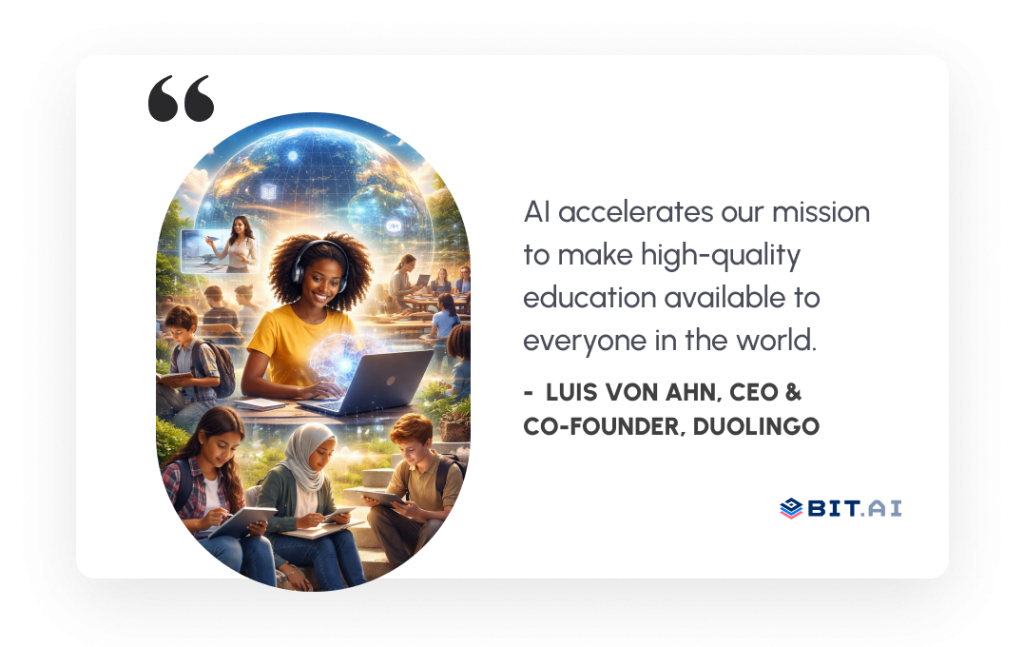
8. Duolingo Max (AI Language Learning Agent)
Another interesting example of an AI agent is Duolingo Max, offered by Duolingo, the popular language-learning app that helps millions of users practice and master new languages.
Duolingo Max is a premium AI-powered language learning feature that uses advanced AI (including conversational AI models) to make learning more interactive and personalized.
Learning feels human again – because AI adapts to how you think.
Instead of just giving you fixed exercises, this AI agent adapts to how you learn. It is capable of describing the errors in a simple way and even allowing you to rehearse a real-life dialogue, as though you are chatting with a tutor.
Here’s what it does:
- Provides detailed, easy-to-understand explanations for answers
- Simulates real conversations for practice
- Adapts lessons based on your learning progress
- Makes language learning more interactive and personalized
In simple terms, Duolingo Max acts like a personal language tutor that guides, explains, and practices with you, making it a great example of an AI agent in education.
9. TikTok recommendation algorithm
Every time you open TikTok and start scrolling, the content you see isn’t random. It’s carefully selected by an AI agent that learns your preferences and continuously adapts to your behavior.
This AI agent observes how you interact with videos, what you watch till the end, what you skip, what you like, share, or rewatch. Based on these signals, it quickly figures out what kind of content you enjoy and starts serving more of it.
The more you scroll, the smarter it gets – AI learns you faster than you realize.
What makes it powerful is how fast it learns. Even a few minutes of scrolling is enough for the system to start personalizing your feed.
Here’s what it does:
- Monitors user activity (watch time, likes, shares, comments).
- Discovers content patterns that you like.
- Continuously updates your “For You” feed in real time
- Improves recommendations the more you interact
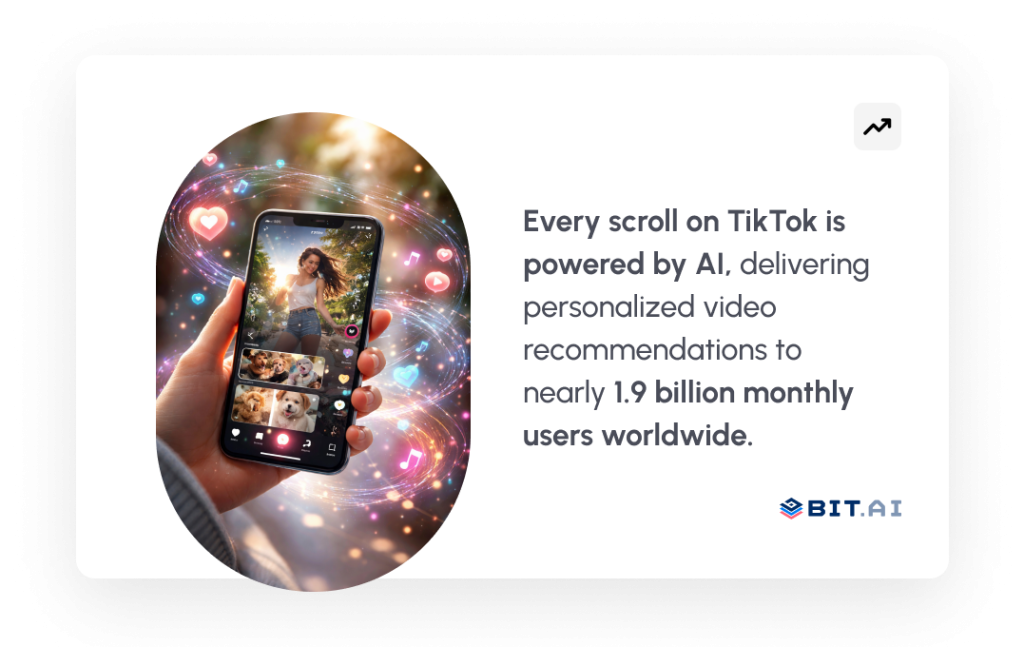
In simple terms, it acts like a smart content curator that understands your interests and keeps delivering videos you’re most likely to enjoy.
Check these AI:
10. LinkedIn job matching AI (AI Recruitment Agent)
Another everyday example of an AI agent is the LinkedIn job matching algorithm.
When you browse jobs on LinkedIn, the roles you see aren’t random. The AI agent analyzes your profile skills, experience, activity, and preferences to match you with relevant job opportunities.
The right opportunity finds you – AI does the searching behind the scenes.
You don’t have to manually search through hundreds of listings; the system brings suitable roles directly to you.
Here’s what it does:
- Find matches on the basis of skills and profile information.
- Recommends relevant openings and companies
- Learns from your activity (clicks, applications, searches)
- Continuously improves suggestions over time
In simple terms, it acts like a smart recruiter that understands your profile and connects you with the right opportunities.
Wrap Up: AI Agents Are Already Part of Your Everyday Life
When you take a closer look, you’ll realize AI agents aren’t something distant or complicated; they’re already a part of your daily routine. From helping you find the right content to making meetings easier and guiding you on the road, they quietly handle small decisions that save you time and effort.
And this is just the beginning. As these systems continue to improve, they’ll become even more helpful, more personalized, and more naturally integrated into how we live and work.
So the next time something feels quick, easy, or just perfectly timed, there’s a good chance an AI agent is working behind the scenes.
Thanks for reading, and hope this gave you a clearer, more practical understanding of AI agents in real life 🙂
FAQs
1. Where are AI agents used in everyday life?
The applications of AI agents include voice assistants, navigation systems, streaming applications, online purchasing, and even intelligent cars.
2. Are AI agents the same as chatbots?
Not exactly. Chatbots are a type of AI agent, but AI agents are broader; they can make decisions and perform tasks beyond just conversations.
3. Are AI agents fully autonomous?
Some are fully autonomous (like driverless cars in limited areas), while others still require human input or supervision, depending on their use case.