AI agents are quietly powering everything from chatbots and virtual assistants to smart recommendations and automated systems we use every day. These AI agents operate in the background to ensure that everything proceeds smoothly by assisting businesses in responding to customers faster and doing their work more effectively.
However, there is an interesting part that not all AI agents operate in a similar way. There are basic AI agents that are governed by simple rules, and there are those that are able to learn and make smarter choices over time. And that’s exactly what makes AI agents so useful in different situations.
So, in this guide, we’ll break down the different types of AI agents in a clear, easy way, so you can understand how they actually work and where they’re used.
Let’s break down the different types of AI agents and understand how each one actually works in real-world scenarios.
Types of AI Agents You Should Know
Let’s take a look at the main types of AI agents so you can understand how they function and where they’re used.
1. Simple Reflex Agents
Simple reflex agents are the most fundamental type of AI agents, since they react to specific situations without considering anything else and respond instantaneously. They don’t rely on past experiences or future predictions; they simply react to what’s happening right now.
The essential principle behind simple reflex agents is very simple: if a certain condition is met, perform a specific action. They process the current input (or “percept”) and match it against a set of predefined rules to decide what to do next. There’s no memory, no learning, and no ability to adapt beyond those rules.
How Simple Reflex Agents Work:
- Operate on clearly defined if–then rules for every action
- React only to the current input, without considering context
- Do not store or recall past information
- Cannot improve or adapt over time
Real-world example:
A common example of a simple reflex agent is a thermostat commonly used in homes and offices. Its job is to maintain a set temperature, and it does this using very basic if–then logic.
Here’s how it works in real life:
- If the room temperature rises above the set limit → the thermostat turns the air conditioner ON
- If the temperature drops below the set limit → it turns the air conditioner OFF
That’s it. The thermostat does not study the weather, does not recall how it was yesterday, and doesn’t attempt to optimize energy consumption in the long term. It merely responds to the existing reading of temperature and operates within its programmed regulations.
This is exactly what makes it a perfect example of a simple reflex agent; it responds instantly, works reliably in a controlled environment, and sticks strictly to predefined conditions without learning or adapting.

Read this…
2. Model-Based Agents
While simple reflex agents only react to what’s happening right now, model-based agents go a step further by adding context to their decisions. They don’t just depend on the current input; they also maintain an internal understanding (or “model”) of the environment.
In simple terms, these agents remember what has already happened and use that information to make better decisions. This becomes especially useful in situations where the full picture isn’t visible at once or when the environment keeps changing.
At the core, a model-based agent works using two key elements:
- Current input – what is happening right now
- Internal state – what the agent knows or remembers from past interactions
By combining these, the agent can respond more intelligently instead of just following fixed reactions. This enables model-based agents to be more flexible, reliable, and convenient in real-world situations where decisions just need a bit of knowledge and context, and not immediate responses.
How they work:
- Maintain an internal model of the environment
- Use both current input and past information to make decisions
- Can handle partially observable situations
- More adaptable than simple reflex agents, but still rule-driven
Real-world example:
A simple way to understand a model-based agent is by looking at a robotic vacuum cleaner used in many homes. Here’s what makes it different and smarter:
- As it moves around your house, it creates a basic map of the rooms
- It remembers where things are, like walls, furniture, or corners
- If it finds a blocked path, it doesn’t keep bumping into it, instead, it changes direction based on what it already knows
So, it’s not just reacting to what’s in front of it at the moment. It’s also using memory to decide what to do next. For example, if it has already cleaned one area, it won’t waste time going over the same spot again and again. It plans its movement better because it has an idea of the space.
That’s what makes it a model-based agent: it remembers, understands, and then acts, which makes it much more useful in real-life situations compared to simple rule-based systems.
3. Goal-Based Agents
Goal-based agents are a type of Intelligent Agent that take AI decision-making to a more practical and intelligent level by focusing on achieving a specific goal or outcome that they are trying to achieve. Unlike simple reflex agents (which only react to inputs) or model-based agents (which use memory), these agents make decisions based on a clear objective they are trying to reach.
Before taking any action, a goal-based agent evaluates one important thing: “Will this action help me achieve my goal?” This is what makes them more thoughtful and purpose-driven.
In simple terms, goal-based AI agents don’t just follow rules; they plan their actions. They look at different possible options (also called action paths) and choose the one that brings them closest to the desired result.
Because of this approach, goal-based agents are more flexible and decision-focused. They prove particularly valuable in scenarios where various solutions exist to a particular problem and the best choice depends on the final objective.
How they work:
- Start with a clearly defined goal or desired outcome
- Observe the current situation (input or environment)
- Identify different possible actions or paths
- Evaluate which option will move closer to the goal
- Choose and perform the action that best achieves the objective
Real-world example:
Many navigation systems, including Google Maps, are an excellent picture of what a goal-based agent is. The way it works in the real world is as follows:
- You enter your destination (your goal)
- The system looks at different routes
- It considers factors like distance, traffic, and time
- Then it chooses the best possible route to help you reach faster
If there’s traffic on the way, it can even suggest a new route, because its main focus is still the same: getting you to your destination efficiently.
4. Utility-Based Agents
Utility-based agents are designed to not just reach a goal, but to choose the best possible way to reach it.
In real life, there are often many ways to achieve the same goal. A utility-based agent compares all these options and selects the one that gives the maximum benefit based on certain factors like time, cost, comfort, or risk.
They evaluate each option based on a utility value (a measure of how good or beneficial an outcome is) and then choose the one that gives the highest overall benefit.
How they work:
- Define a goal or desired outcome
- Assign a utility value (score) to different possible outcomes
- Compare all available options or actions
- Choose the action that provides the maximum benefit or satisfaction
Real-world example:
A good example of a utility-based agent is an investment or financial recommendation system.
Here’s how it works in real life:
- It examines various types of investments (stocks, mutual funds, etc.)
- It considers aspects such as risk, return, trends in the market, and the preferences of the user.
- Each option is given a kind of score (utility value)
- Then it suggests the option that offers the best balance of risk and return
So, instead of just helping you invest, it helps you choose the most beneficial investment based on your goals.
Know more about AI…
5. Learning Agents
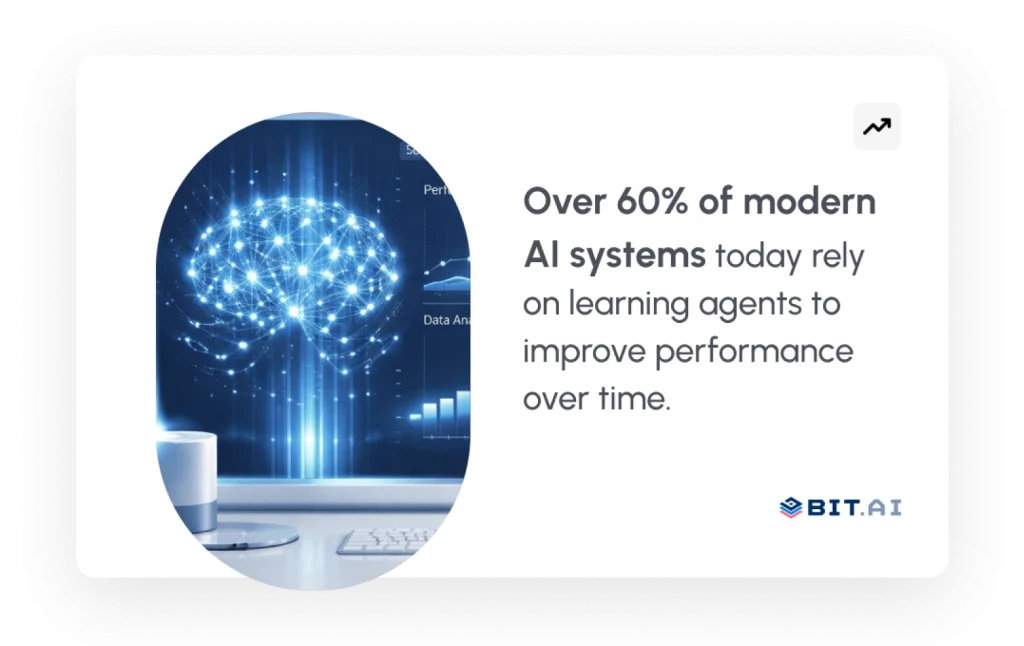
Learning agents are the most advanced category of AI agents because they not only follow rules and make decisions like other types of agents; they learn and get better over time, too.
Unlike other agents, learning agents don’t stay the same. They continuously analyze data, learn from past experiences, and adjust their actions to perform better in the future. This makes them highly useful in real-world situations where things keep changing.
In simple terms, these agents get smarter with use. The more data they receive and the more they interact with the environment, the better their decisions become.
How they work:
- Start with basic knowledge or rules
- Observe data and outcomes from past actions
- Learn patterns using machine learning techniques
- Update their behavior to improve future performance
Real-world example:
A recommendation system used by a platform such as Netflix is one of the most common examples of a learning agent. The way it works in the real world is as follows:
Here’s how it works in real life:
- It tracks what you watch, listen to, or interact with
- It learns your preferences and behavior patterns
- Over time, it starts suggesting content that better matches your interests
- The more you use it, the more accurate and personalized the recommendations become
So, instead of giving the same output every time, it adapts based on your actions.
Quick Comparison of AI Agent Types
Now that you’ve explored each type, here’s a simple comparison to help you quickly understand the key differences between various types of AI agents:
| Type of AI Agent | What it does | When to Use the Right Type of AI Agent |
| Simple Reflex | Reacts instantly | Basic automation, like triggers and alerts |
| Model-Based | Uses past + present info | Smart systems where context matters (e.g., smart devices) |
| Goal-Based | Works to achieve a goal | Planning tasks like navigation or workflows |
| Utility-Based | Chooses the best option | Optimization tasks like finance or logistics |
| Learning | Improves over time | Personalization and continuous improvement (e.g., recommendations, AI tools) |
So, in a nutshell, as you move from simple reflex agents to learning agents, the level of intelligence, adaptability, and decision-making capability steadily increases, making each type suited for more complex and dynamic environments.
Wrap Up
Now you have a fairly good understanding of how different AI agents work under the hood, how simple reflex agents respond immediately, and how model-based agents act with memory, goal-focused agents act depending on results, utility-driven agents act seeking the most optimal choice, and learning agents act to improve.
That is the actual takeaway from the blog: AI isn’t a single system, but a series of intelligent decision-making models that address various requirements. When you get familiar with these concepts, it will be so easy to realize how AI agents power real-world applications and everyday technology.
FAQs
1. What is an AI agent?
An AI agent is a system capable of perceiving the surroundings and processing information in order to act in a manner that attains particular objectives.
2. Which type of AI agent is the simplest?
Simple reflex agents are the most basic AI agent type, as they respond instantly to inputs using predefined rules without considering past experiences.
3. How are goal-based AI agents different from utility-based agents?
Goal-oriented agents aim at attaining a given result, whereas utility-oriented community agents go the extra mile and select among the numerous options to give you the best result that is optimal or advantageous.
4. Why are learning agents important?
Learning agents, being the most advanced type of AI agent, improve over time by adapting to new data and experiences, making them more effective in dynamic and complex environments.